The Claude Certified Architect: Foundations exam is a 60-question, 120-minute test open only to Claude Partner Network members. Here's what it tests, how to prepare for free, and the best Udemy courses and practice exams.
What the Claude Certified Architect exam is
The Claude Certified Architect: Foundations exam is Anthropic's credential for people who design and build agent systems with Claude. It's a proctored, 60-question exam that runs 120 minutes, and you pass with a scaled score of 720 out of 1,000. Before you spend money on prep, though, check one thing: Anthropic only opens its exams to members of the Claude Partner Network.
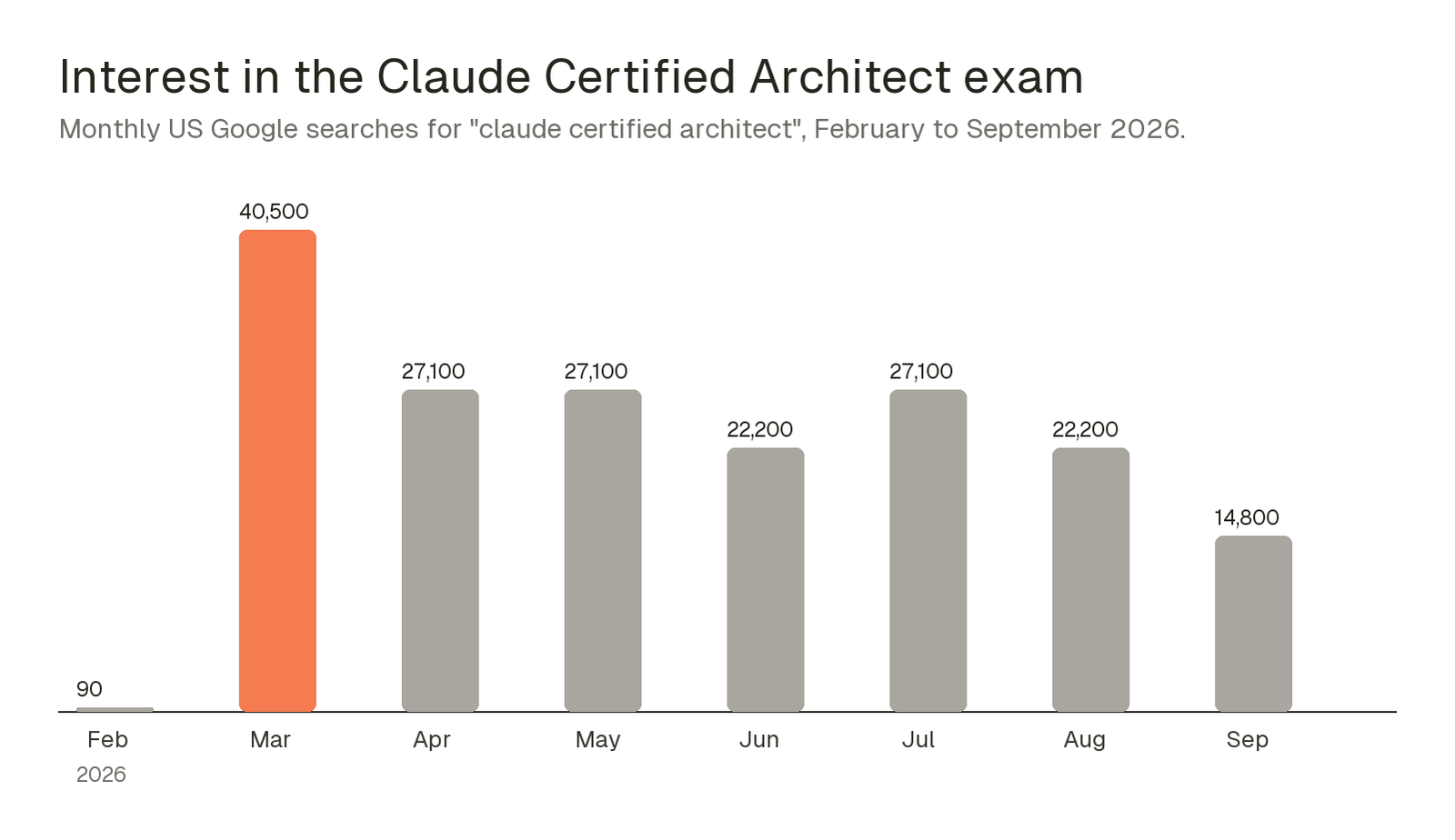
Anthropic launched the certification in March 2026 and, on July 23, added three more credentials. More than 36,000 consultants at more than 1,300 organizations had passed one by then. Interest is high: US searches for "claude certified architect" reached 40,500 in March and were still 14,800 in September.
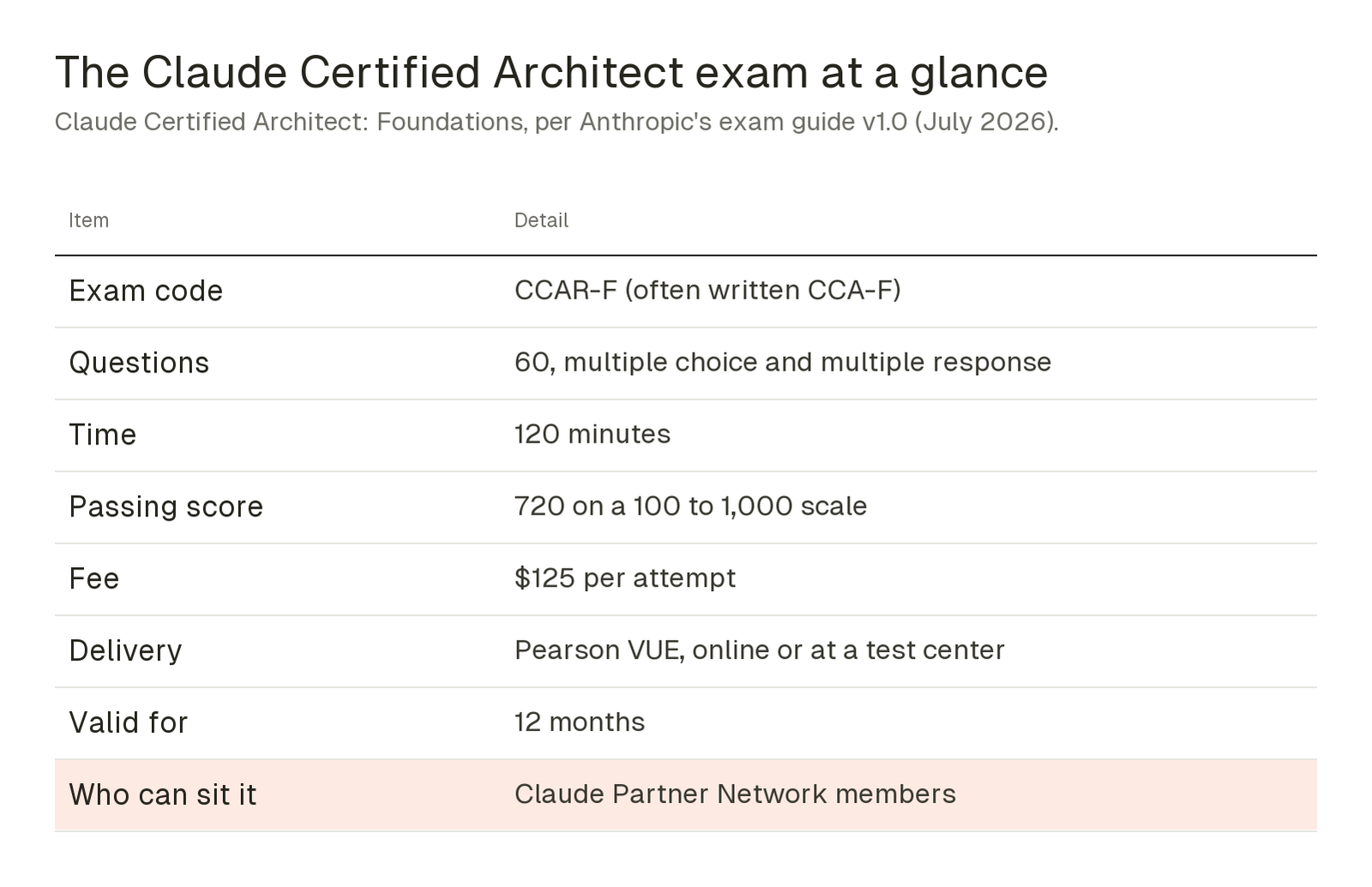
Anthropic doesn't publish the exam guide on an open web page. It sits in the Partner Academy, so the fee, question count and timing above come from prep sites that quote guide version 1.0 from July 2026. They agree on these numbers, but confirm them when you book.
Who can take the Claude certification exam
Here's the part most Claude certification guides skip. Anthropic's own announcement says the exams are "available to members of the Claude Partner Network." Firms join the network, which is free, and then register their staff. A freelancer or a developer at a company that hasn't joined can't simply book a seat.
That shapes who should prepare now. If you work at a consultancy, systems integrator or agency that builds on Claude, ask whether your firm is a partner. Accenture, Deloitte, PwC and KPMG are among the firms that have pledged to certify thousands of staff. If you don't, you can still learn the material and be ready when access opens, but there's no anthropic certification to sit yet.
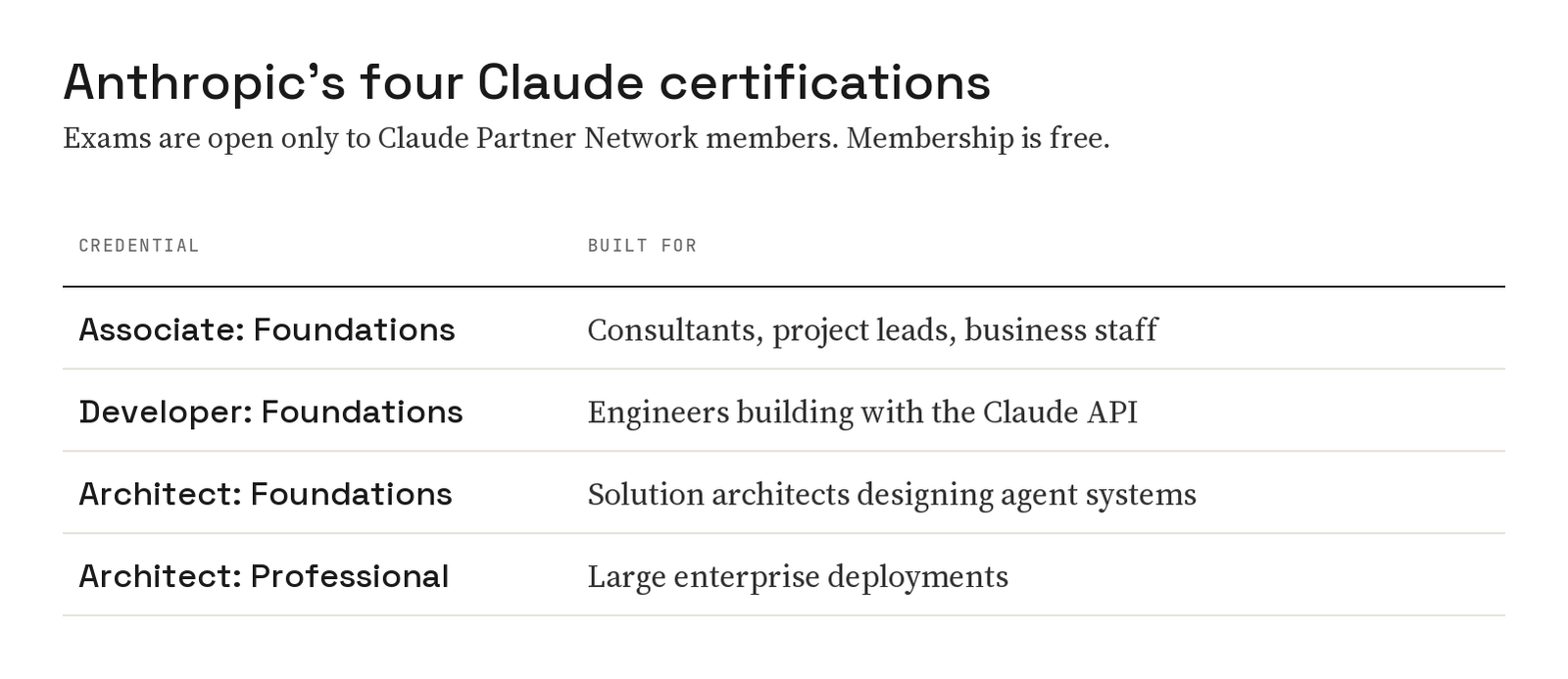
The Architect exam is one of four. The Associate exam covers everyday use of Claude for consultants and project leads, the Claude Certified Developer exam covers the Claude API, tool use and agent development, and Architect: Professional is the advanced step for large enterprise work. There's still no separate Claude Code certification; Claude Code is one domain inside the Architect exam. All four are delivered through Pearson, and passing candidates get a Credly digital badge.
What the Claude Certified Architect exam tests
The exam is scenario-based. You read a description of a system and pick the design that works, so memorizing feature names won't carry you. The exam guide splits it into five domains, and agent design is the biggest by a clear margin.
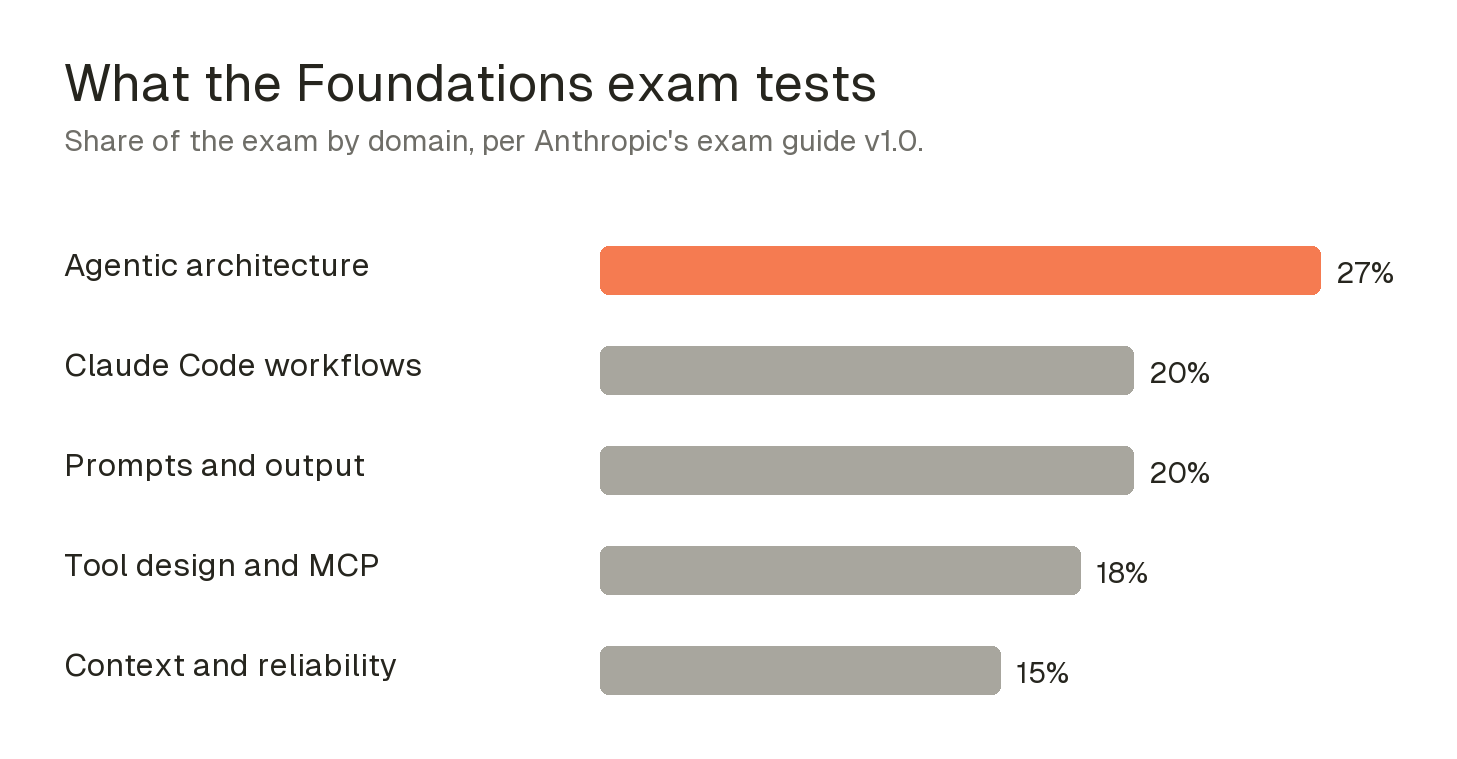
- Agentic architecture and orchestration (27%): agent loops, coordinator and subagent designs, multi-step workflows with the Claude Agent SDK.
- Claude Code configuration and workflows (20%): CLAUDE.md memory, path rules, skills, subagents, hooks, permissions and plan mode.
- Prompt engineering and structured output (20%): clear instructions, JSON schemas, validation and retry loops, batch processing.
- Tool design and MCP integration (18%): writing tools the model understands, structured errors, connecting MCP servers.
- Context management and reliability (15%): long sessions, compaction, external memory and working across large repositories.
The free prep: Anthropic's own courses
Start with what Anthropic gives away. Partner firms get certification prep courses for each credential in the Anthropic Partner Academy, which is free; Anthropic says more than 400,000 people completed Claude training there this year. If your firm is a partner, that's your first stop.
Everyone else can use the public Claude Academy. Its free Claude Code in Action course covers plan mode, CLAUDE.md, skills, permission modes and hooks, which lines up with the Claude Code domain. Add Anthropic's Claude Code documentation and our beginner's guide to Claude Code, and you've covered a fifth of the exam for nothing.
What free material doesn't give you is exam practice. The questions are long scenarios with several plausible answers, and timing matters at two minutes a question. That's where paid prep earns its price.
Best course to learn the material: Claude Code Beginner Crash Course
No exam-specific course on Udemy has many reviews yet; the exam is too new. So for the learning itself, we'd pick a proven course that maps to the syllabus. Eden Marco's Claude Code Beginner Crash Course has 4,163 ratings, the most of any course we found that says it covers the Claude Certified Architect: Foundations topics.
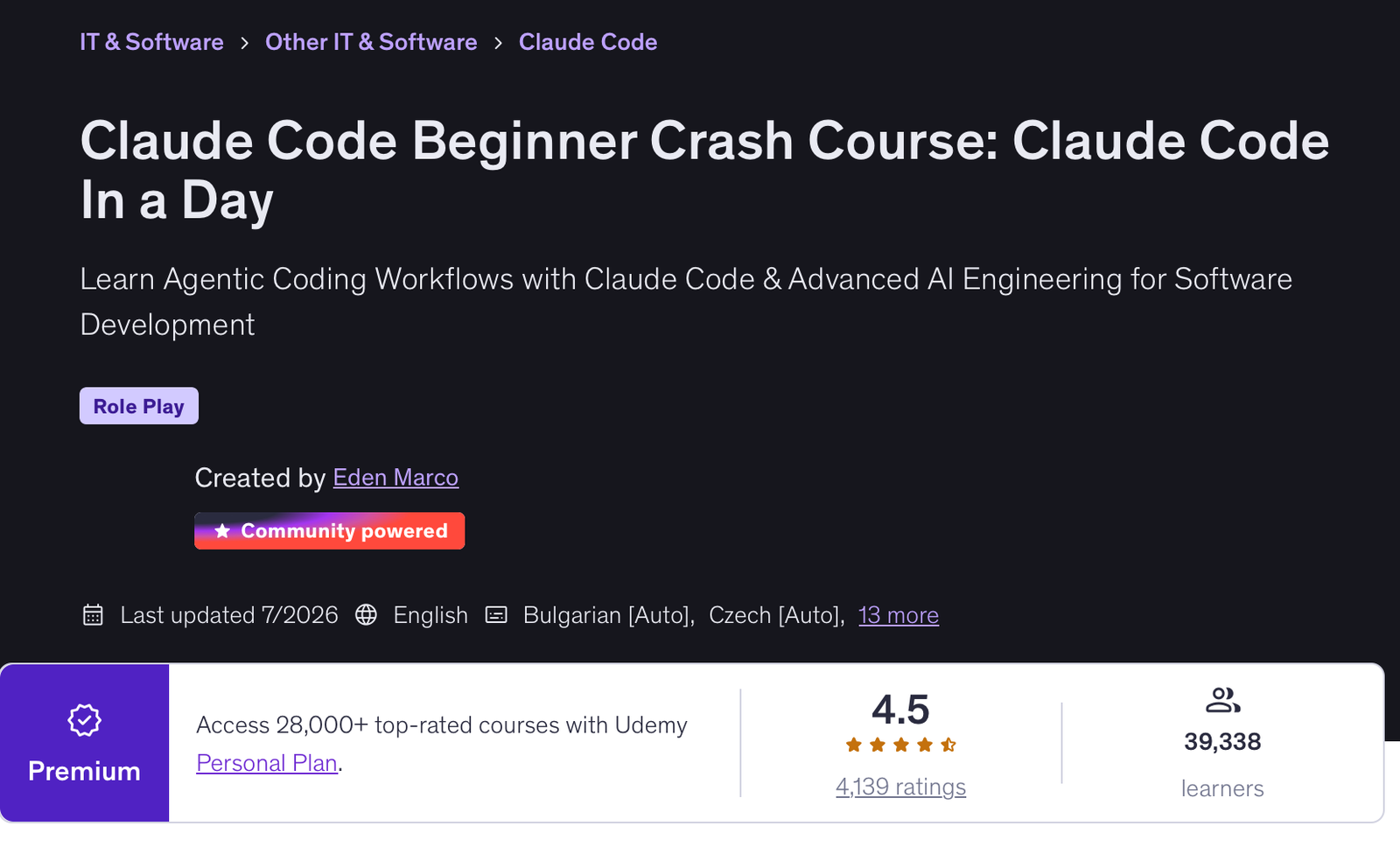
It spends 10.5 hours on the architecture of Claude Code: CLAUDE.md memory files, slash commands, hooks, subagents with their own context, MCP servers, plugins and GitHub automation. That covers the Claude Code, tool design and context domains well. It's written for working developers, despite the title.
It won't drill you on exam-style scenarios, so pair it with one of the practice exams below. Our ranking of Claude Code courses has other options if you want a longer or shorter course.
Best practice exams for the Claude Certified Architect exam
Practice tests are the most useful paid prep for this exam, and the newest. Federico Garay's Claude Certified Architect Foundations: 6 Exam Simulations is our pick. It holds a 4.9 rating from five ratings and 349 learners, was updated in September 2026, and gives you six full mocks of 60 questions in 120 minutes, matching the real format.
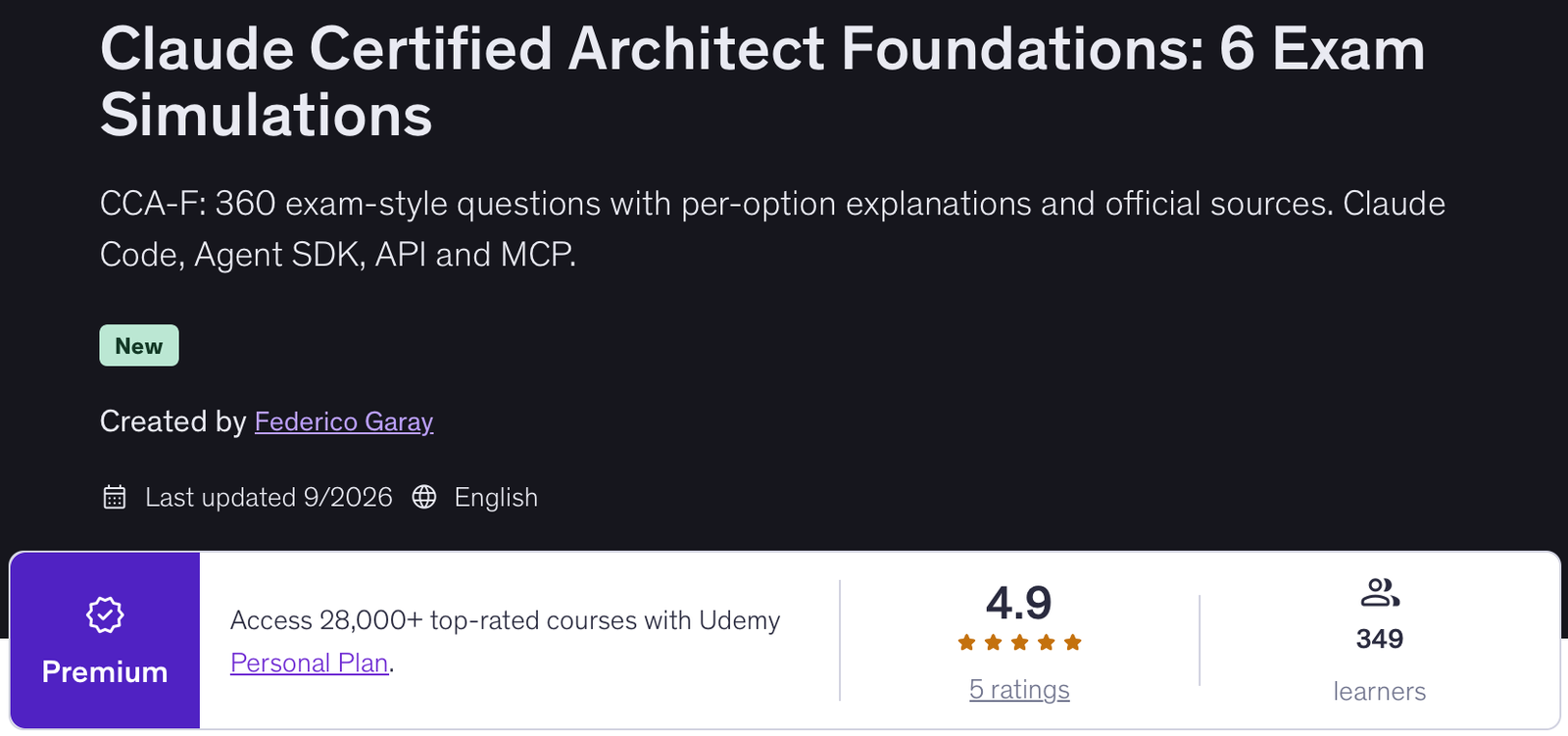
Each of its 360 questions explains every answer option and links to the official source, which matters more than the score. When you miss a question about hooks or MCP errors, you want to know why each of the other three choices was wrong as well as which one was right.
Five ratings is a thin signal, so treat this as the best of a new crop rather than a proven bestseller. Udemy's 30-day refund policy lowers the risk. If you finish all six mocks and want more, Firstlink Consulting's 6 Practice Exams set is a good second bank, covered below.
A second question bank: Firstlink's 6 Practice Exams
Firstlink Consulting's Claude Certified Architect Foundations: 6 Practice Exams is the best-rated alternative, at 5.0 from six ratings, updated in September 2026. It also has 360 questions in six timed mocks, with an explanation for each answer choice across all five domains.
Firstlink also makes one of the deeper Claude Code courses on Udemy, so its questions lean into skills, subagents and MCP. Taking two different question banks is the best way to avoid memorizing one author's phrasing instead of learning the material.
Aiming for Professional too? One course covers both
If your firm wants you at the Architect: Professional level, the GIMIT Claude Certified Architect Masterclass from instructor Sachin covers both the Foundations and Professional exams in 19 hours across 117 lectures. It has a 4.4 rating from seven ratings and was updated in September 2026.
It's built around the Claude API: prompt engineering, MCP, agentic workflows and running at enterprise scale. That makes it heavier on the API and lighter on Claude Code than Eden Marco's course, so it suits engineers who build services more than people who live in the terminal. The low rating count applies here too.
Is the Claude certification worth it?
For people at partner firms, yes. Big consultancies have publicly committed to certifying tens of thousands of staff, and the Partner Network's top tier requires 1,000 certified practitioners per firm. That turns the credential into a staffing requirement, which is about as strong a signal as a certification gets.
For everyone else, it's a bet on access opening up. The material is worth learning either way, because it's the same skill set as building reliable agents with Claude. Just don't pay for an exam voucher you can't use. Budget about $25 to $50 for a course and a practice-test set, plus $125 for the exam once your employer can register you.
The credential lasts 12 months, according to the exam guide figures, so plan on renewing. If you also pay for Claude Code yourself to practice, our Claude Code pricing breakdown shows which plan gives you enough room for long agent sessions.
How to prepare for the Claude Certified Architect exam
A realistic plan for a working developer is four to six weeks. Here's the order we'd use.
- Confirm access first: ask whether your employer is in the Claude Partner Network and can register you.
- Week 1: take Anthropic's free Claude Code in Action course and read the Claude Code docs on memory, hooks and permissions.
- Weeks 2 and 3: work through Eden Marco's crash course, building each feature in your own repository.
- Week 4: build one small agent with tools and an MCP server, so the architecture questions feel familiar.
- Weeks 5 and 6: take practice exams under real timing, review every explanation, then retake the ones you scored lowest on.
- Book the exam once you're scoring well above the pass mark on mocks you haven't seen before.
Sources
- Claude blog: Four role-based certifications
- Claude Partner Network
- Claude Certified Architect (Foundations) exam guide summary
- Claude Academy
- Claude Academy: Claude Code in action
- Claude Code documentation
- Udemy: Claude Code Beginner Crash Course
- Udemy: Claude Certified Architect Foundations: 6 Exam Simulations
- Udemy: Claude Certified Architect Foundations: 6 Practice Exams
- Udemy: Claude Certified Architect Masterclass: CCAR-F & CCAR-P