Image: Flickr / Wikimedia Commons / Unsplash
Higgsfield AI Pricing (October 2026): Every Plan, What Credits Buy, and Whether It's Worth It
Basic is $9, Pro is $23 to $29 and Max is $59 to $79 a month. The plan you pick decides more than your credit count: it also decides which models you can use and whether you get Unlimited.
Image: Flickr / Wikimedia Commons / Unsplash
This article contains an affiliate link. AI Eating The World may earn a commission on qualifying purchases, at no extra cost to you.
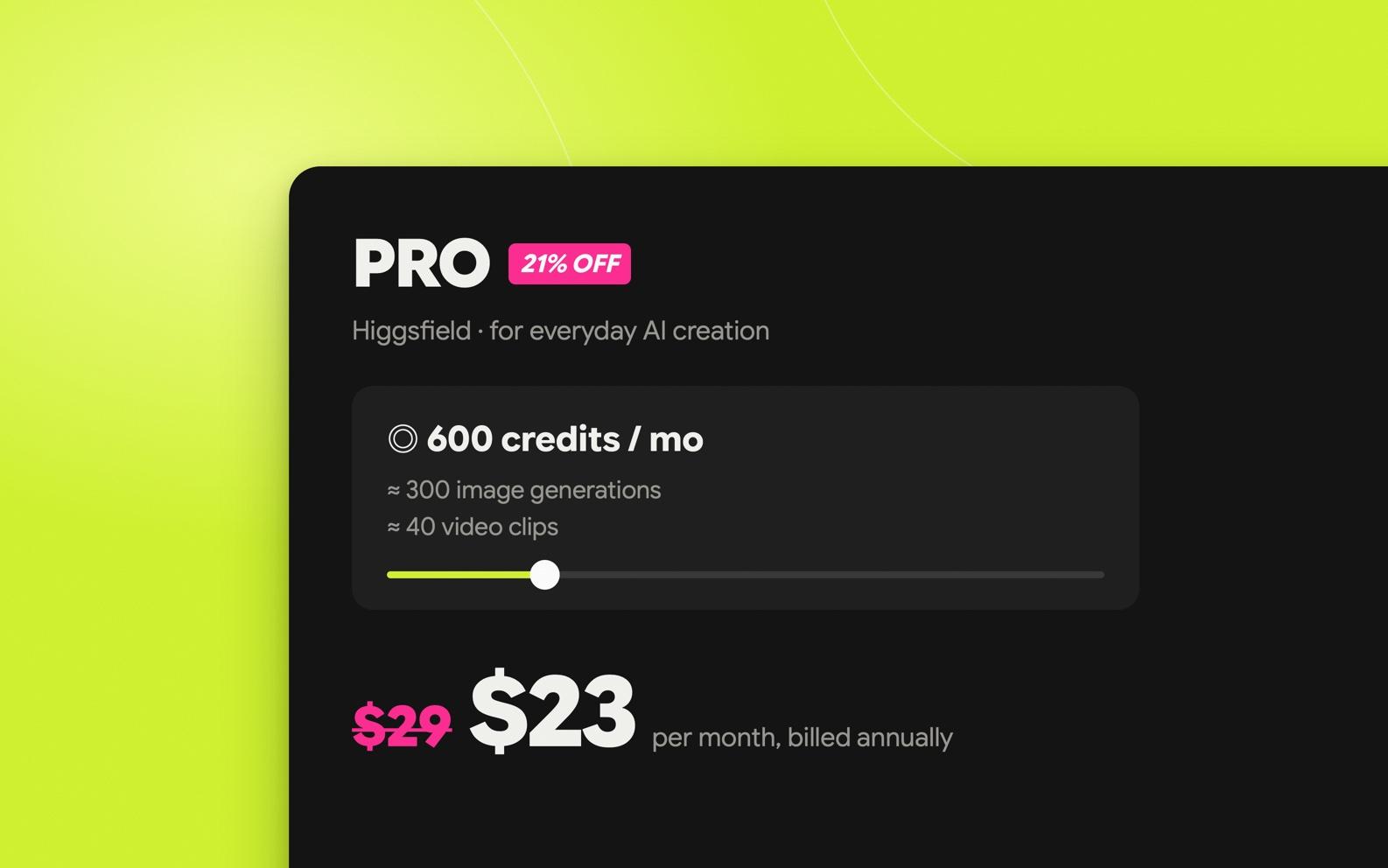
Higgsfield AI pricing starts at $9 a month for Basic, with Pro at $23 (annual) or $29 (monthly) and Max at $59 or $79. Here is what each plan's credits buy, how Unlimited works, whether the free tier is enough, and which plan fits which creator.
Higgsfield AI pricing at a glance
Higgsfield AI pricing has four individual tiers as of October 20, 2026: Free, Basic at $9 a month, Pro at $29 a month ($23 a month billed annually) and Max at $79 a month ($59 a month billed annually). Teams start at $65 per seat per month. Every paid plan is a monthly credit allowance, and the models you can spend those credits on change with the tier.
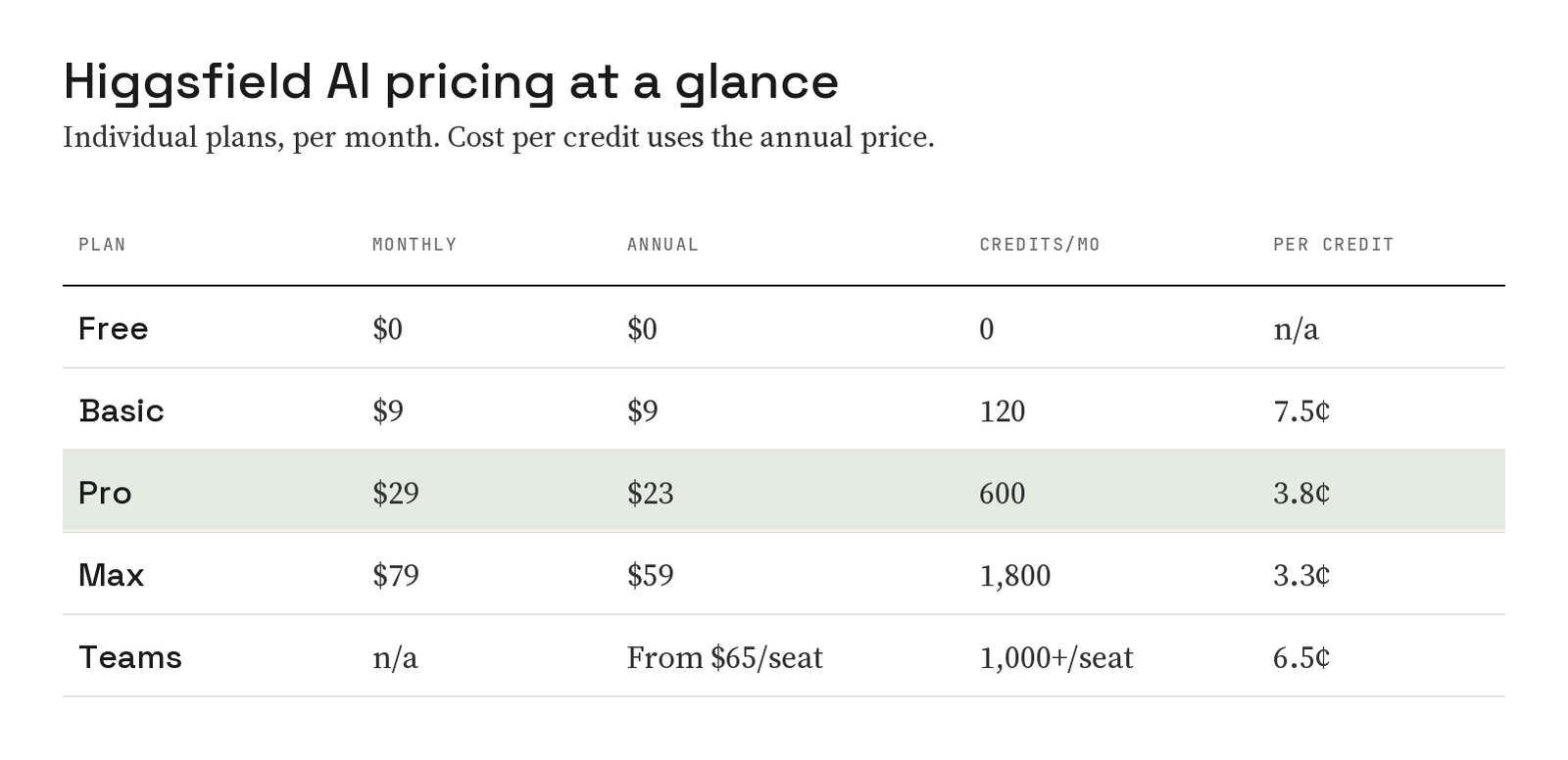
Annual billing is where the Higgsfield pricing math changes. Pro drops from $29 to $23 a month, which Higgsfield says saves $72 a year, and Max drops from $79 to $59, a $240 saving. Basic costs $9 either way. Pro also has a 900-credit option at $43 a month, or $34 billed annually, and Max scales to 3,600 and 5,400 credits.
For most solo creators the real choice is Pro versus Max. Basic is a starter plan with a fixed 120 credits and a short model list, and Teams only makes sense once two or more people share one credit pool.
Sources for this section
Is Higgsfield free?
Partly. You can sign up and generate without paying, but the free tier comes with zero credits and a small set of models. Higgsfield's help center says free access "is limited to a small set of models and doesn't include credits." The pricing comparison table also lists commercial use as not included on Free, so anything you make for a client or an ad needs a paid plan.

There is no standard free trial either. Higgsfield's help center says plainly that there is no trial period before a subscription. Promotions with free credits or short Unlimited windows come and go, so treat any "Higgsfield free credits" offer you find in search results as temporary until the pricing page confirms it.
The safety net is the refund policy. Higgsfield refunds within 7 days of your first purchase if you have not used any credits, minus a service fee of up to 6%. Renewals are not refundable. In practice, that means the cheapest way to test it properly is one month of Basic or Pro on monthly billing, not an annual plan.
Sources for this section
What Higgsfield credits actually buy
Higgsfield credits are the unit you spend on every generation, and the price per generation swings widely by model, length and resolution. A Nano Banana Pro image costs 2 credits. A 5-second Kling 3.0 clip at 1080p costs about 8. A 4-second Google Veo 3.1 clip at 1080p costs about 40, and a 4-second Sora 2 Pro clip at 1080p costs about 50.
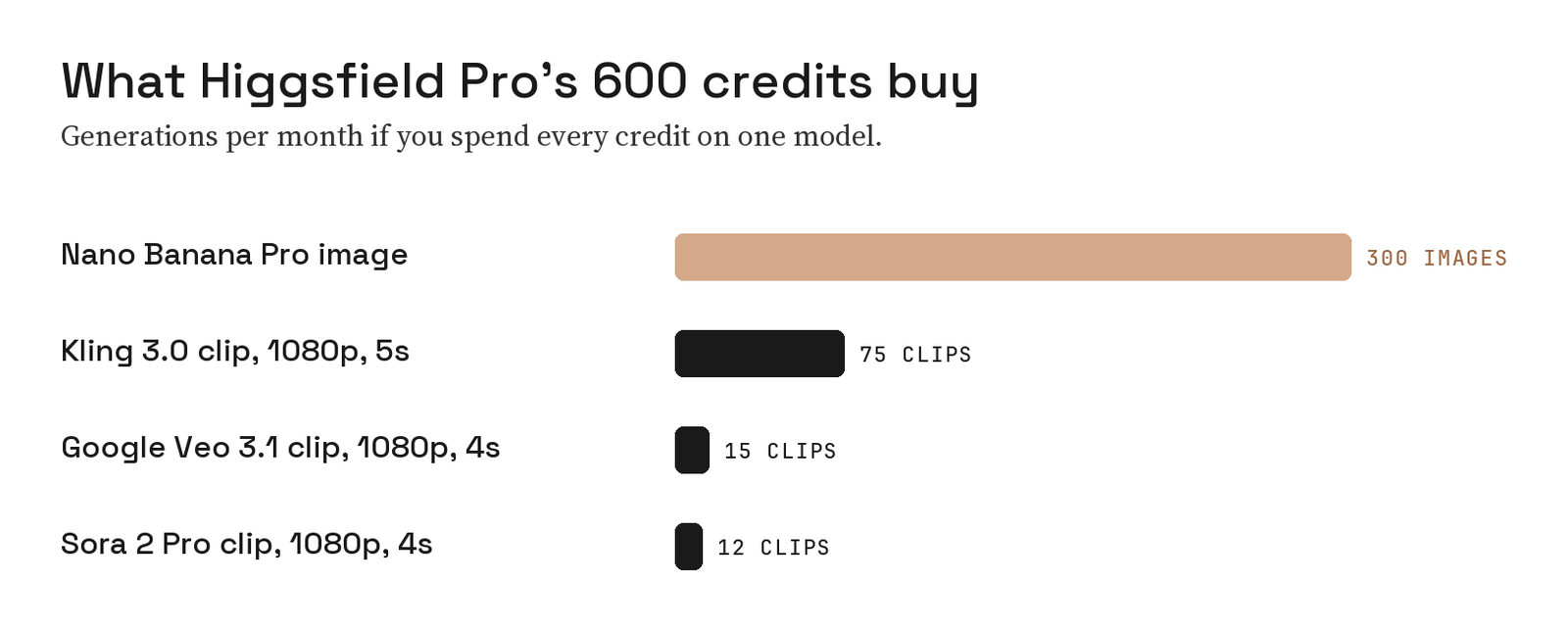
So the same 600 credits on Pro can mean 300 images or just 12 premium video clips. If your work is mostly video from the top-end models, budget for Max or for extra credit packs. If you mostly make images or use cheaper video models like Kling, Pro goes a long way.
Two rules matter for budgeting. Subscription credits do not roll over: unused credits expire at the end of each cycle. And if you run out, you can buy credit packs or upgrade mid-cycle. Upgrades apply immediately with a prorated charge, while downgrades wait until the current period ends.
Sources for this section
How Higgsfield Unlimited works, and where it doesn't
Higgsfield Unlimited lets you generate on selected models without spending credits. It is the main reason many people pay for Pro or Max instead of Basic, but the details depend on both your plan and your billing period.

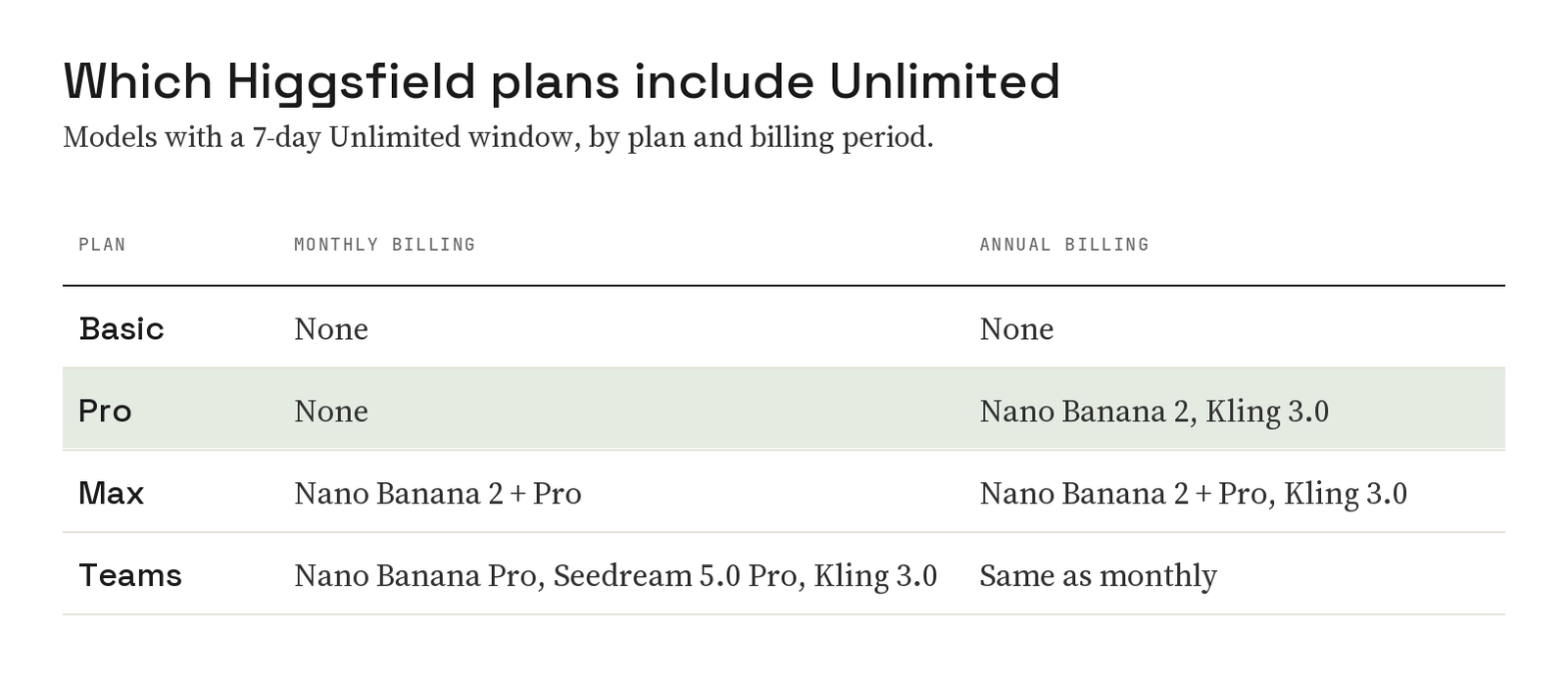
On the October 20 pricing page, annual Pro includes 7-day Unlimited on Nano Banana 2 at 2K and Kling 3.0. Annual Max adds Nano Banana Pro at 2K. Monthly Pro lists no Unlimited models, and monthly Max lists Nano Banana 2 and Nano Banana Pro. Basic has none. Higgsfield's help center describes Unlimited as a one-time window, not a recurring benefit, so read it as a strong first week rather than a month of free generations.
There are three catches. Speed can slow down during peak hours, and Higgsfield suggests switching to Credit Mode to skip the queue. Unlimited is for personal, human use only, with automation and account sharing banned. And Unlimited models and free generations only work on higgsfield.ai. They do not apply on Higgsfield's MCP or CLI, so if you generate from Claude, every run spends credits.
Sources for this section
Which Higgsfield plan should you buy?
Here is how the Higgsfield plans line up by the kind of work you do.
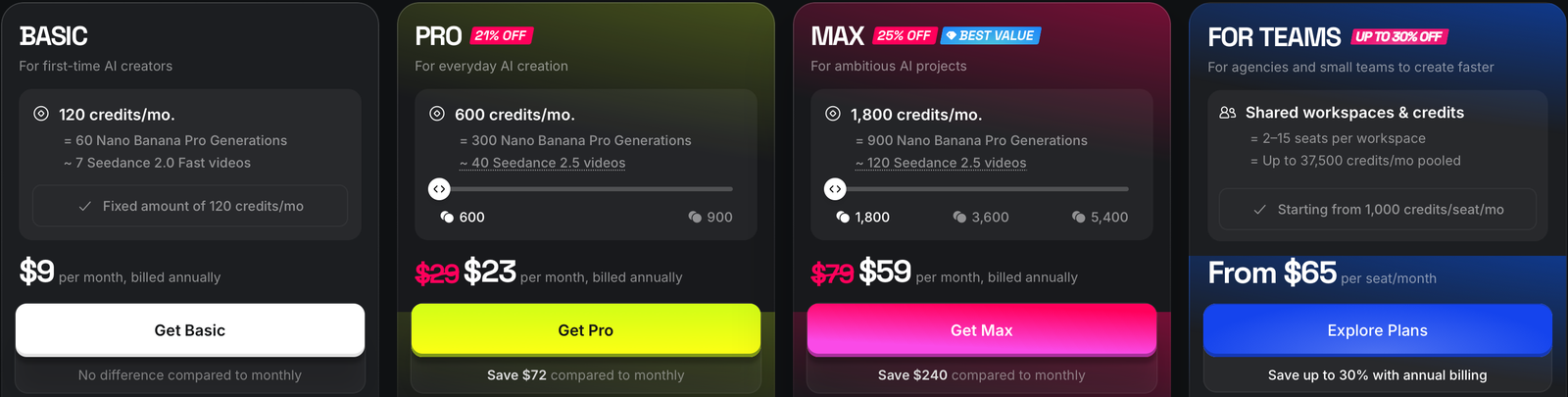
Basic ($9) suits someone testing AI images. You get 120 credits, about 60 Nano Banana Pro images, plus access to Seedance 2.0 Fast and 2.0 Mini for video. The comparison table lists features like start and end frame control, Higgsfield Speak and the UGC builder as not included.
Pro ($23 annual, $29 monthly) is the default pick for creators, marketers and small business owners who post every week. It unlocks every model and feature, commercial use, more parallel generations and, on annual billing, the 7-day Unlimited window. If you are not sure, start here on monthly billing and switch to annual once you know your volume.
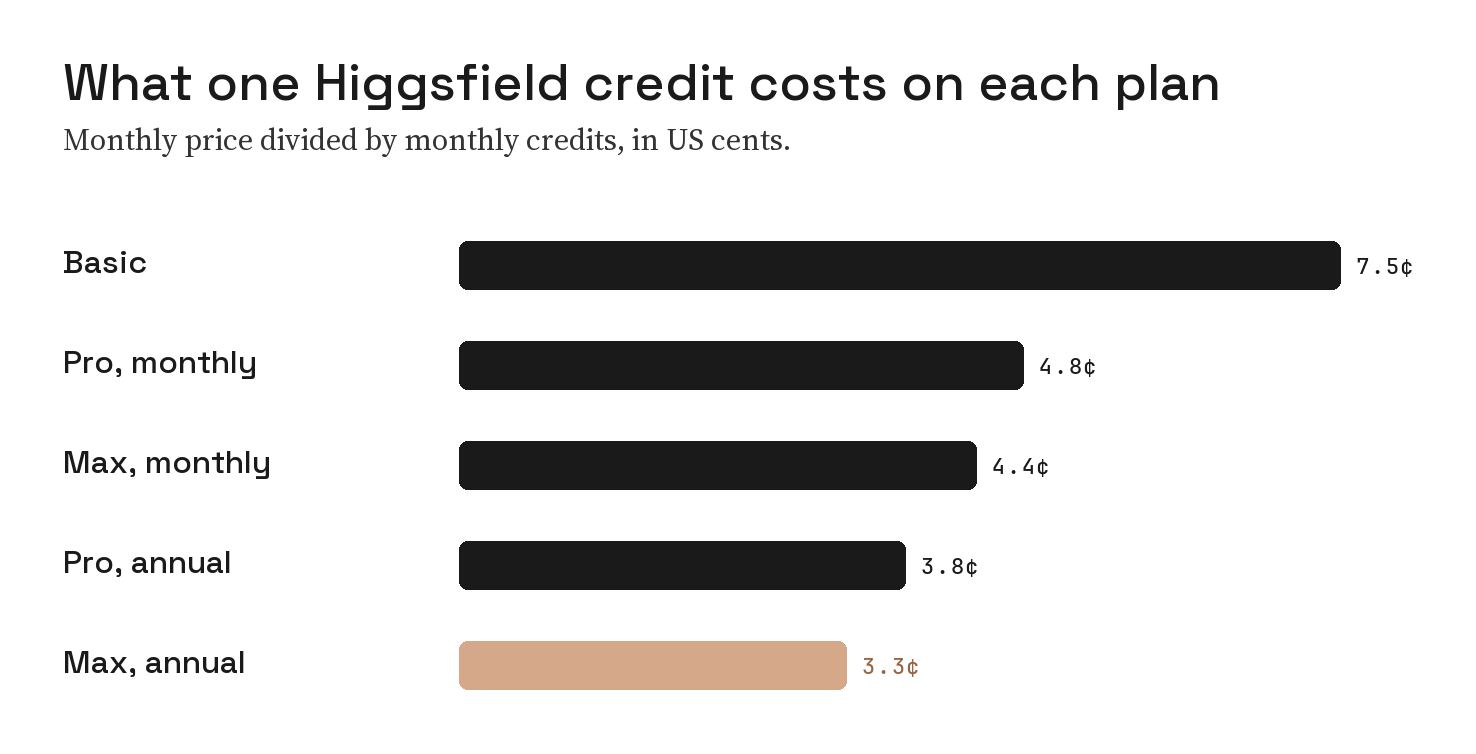
Max ($59 annual, $79 monthly) is for people producing video ads, UGC or client work at volume. It has the lowest cost per credit of any individual plan, about 3.3 cents on annual billing, and the widest Unlimited window. Teams (from $65 a seat) only makes sense when several people need one shared credit pool and admin controls.
Is Higgsfield worth it?
Higgsfield is worth it if you want many top video and image models in one place. It runs other companies' models, including Kling, Google Veo, Sora, Seedance and Nano Banana, next to its own tools like Soul and Higgsfield Speak. One subscription, one credit balance and one editor replace several separate accounts.
It is less worth it if you only ever use one model. In that case, compare the price of buying that model directly from its maker, such as Kling or Google, before you subscribe. Skip Higgsfield too if you want credits that roll over, since unused subscription credits expire every cycle.
If you do subscribe, the billing choice matters as much as the plan. One credit costs about 7.5 cents on Basic but about 3.3 cents on annual Max, less than half as much.
Your Higgsfield subscription renews automatically, and you can cancel any time in account settings. The plan stays active until the end of the period you paid for. Prices change often, so check the pricing page on the day you buy.
Sources for this section
Sources
Brian Weerasinghe is the founder and editor of AI Eating The World, where he covers artificial intelligence, tech companies, layoffs, startups, and the future of work. His reporting focuses on how AI is transforming businesses, products, and the global workforce. He writes about major developments across the AI industry, from enterprise adoption and funding trends to the real-world impact of automation and emerging technologies.