Emergent AI is a vibe coding app builder that went from a $300M to a $1.5B valuation in 2026. This review covers what it builds, what each credit costs, how it compares with Lovable, and who should try it.
What Emergent AI builds
Emergent AI is an AI app builder that turns a chat into a working web or mobile app. You describe what you want, and Emergent's AI agents write the frontend, set up the database and backend, and deploy the result on Emergent's own hosting. It sits in the same vibe coding category as Lovable, Bolt and Replit, and it has grown faster than almost anyone in it.
The pitch is aimed at people who don't code. Co-founder Mukund Jha told The Next Web that 70% of Emergent's users have never written code. The product covers the usual targets for this kind of tool: landing pages, internal dashboards, simple CRMs, booking tools, SaaS prototypes and mobile apps.
Two details matter if you are comparing it with other builders. Emergent says you own the code it generates, and paid plans connect to GitHub, so you can move a project off the platform later. The free plan gives you 10 credits a month, which is enough to see how the agents work on a small idea before you pay anything.
Why emergent.sh became a unicorn so fast
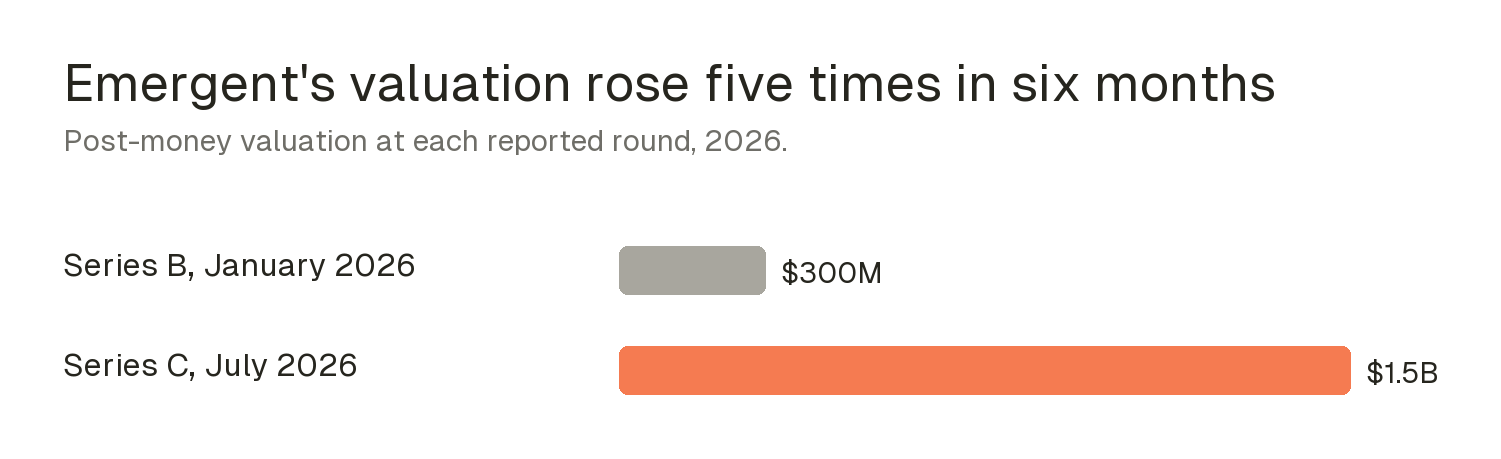
On July 15, 2026, Emergent raised a $130M Series C at a $1.5B valuation, about five times what it was valued at in January. Private equity firm Creaegis led the round, with Claypond Capital and Sentinel Global co-leading. Khosla Ventures, SoftBank Vision Fund 2, Lightspeed and Y Combinator came back in. Total funding now sits at $230M.
The company reports $120M in annualized revenue, 200,000 paying customers and more than 12 million apps built in about a year. These are company figures, not audited ones, and some coverage has questioned how the growth is counted. Still, the money explains why emergent.sh shows up so often in US search results and ads: it can afford to compete with Lovable for the same non-technical founders.
Jha was also candid about the weak spots. He told The Next Web that design is a problem, since many AI-built sites look alike, and that build success rates are still below where he wants them. The new money is going mostly into hiring and research to fix exactly that, plus an expansion in San Francisco.
Emergent AI pricing, credit by credit
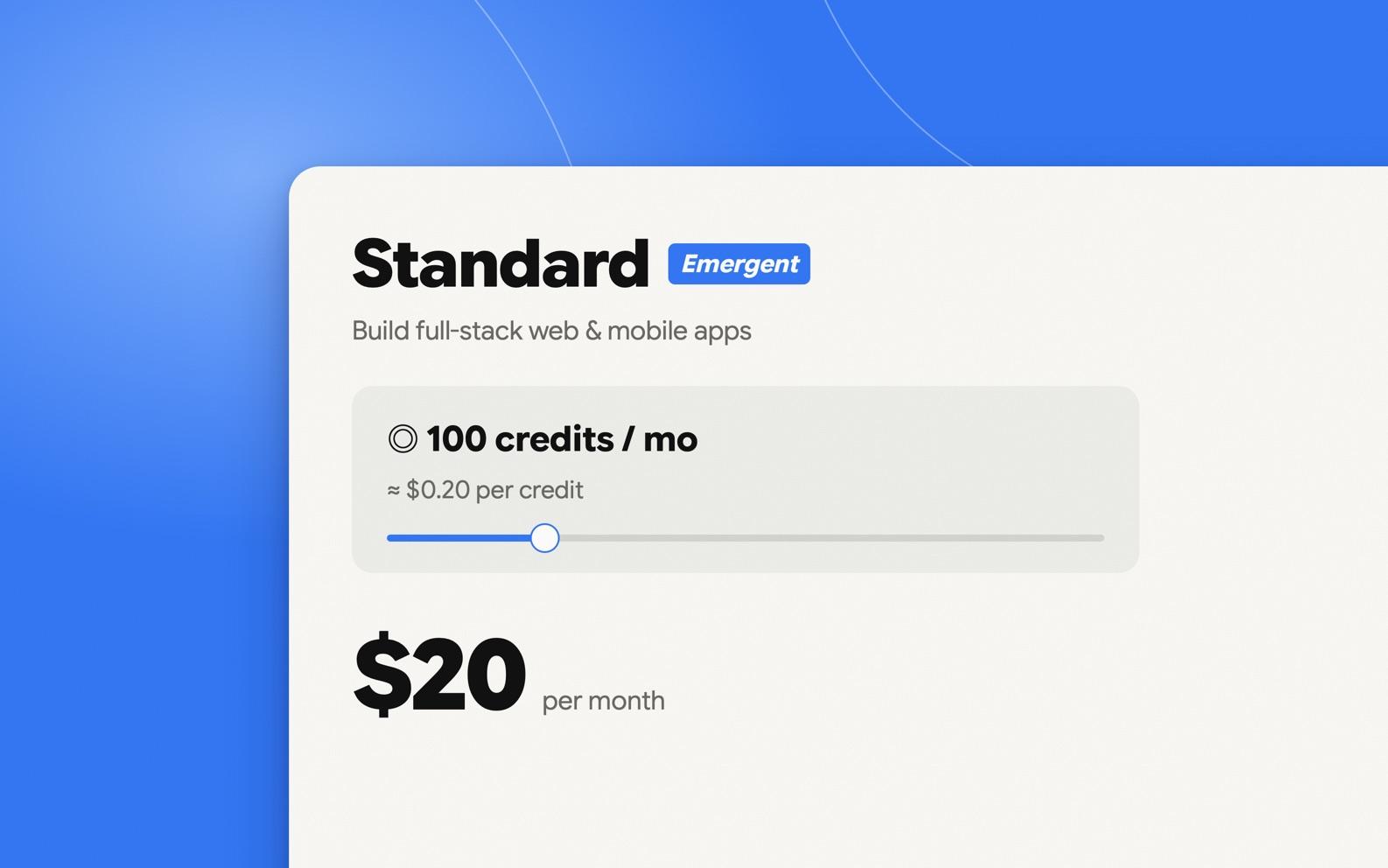
Emergent AI pricing runs on credits. Every task the agents run uses some, and bigger builds use more. As of October 21, 2026, the plans for individuals are Free at $0 with 10 credits a month, Standard at $20 a month with 100 credits, and Pro at $200 a month with 750 credits. Business and Enterprise plans are priced on request and add SSO, shared workspaces and audit logs.
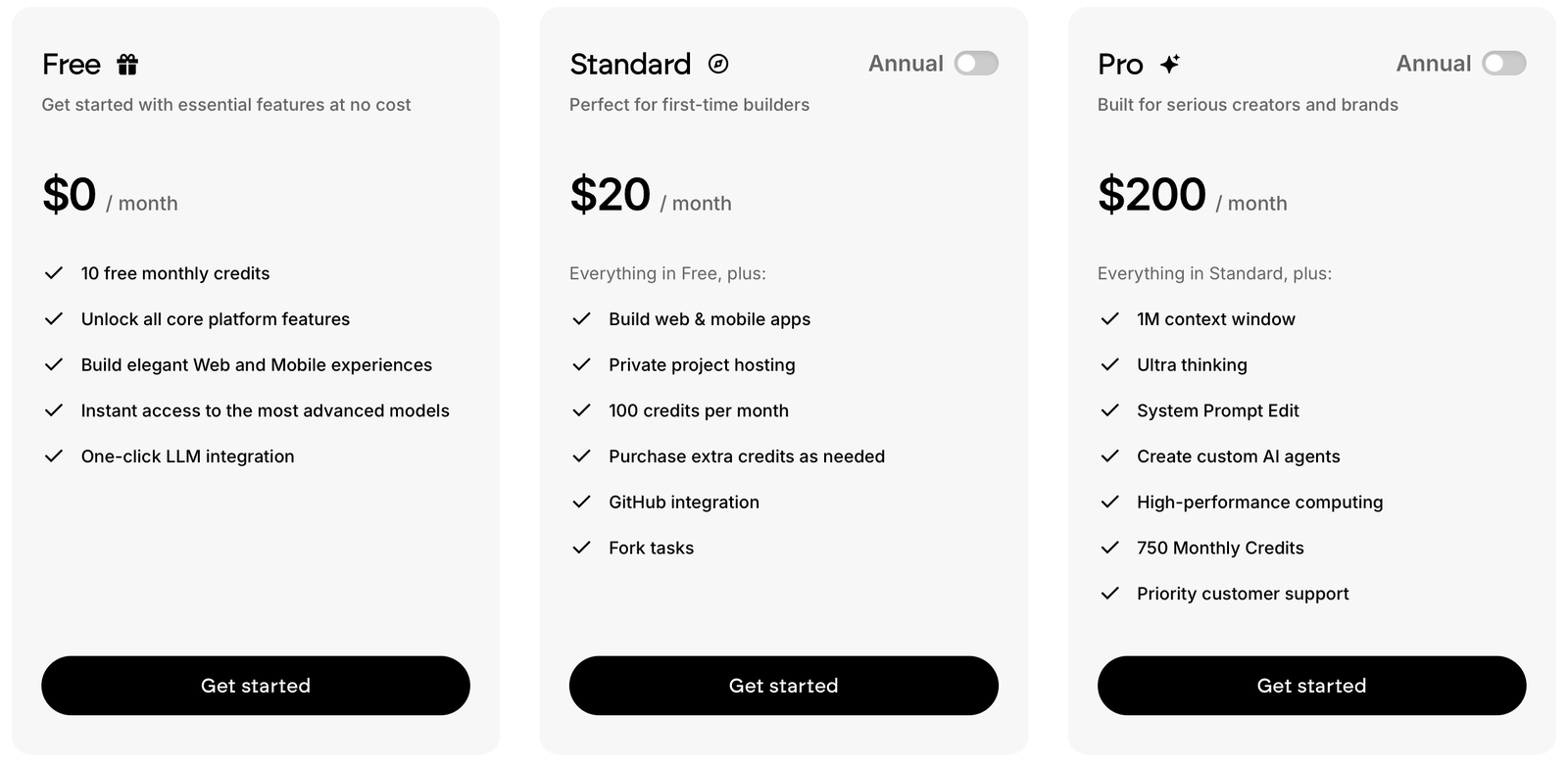
The odd part is that Pro costs more per credit than Standard. Standard works out to $0.20 a credit, while Pro works out to about $0.27. What the extra money buys on Pro is features, not cheaper building: a 1M token context window, an "ultra thinking" mode, system prompt editing, custom AI agents and priority support. Annual billing drops Standard to $17 a month and Pro to $167 a month.
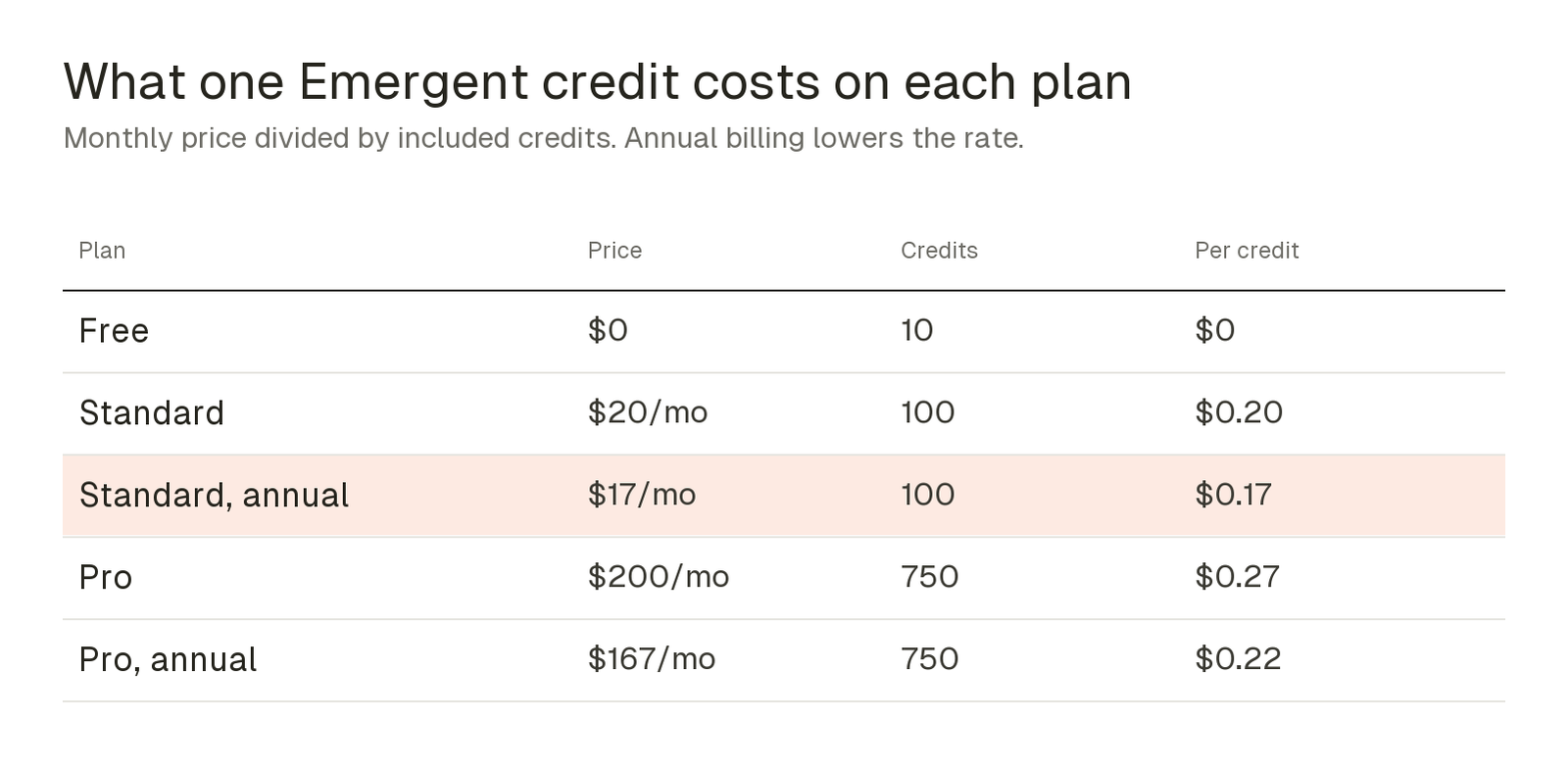
Emergent doesn't publish how many credits a typical task uses, which is the number you actually need. In Emergent's own published test, a client portal app took 20 credits to build. On that basis, Standard covers about five builds of that size a month, before fixes and changes. Extra credits can be bought on Standard, but the pricing page doesn't list their price, so check it in the app before you rely on top-ups.
For most first-time builders, the sensible path is to spend the 10 free credits on one small app, see how many credits it really used, and only then pick Standard, ideally on annual billing if you plan to build every month.
Emergent vs Lovable: where each one wins
If you are looking at Lovable alternatives, Emergent is the most obvious one, and the two tools are closer than their marketing suggests. Both turn a prompt into a full-stack app, both host it for you, and both charge in credits. The differences are in how they spend those credits.
Emergent's own Emergent vs Lovable test built the same client portal in both tools. Lovable finished in 11 minutes using 5.60 credits; Emergent took 12 minutes and used 20 credits. That is one small test written by Emergent's own team, so treat it as a hint, not a verdict. If it holds for your project, Emergent will drain a credit balance faster, and the extra work per request needs to save you fix-up rounds to be worth it.
On free plans, Lovable gives 5 build credits a day up to 30 a month, against Emergent's 10 a month. For pure experimentation, Lovable's free tier lasts longer. Emergent's edge is scope: it targets mobile apps as well as web apps on its paid plans, and its Pro tier exposes deeper controls such as system prompt editing and custom agents that Lovable doesn't offer in the same form.
Both tools share the same risk. An app that looks finished can still have weak authentication or an exposed database, so check security before you put real customer data into anything a vibe coding app produced.
Who should try Emergent, and who should skip it
- Try it if you are a non-technical founder who wants a working prototype with a database and sign-in, not just a landing page.
- Try it if you need a mobile app as well as a web app and want one tool for both.
- Try it if you want code ownership and a GitHub export, so you can hand the project to a developer later.
- Skip it if you are on a tight budget and plan to iterate a lot: at about 20 credits per mid-sized build, 100 credits go quickly.
- Skip Pro unless you need its features. It costs more per credit than Standard.
- Skip it, or any AI app builder, for apps that handle payments or sensitive data until a developer has reviewed the code.