Google's November 2026 core update started November 10 and may take two weeks. Here's why rank trackers disagree mid-rollout, which baseline week to use, and how to run a clean before-and-after once it ends.
What Google confirmed about the November 2026 core update
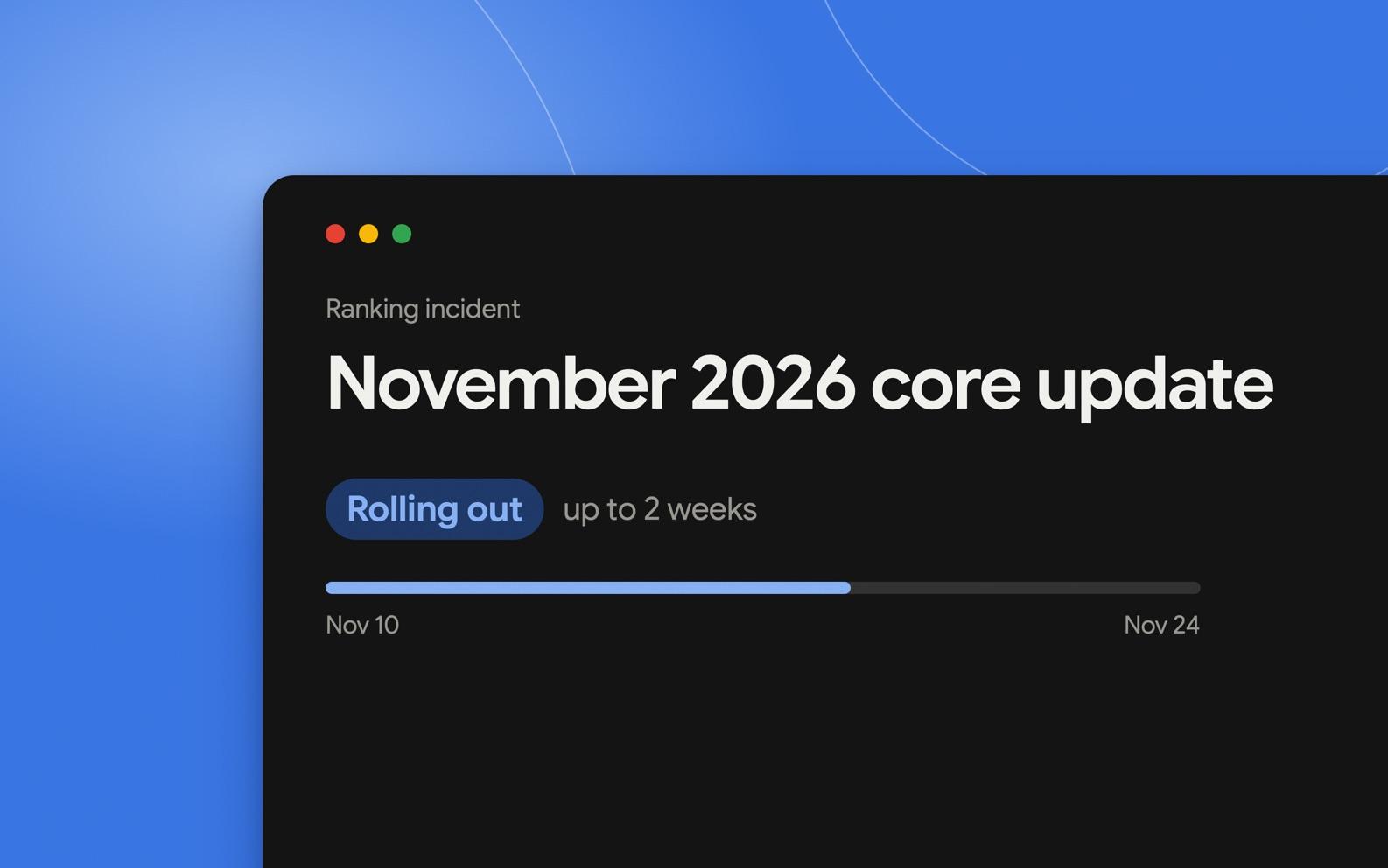
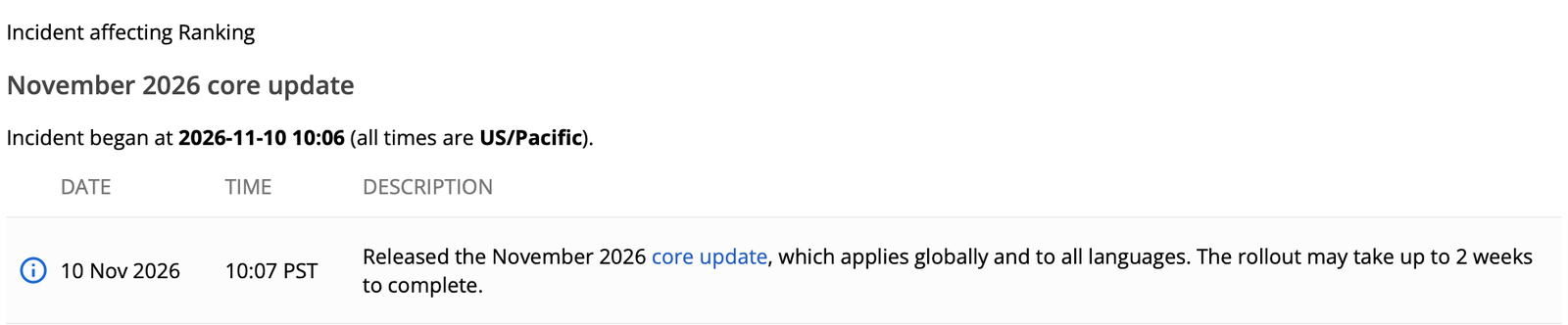
Google started rolling out its November 2026 core update on November 10 at 10:06 a.m. PT. The Search Status Dashboard entry says it applies globally and to all languages, and that the rollout may take up to two weeks. It's the third Google core update of 2026, after March and May.
Google described it, per Search Engine Journal, as a regular update meant to better surface relevant, satisfying content from all types of sites. That's the whole public brief. There's no list of what changed, which is normal for a core update and is exactly why the first week fills up with guesses.
As of November 18, the dashboard still shows the rollout as in progress. If you're reading this mid-rollout, the most useful thing you can do for your site is to stop drawing conclusions from this week's numbers.
Why every rank tracker tells a different story this week
The panic posts all share one screenshot: a tracker chart that dives, recovers, then dives again. During a Google ranking update, that's what rollouts look like. Google pushes changes across data centers over days, so the same query can return different results depending on when and where it's checked.
Rank tracking tools also check a sample of results from fixed locations and devices, and each tool samples differently. Two trackers can disagree about the same keyword on the same morning, and both can be reporting what they saw accurately. A third-party chart is a signal to look closer, never a verdict.
This rollout also shares its week with other changes. Ranking volatility was already being reported on November 9, a day before Google confirmed the update. And on November 12, Google made Gemini 4 Hydrogen the default model for AI Mode, per Search Engine Journal's weekly roundup, which can change which pages AI answers cite and click to.
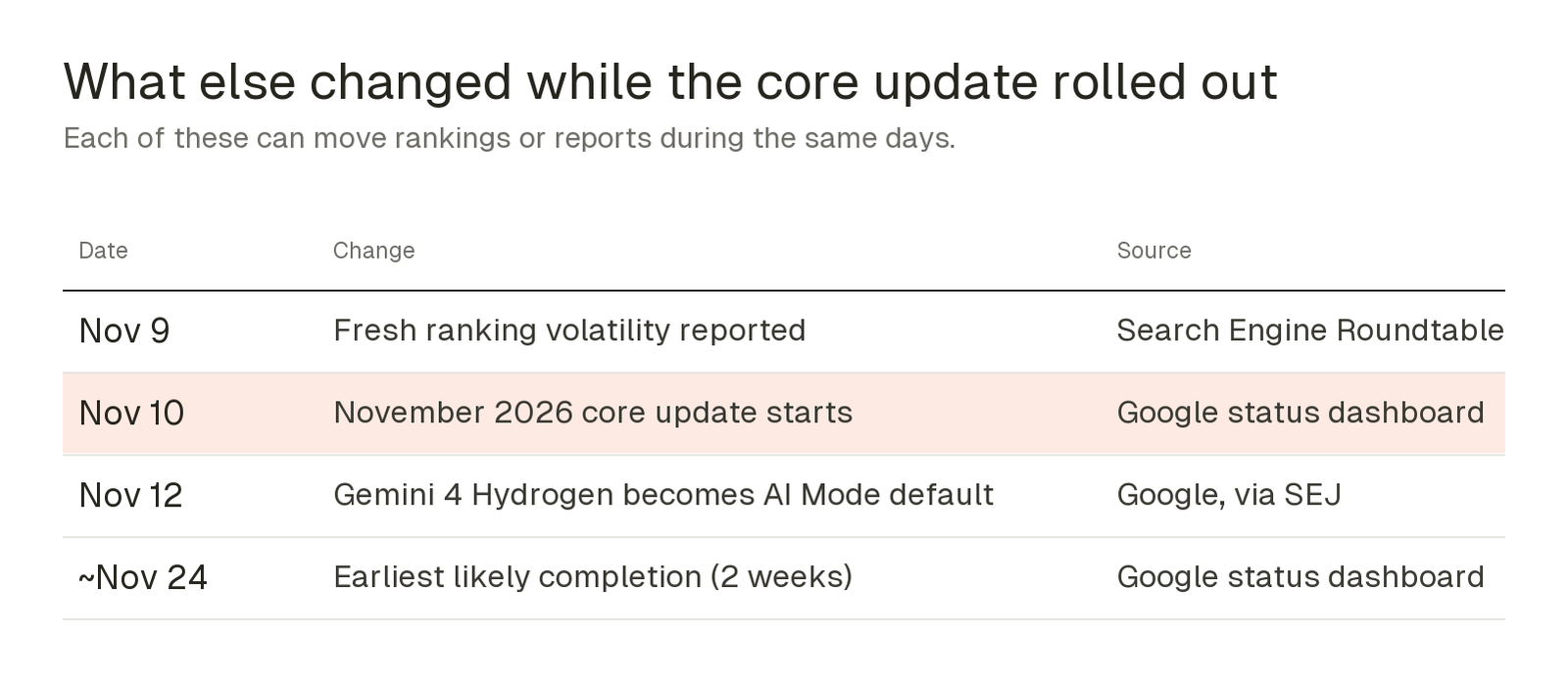
So a drop that started on November 12 might be the core update, an AI Mode change, or both. You can't separate them from inside the rollout. You can only make sure your data is clean enough to separate them afterward.
Pick your baseline before the update finishes
Google's guidance on core updates is specific: wait until the rollout is complete, then wait at least a full week, and compare that week's Search Console data with a week before the rollout started. For this update, that "before" week is November 3 to 9.
When will it end? Google's dashboard shows the two earlier 2026 core updates took about 12 days each. If November follows the same pattern, expect completion around November 22 to 24, which puts your "after" week roughly in the first week of December.
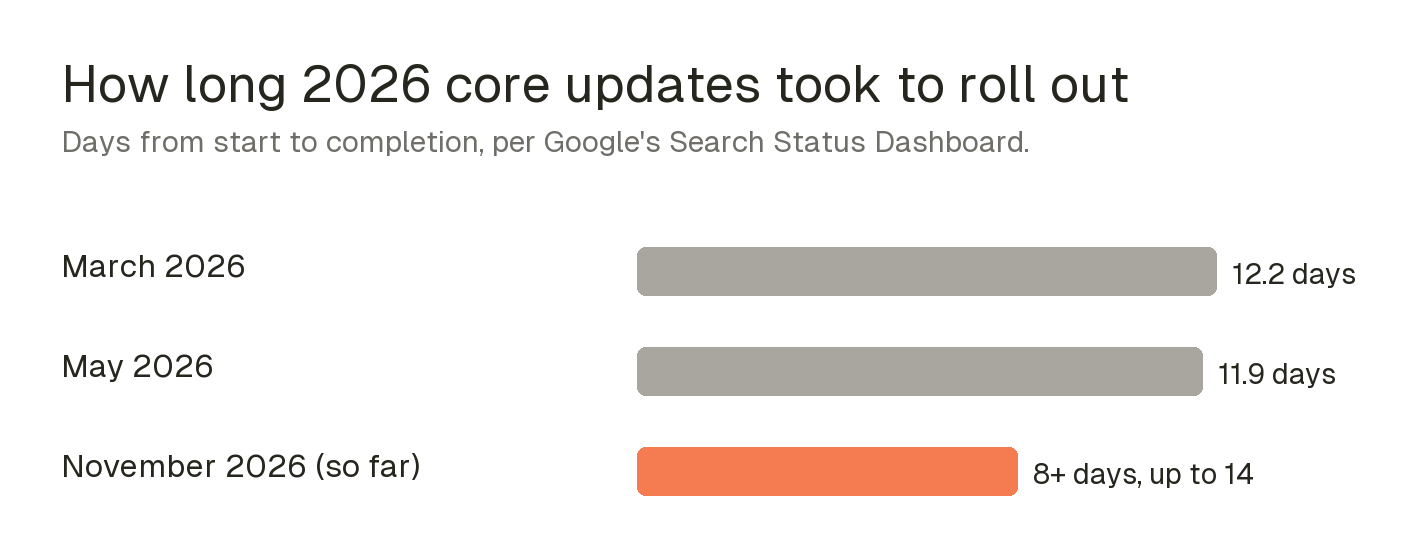
Here's why the baseline week matters so much. Say a pricing page averaged 400 Search Console clicks a week in early November, fell to 250 on November 13, and was back near 380 by November 17. Compare November 13 with the week before and you'd report a 38% loss. Compare the settled week after the rollout with November 3 to 9 and you might see a 5% dip, or a gain. The page didn't change. Only the comparison window did.
Three things to do now, while the data settles:
- Export Search Console clicks, impressions and average position by page for November 3 to 9, so the baseline can't drift.
- Freeze big site changes, such as migrations, template rewrites and mass content updates, until the update completes. Otherwise you won't know which change caused what.
- Note every change you do ship, with the date, in a shared log. A one-line note beats a month of guessing.
Watch SERP volatility for your category, not the whole web
The fastest way to tell whether the update is hitting your niche is to check SERP volatility by category. Semrush Sensor scores daily volatility in Google results on a 0 to 10 scale, broken down by country, device and category. A score in the normal range for your category while you're dropping points to something on your site. A spike across your category points to the update.
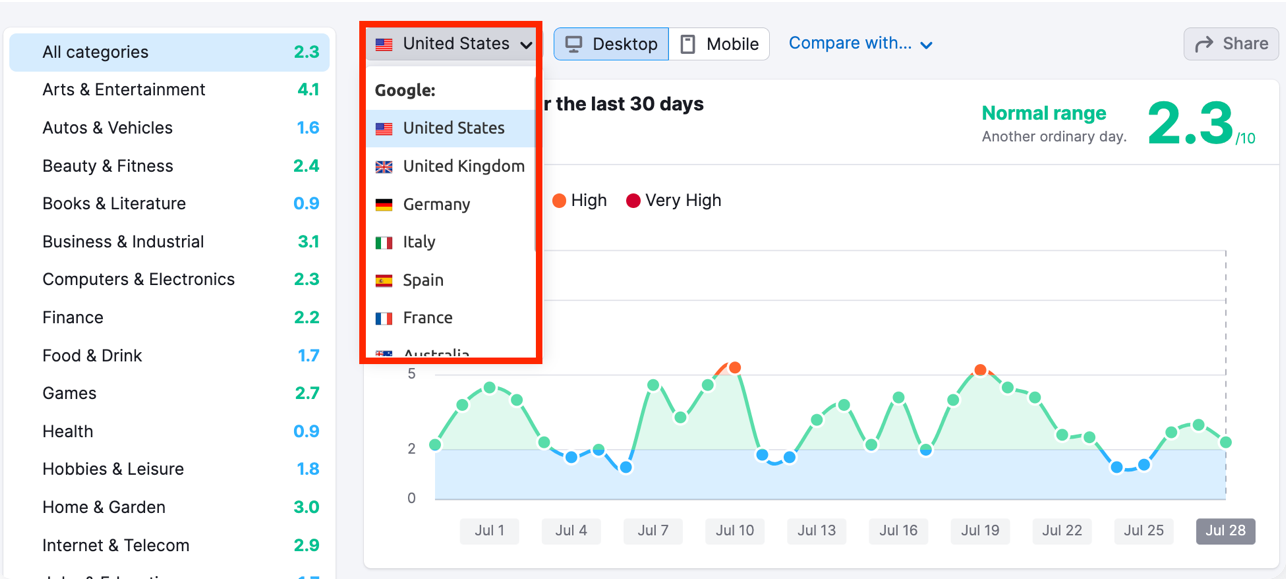
Then narrow it to your own keywords. Position Tracking updates your keyword rankings daily, for the locations and devices you choose, next to the competitors you name. If your rivals' lines move with yours, the update moved the whole set. If you fall while they rise, look at what their pages offer that yours don't. Both tools are part of Semrush's SEO Toolkit.
After the rollout: a clean before-and-after
Once the dashboard marks the update complete and a full week has passed, run the comparison in this order:
First, compare Search Console clicks for the after week against November 3 to 9, page by page. Second, confirm any loss with a second source, such as analytics sessions for the same pages, before calling it real. Third, check whether the losing pages also lost AI Overview or AI Mode visibility, since the November 12 model change could explain part of it.
Google's own guidance says a small move, such as position 2 to position 4, doesn't call for drastic changes. Save the rewrites for pages that lost clicks, sessions and conversions together. Our earlier piece on diagnosing a Google traffic drop walks through that triage, including how to tell a core update hit from a spam update.
For pages that did lose, Google's core update guidance points to its questions about content quality rather than technical fixes. Ask whether each page offers original information or analysis, whether it fully answers the question someone searched, and whether a reader would trust it enough to act on it. Compare the losing page with the pages that now rank above it on those three points, and you'll usually find the gap faster than any checklist of ranking factors will show it. Recovery, if it comes, usually takes until a later core update, so improve the page for readers rather than for this week's chart.
Semrush One bundles the SEO Toolkit with the AI Visibility Toolkit, so you can check rankings and AI answer visibility for the same pages in one place. It has a 7-day free trial, which is enough to set up tracking now and have daily data by the time the rollout ends.
The short version
- The November 2026 core update started November 10 and may run until about November 24.
- Don't judge it mid-rollout. Tracker swings this week are expected, and trackers will disagree.
- Your baseline is November 3 to 9. Export it now.
- Check category volatility and competitors before blaming your site.
- Compare a full week after completion with the baseline, and confirm losses with a second source.
Sources
- Google Search Status Dashboard: November 2026 core update
- Google Search Status Dashboard: Ranking incident history
- Google Search Central: Google Search's core updates and your website
- Search Engine Journal: Google's November 2026 core update starts rolling out
- Search Engine Journal: SEO Pulse, core update, ChatGPT Business Hub and AI Mode's new model
- Semrush KB: Semrush Sensor
- Semrush KB: Position Tracking
- Semrush KB: Semrush One