AI Search Optimization Audit: Turn Brand Claims Into Proof AI Can Check
A one-page workflow to find the buyer questions that matter, see what AI answers cite, and back every claim with evidence a reader or an AI system can verify.
AI search optimization comes down to whether an AI system can check what your pages claim. This guide walks through a one-page AI visibility audit: pick the buyer questions that matter, see which sources AI answers already cite, rewrite vague brand claims as specific proof, and track citations and brand mentions as separate results.
Best for
- Marketers who own product and comparison pages
- Founders writing their own site copy
- SEO leads adding AI visibility to their reporting
Requirements
- One high-value page: product, comparison or use case
- Five to ten buyer questions
- Real evidence: case studies, reviews, survey data, awards
- Semrush AI Visibility Toolkit or a Semrush One trial
Why AI search optimization now rewards proof
Most brand pages are written to persuade a person who is already on the page. "The fastest onboarding." "Trusted by leading teams." Those lines do little when the reader is an AI system assembling an answer from several sources, because there is nothing in them it can check or quote.
Google's own advice is plain. Its documentation on AI features says there are no additional requirements to appear in AI Overviews or AI Mode, and no special optimizations needed: the same SEO fundamentals apply, including helpful, people-first content. So this isn't about a new trick. It's about making the content you already have easier to verify.
There is research behind the idea, too. In the generative engine optimization (GEO) study presented at KDD 2024, researchers tested ways of rewriting web sources and found that adding citations, quotations from relevant sources and statistics was among the most effective, lifting a source's visibility in generative engine responses by over 40% across their benchmark queries. That was a controlled test, not a promise for your page, but it points the same way: specific, sourced statements get used.
Get a baseline: citations and mentions are different results
Before changing a word, record where you stand. We ran our own domain through Semrush's free Domain Overview, which now shows an AI Search panel next to the classic SEO numbers. The result is a useful warning about what to measure.
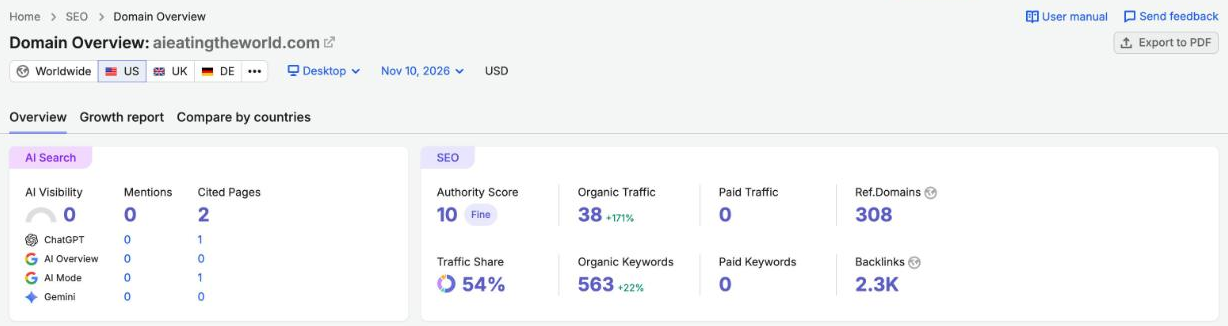
Two of our pages were cited, one in ChatGPT and one in Google AI Mode, yet the brand was mentioned zero times. A citation means an AI answer used your page as a source. A mention means the answer named your brand. You can earn the first without the second, which is why the two need to be tracked separately.
For a proper baseline on the questions your buyers ask, Semrush's AI Visibility Toolkit goes further. Its Visibility Overview benchmarks your presence against competing brands, and Brand Performance shows how AI platforms describe you, so you can see which of your claims they repeat and which they ignore.
Choose the buyer questions worth auditing
Pick one page that earns money, such as a product, comparison or use-case page, then list five to ten questions a buyer would ask an AI assistant before choosing you. Write them the way people type into ChatGPT, not as keywords: "Which invoicing tool works best for a five-person agency?" rather than "agency invoicing software".
Semrush's Prompt Research report helps you check that list against real demand. Enter a topic and it returns related topics and individual prompts, the AI response for each, how many brands it mentions and how many sources it cites. The Questions report in the same toolkit surfaces the questions people ask AI platforms in your category, which is useful for catching ones your team never thought of.
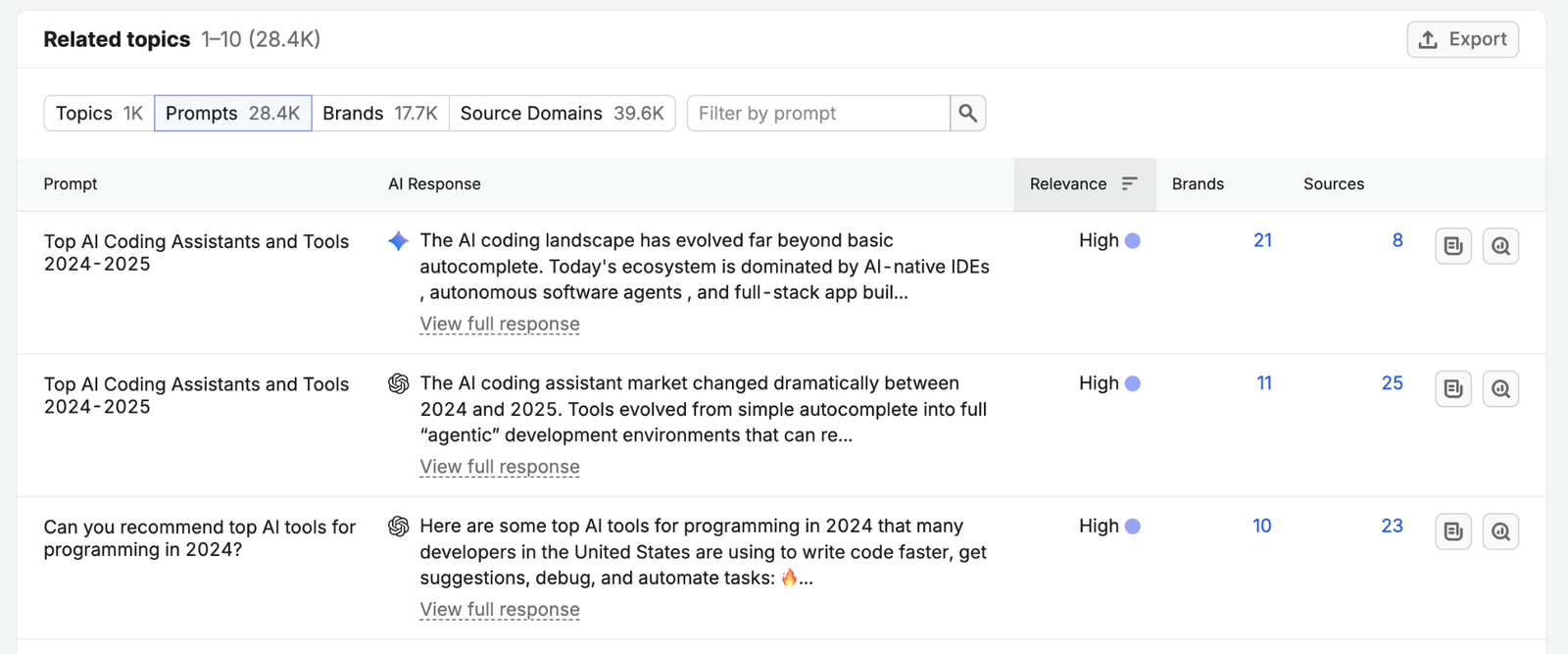
Keep the prompts with high relevance and many cited sources. Those are the answers where evidence decides who gets used.
Sources: Semrush KB: Prompt Research report
See which sources AI answers already trust
Next, find out what the answers rely on today. In Prompt Tracking, which runs your prompts daily in ChatGPT, Google AI Mode and Gemini, the Sources tab lists every page cited across your tracked prompts and groups them into your domain, competitor domains, knowledge bases, social, digital PR and other categories. For each cited page it shows how often it was cited and how often your brand was mentioned alongside it.
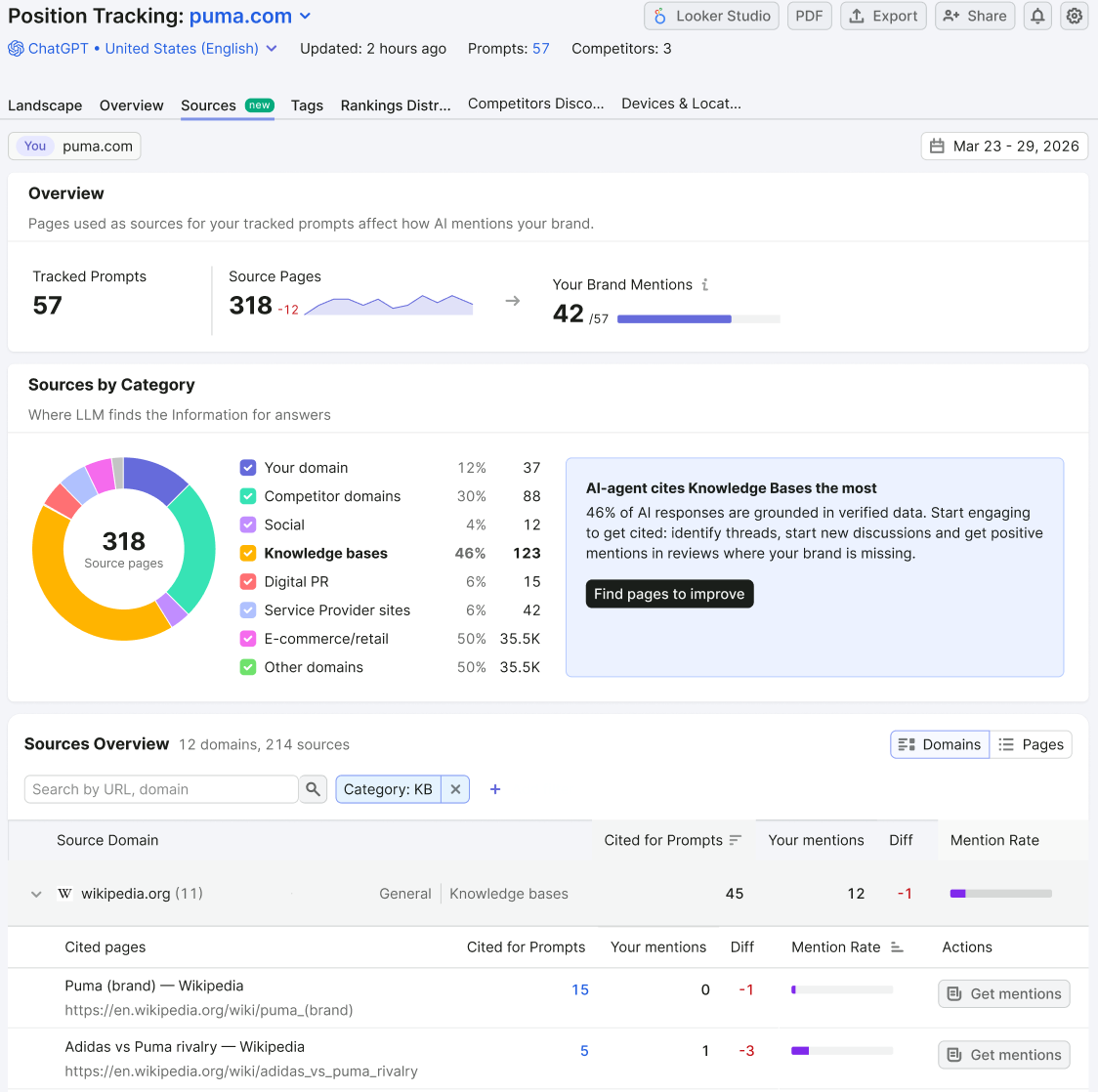
Read the list with two questions in mind. Which of your own pages get cited, and for which prompts? And which third-party pages, such as review sites, industry publications or knowledge bases, keep appearing without mentioning you? The first group is what you rewrite. The second is where you earn independent coverage, which is often the shortest route to getting cited by AI in a crowded category.
Sources: Semrush KB: Prompt Tracking
Rewrite each claim as proof a reader can check
Now go through your page line by line and mark every claim a skeptical buyer would question. Each one needs a piece of evidence placed right next to it, not on a separate testimonials page three clicks away. Good evidence is specific, dated, attributed and linked.
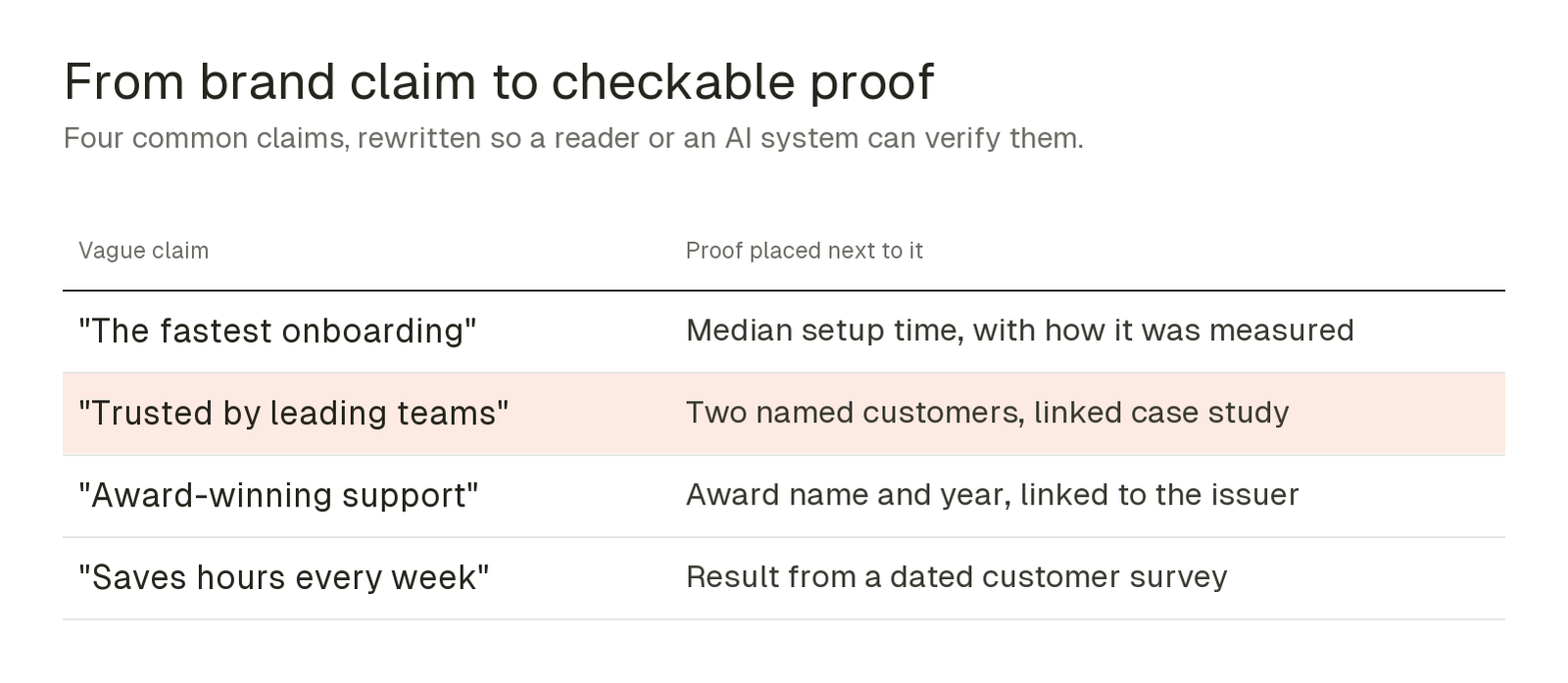
Here is one rewrite in full, using a made-up clinic scheduling app to show the pattern. Before: "Our scheduling app is the easiest way for clinics to cut no-shows." After: "Clinics using our reminders cut no-shows from 18% to 11% over six months, based on appointment data from 42 US clinics we analyzed in August 2026. Read the full case study." The second version gives an AI system a number, a sample, a date and a source to cite, and gives a buyer a reason to believe it.
Semrush's own guidance on optimizing content for LLMs makes the same points from the other side: clear answers, credible information and content that is easy to extract. Put the direct answer under a descriptive heading, keep one claim per sentence, and link the evidence inline.
A prompt to find unsupported claims
Use this with ChatGPT, Claude or Gemini to speed up the line-by-line pass. Paste the page text and a list of the evidence you actually have. The last instruction matters most: an assistant asked to "add proof" will happily make some up, and fabricated statistics are worse than vague claims.
Build proof that lives off your site
A brand vouching for itself only goes so far. Independent coverage corroborates what your page says, and the Sources tab has already shown you which outside pages AI answers trust in your category. Work that list: get listed or reviewed on the review sites that keep appearing, pitch data from your own research to the publications that are cited, and correct out-of-date facts about you on knowledge bases where you're allowed to.
Keep it clean. The FTC's rule on fake reviews and testimonials, announced in August 2024, bans fake reviews, including AI-generated ones, as well as buying reviews and undisclosed insider reviews. Ask real customers for honest reviews and disclose any relationship.
Track citations and mentions after you republish
Republish the page, then give it a few weeks before judging. Keep the same prompt set in Prompt Tracking so the before and after are comparable, and watch two numbers apart: how often your rewritten page is cited, and how often your brand is named in the answer. If citations rise while mentions don't, the page is being used as a source but the answer isn't connecting it to you, so make your brand name and the claim appear together in the same sentence.
Be honest with yourself and your boss about what this can and can't do. Adding proof points makes a page more useful and more credible. It doesn't guarantee a citation, and AI answers change from day to day. Measure over a month, not a morning.
The AI Visibility Toolkit is a $99-a-month add-on, and Semrush One includes it. If you want to run this audit before paying, Semrush One has a 7-day free trial, which is enough to set up Prompt Tracking, read the Sources tab and finish one page.
Before you republish the page
Sources
- Google Search Central: AI features and your website
- Aggarwal et al.: GEO, Generative Engine Optimization (KDD 2024)
- Semrush blog: How to optimize content for LLMs
- FTC: Final rule banning fake reviews and testimonials (August 2024)
- Semrush KB: AI Visibility Toolkit
- Semrush KB: Prompt Research report
- Semrush KB: Prompt Tracking
- Semrush KB: Brand Performance reports
- Semrush KB: Semrush One
Founder and Editor
Brian Weerasinghe is the founder and editor of AI Eating The World, where he covers artificial intelligence, tech companies, layoffs, startups, and the future of work. His reporting focuses on how AI is transforming businesses, products, and the global workforce. He writes about major developments across the AI industry, from enterprise adoption and funding trends to the real-world impact of automation and emerging technologies.