Image: Flickr / Wikimedia Commons / Unsplash
AI Share of Voice: How to Measure Brand Visibility When Every Answer Changes
ChatGPT almost never gives the same list of brands twice. A 70,000-response study shows why single screenshots mislead, and which rates hold up in a report.
Image: Flickr / Wikimedia Commons / Unsplash
This article contains affiliate links to Semrush. AI Eating The World may earn a commission on qualifying purchases, at no extra cost to you.
ChatGPT repeated the same brand list on two random days just 0.3% of the time. Here's how to measure AI share of voice, presence and first-mention rates across a fixed prompt set instead.
One screenshot can't tell you if ChatGPT recommends your brand
Someone on the leadership team types your category into ChatGPT, doesn't see your company, and forwards the screenshot. A week later a colleague runs the same prompt and you're the first name in the answer. Both screenshots are accurate. Neither tells you much, and that's the case for measuring AI share of voice over many runs instead of judging a single answer.
Glen Allsopp's study for Detailed, published September 23, 2026, shows how unstable single answers are. He checked about 1,300 mostly commercial prompts every day for 28 days in both ChatGPT and Google AI Overviews, a little over 70,000 responses. Pick any two days at random and ChatGPT returned exactly the same list of brands for a prompt 0.3% of the time. AI Overviews managed 1.1%. For 41% of ChatGPT prompts, the brand set never repeated once in the whole month.
Meanwhile the demand for a number keeps rising. In uSERP's September survey of 116 SEO professionals, 79.3% had been asked by a client or executive to make AI citations a KPI, and only 21.6% tracked them as one. Teams need a measure that survives the noise.
The leaders mostly stay put. Everyone else churns
The same data has a more reassuring side. Answers have a core and a tail. Brands named on at least 80% of days changed from one day to the next only 13% of the time in ChatGPT and 11% in AI Overviews. Tail brands changed 78% and 65% of the time. Cited domains followed the same split.

Even the leader isn't safe on any given day. The usual top brand for a prompt was named first on half of ChatGPT days and 60% of AI Overview days. When it wasn't named first in ChatGPT, it was usually missing from the answer entirely. Allsopp also found the leader changed between the first and second fortnight on roughly half of prompts, so a two-week snapshot is about the shortest window worth reporting on.
For a brand in the tail, the practical lesson is that a single good day means little. You're trying to move from appearing sometimes to appearing most of the time, and only a rate measured across many runs will show whether that's happening.
Sources for this section
How to measure AI visibility with five rates
AI visibility tracking works when it counts the same things the same way every time. These five metrics cover what most leadership teams actually want to know.
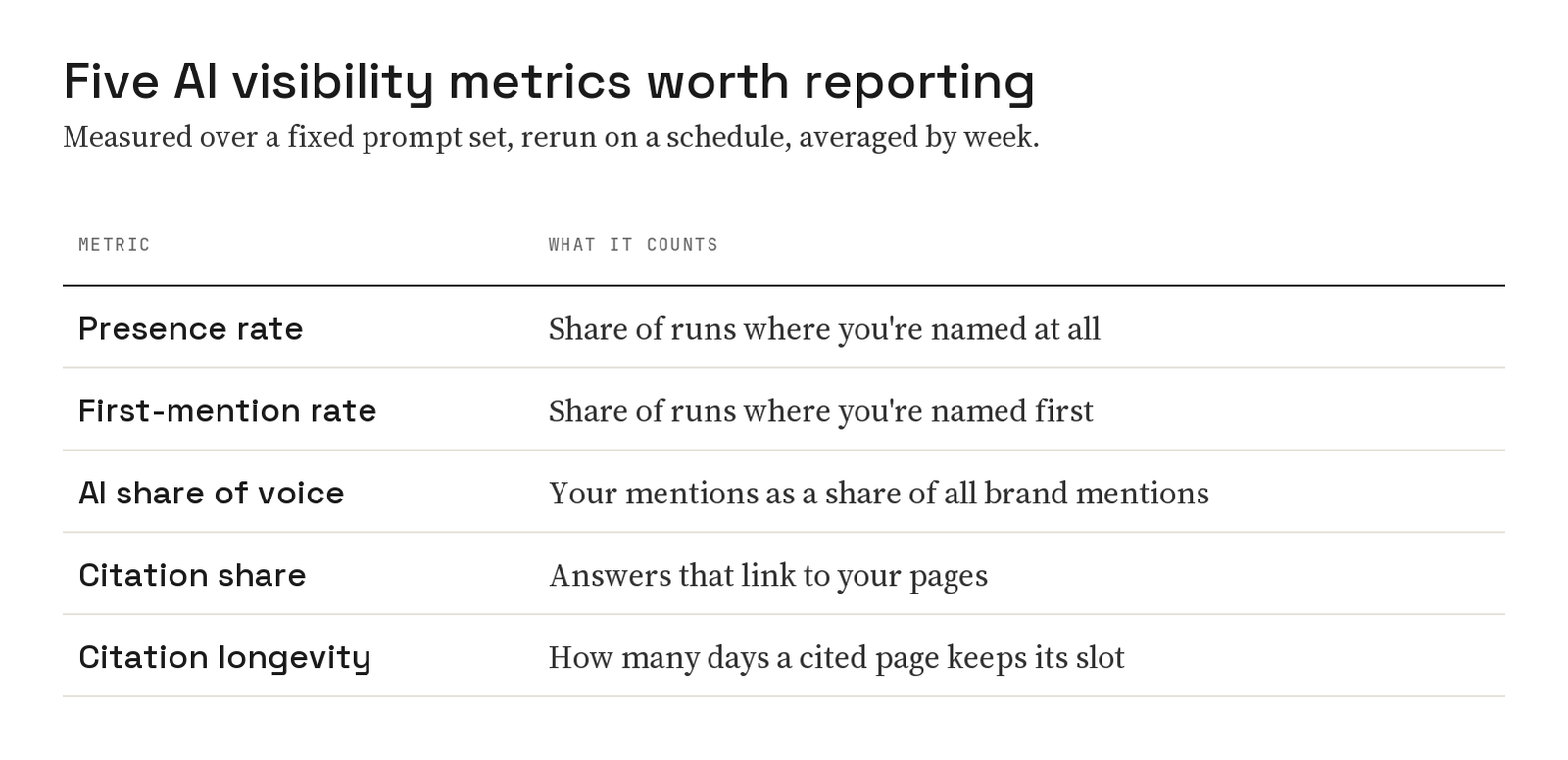
Here's how the math works on a small set. Say you track 40 prompts once a day for a week, which gives you 280 answers. Your brand appears in 112 of them, so your presence rate is 40%. It's named first in 42, a first-mention rate of 15%. Across all 280 answers, every brand together is mentioned 1,000 times and yours accounts for 130 of those mentions, so your AI share of voice is 13%. Report those weekly, and a move from 13% to 17% over a quarter means something in a way a screenshot never could.
Keep mentions and citations in separate columns. In a June 2026 Semrush study with Kevin Indig, 61.7% of brand appearances across four AI engines were citations that never named the brand in the answer text. Engines also behave differently: ChatGPT cited sources in 87% of appearances but named the brand in 20.7%, while Gemini named brands 83.7% of the time and cited them in 21.4%. A single blended score hides that, which is why LLM visibility should be reported per platform.
Sources for this section
Building a prompt set that holds up
Your metrics are only as good as the prompts behind them. A set that changes every month can't show a trend, and a set full of prompts nobody asks shows a trend that doesn't matter.
- Start with 30 to 60 prompts per product line, written the way a buyer would ask, not the way your keyword list reads.
- Mix intents: definitions, comparisons, "best X for Y" questions and alternatives to a named competitor.
- Freeze the set for a quarter. Add new prompts in a separate group so the core trend stays comparable.
- Run it on a schedule, daily if you can, and report weekly averages instead of daily readings.
- Log model releases and major product launches on the same timeline so a sudden jump has a likely explanation.
Tracking brand visibility in ChatGPT with Semrush One
Running 40 prompts a day across three or four assistants by hand isn't realistic for most teams, and copying results into a spreadsheet is where tracking usually breaks down. Semrush One bundles the AI Visibility Toolkit, which runs prompt sets on a schedule and reports mentions, citations and share of voice, with the SEO Toolkit, so AI visibility sits next to your Google rankings in one project.
The 7-day free trial gives you a week of daily readings on your own prompt set. That's enough to see where your presence rate starts before anyone asks for the next screenshot.
Three Semrush views for AI brand monitoring
Prompt Tracking is where the prompt set lives. It runs your prompts daily in ChatGPT, Google AI Mode and Gemini and shows, prompt by prompt, whether your brand was mentioned or missed, how many of your own pages were cited as sources, and how your AI visibility changed since the last check.

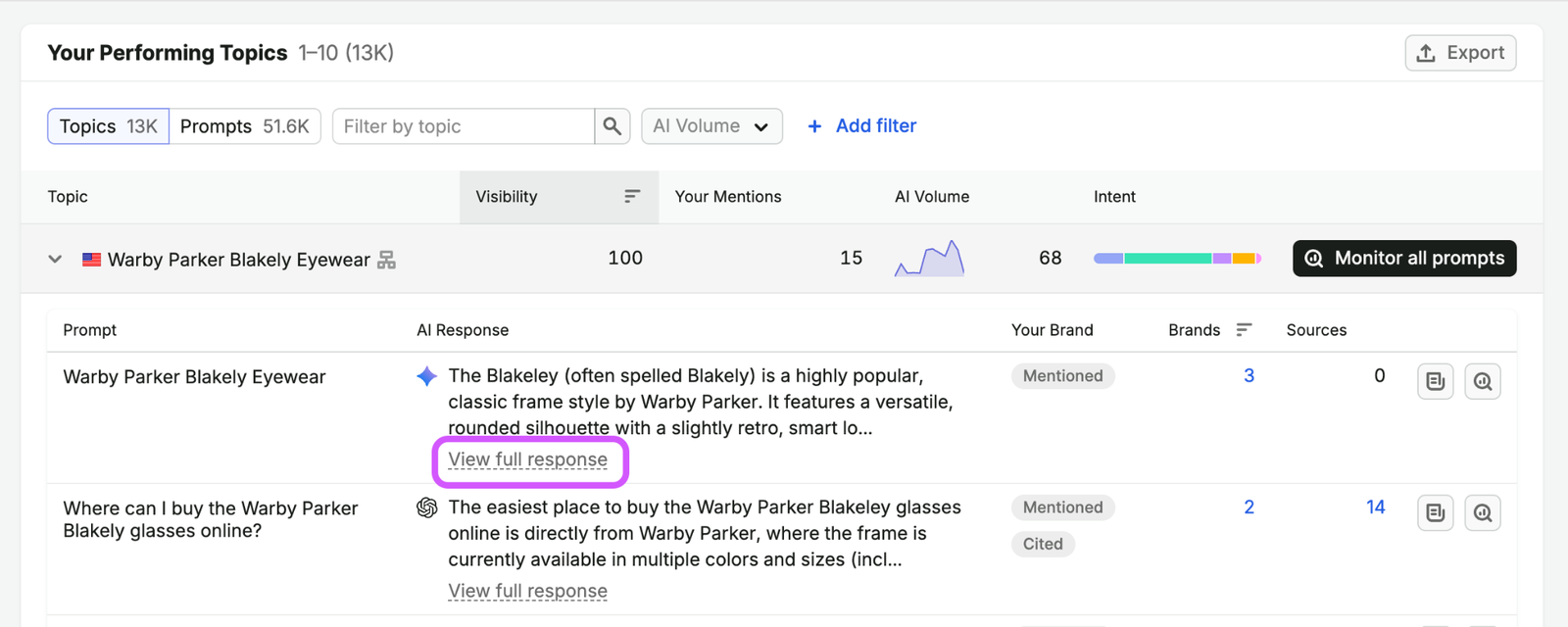
Expanding a topic in the Visibility Overview report shows the individual prompts behind it, the AI response, whether your brand was mentioned or cited, how many brands appeared and how many sources the answer used. It's the quickest way to read the actual answers behind a number before you present it.
The Narrative Drivers report, part of Brand Performance, is the one to put in front of leadership. It shows AI share of voice by platform across ChatGPT, Google AI Mode, Perplexity and Gemini, a share of voice trend against the competitors you choose, and the domains AI answers cite most for your category, with AI-generated suggestions on where to close the gap.
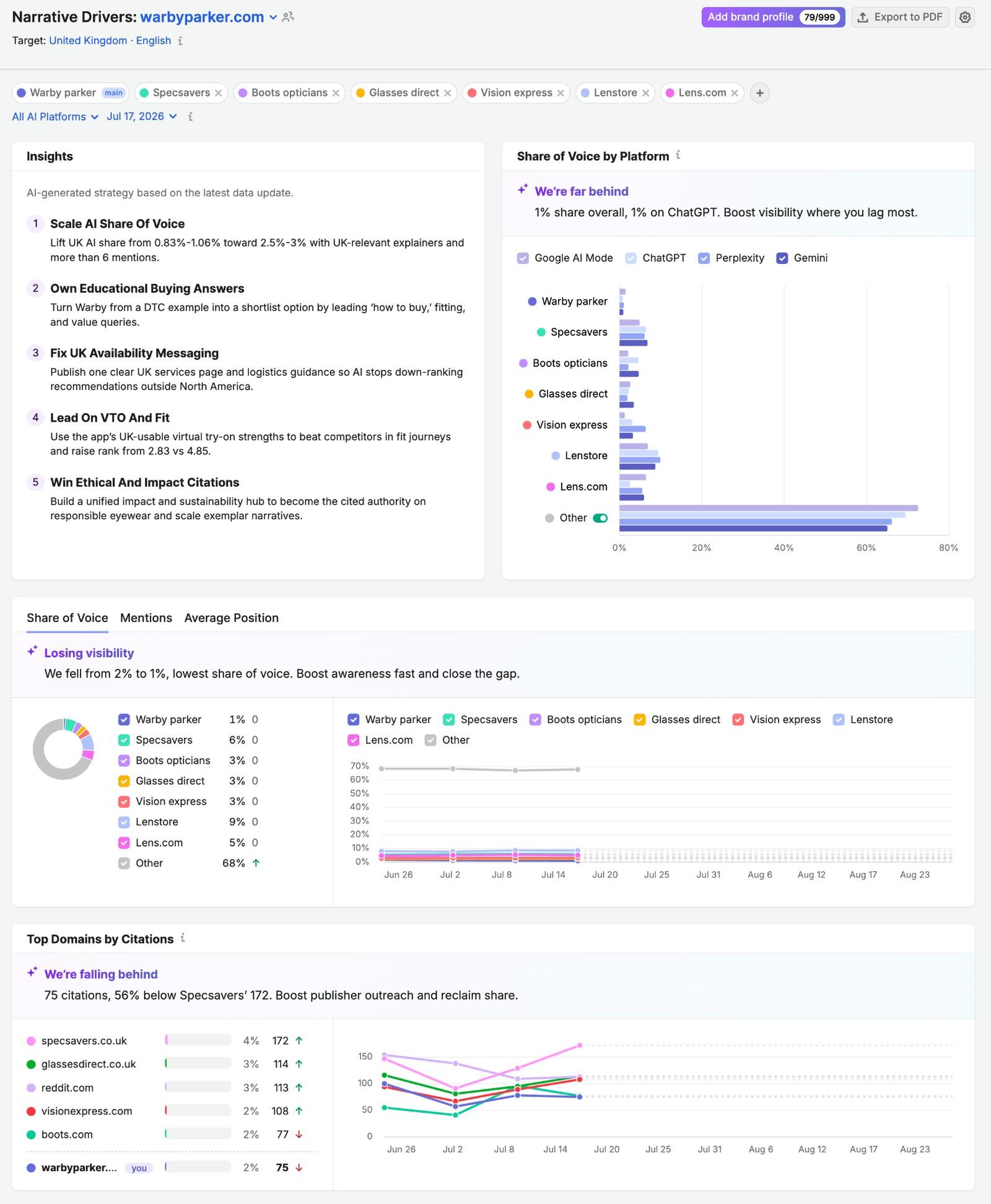
Put those together and the weekly report writes itself: presence and mentions from Prompt Tracking, share of voice from Narrative Drivers, and a few real answers pulled from the prompt view as examples.
Sources for this section
The short version for your next report
- Single AI answers are close to random for brands outside the core. Report rates across many runs.
- Track presence, first mention and AI share of voice weekly, and keep citations in their own column.
- Report each AI platform separately. ChatGPT and Gemini treat mentions and citations very differently.
- Freeze your prompt set for a quarter so the trend means something.
- Use two weeks as the minimum window before calling a change.