Image: Flickr / Wikimedia Commons / Unsplash
Topical Authority in ChatGPT: Most Categories Still Have No Brand Owner
A study of 1,094 categories found a clear brand owner in only 15% of them, and classic SEO metrics barely predicted who won. Here's how to claim one before a competitor does.
Image: Flickr / Wikimedia Commons / Unsplash
This article contains affiliate links to Semrush. AI Eating The World may earn a commission on qualifying purchases, at no extra cost to you.
Only 15.2% of 1,094 US categories tracked in ChatGPT have a clear brand owner. Here's what predicts ownership, why owners hold on, and how to build topical authority and AI brand mentions in your category.
Most categories in ChatGPT still have no brand owner
Topical authority used to describe how thoroughly a site covered a subject in Google. In AI search it has a sharper meaning: when someone asks ChatGPT about your category, is your brand the one it names? A study Semrush ran with Kevin Indig, published July 20, 2026, tracked 1,094 US categories in ChatGPT every month from January to June. Each category got five prompts: a definition, a comparison, an alternatives question, a use case and a buying question. Across them, the study logged more than 50,000 brands and 600,000 citations.
A brand counted as the clear owner of a category if it had the highest share of mentions, appeared in at least four of the five prompts and led the runner-up by at least five percentage points. Only 15.2% of categories had one.
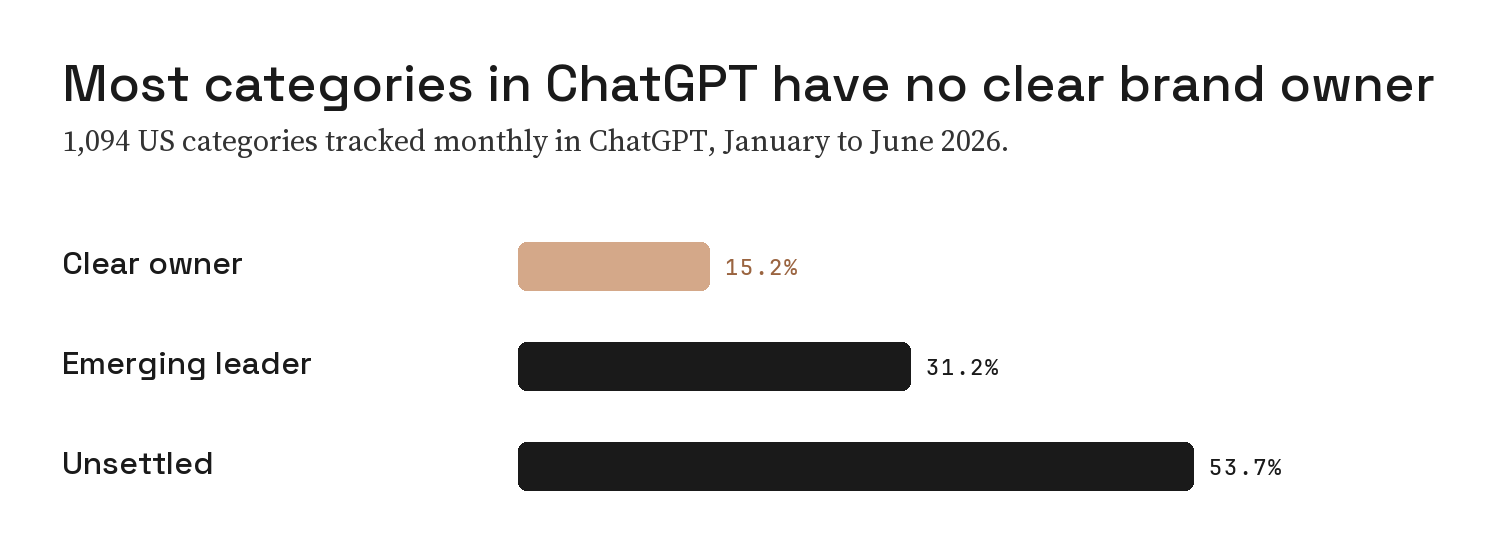
The bigger the category, the more open it was. Among the higher-demand half of categories, which accounted for 98% of the AI search volume in the sample, only 11.3% had an owner, against 19% in the lower-demand half. For most US companies, that means the questions buyers ask most about their category don't yet have a default answer.
Sources for this section
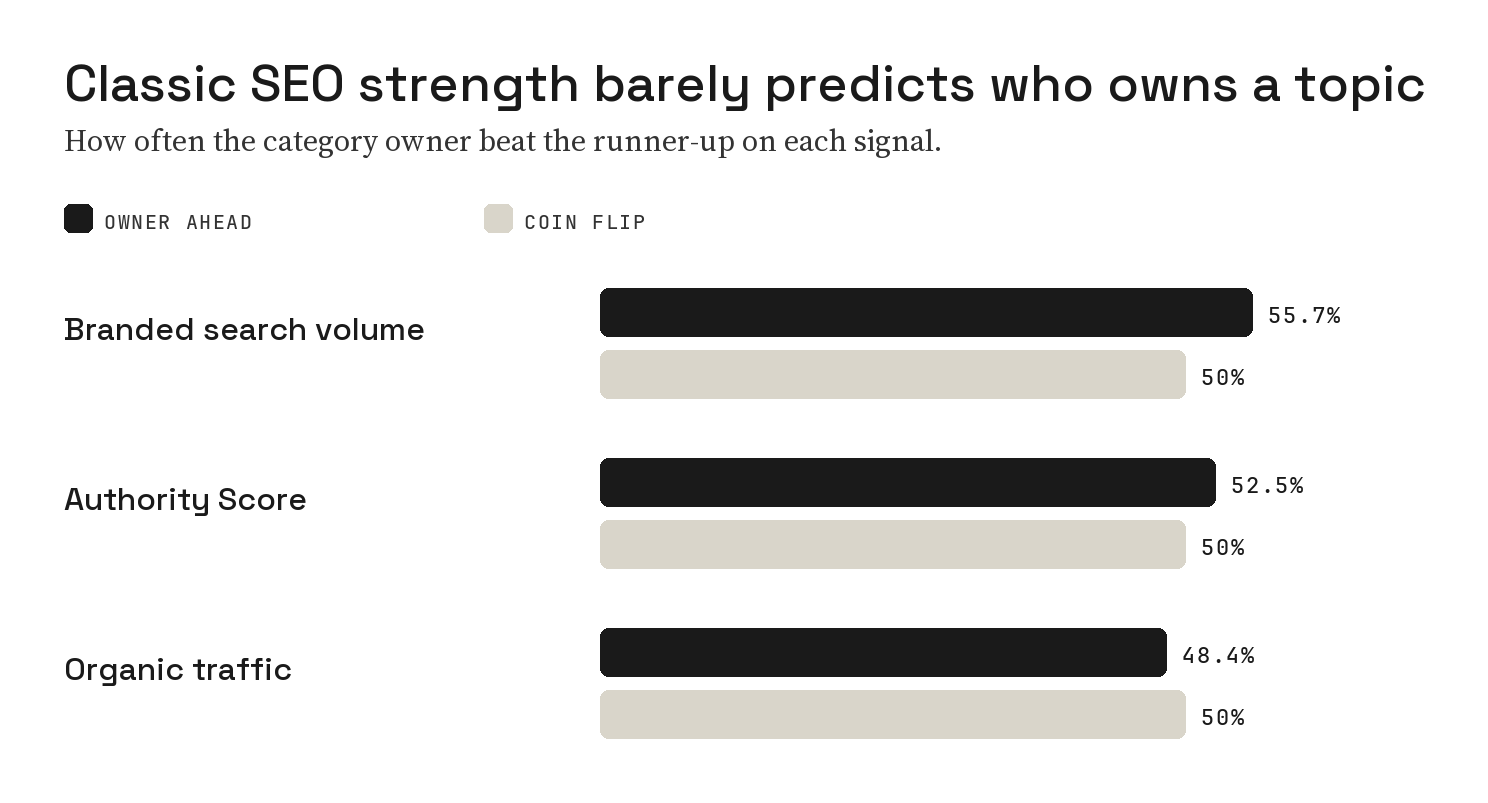
Classic SEO strength doesn't decide who ChatGPT names
If the usual SEO metrics predicted ownership, the strongest domains would win most categories. They don't. The study compared each owner with the runner-up and found the owner had higher branded search volume in 55.7% of pairs, a higher Authority Score in 52.5% and more organic traffic in 48.4%. Only branded search volume was statistically significant, and even that edge was modest.
Mentions and citations also pulled apart. Only 21% of the most-cited domains in a category were also the most-mentioned brand, and the two measures were slightly negatively correlated. A site can be the source ChatGPT reads and still not be the brand it recommends.
That's the gap entity SEO tries to close. The model has to connect your brand name with the category, consistently, across the pages it reads. Much of that connection is made off your site. A June 2026 study on arXiv of nearly 190,000 AI citations about 128 brands found that 85.7% of cited URLs belonged to sites the brands didn't own.
Owners hold on once they lead by enough
The timing argument is in the retention data. Clear owners kept first place in 90.4% of month-over-month comparisons. When leaders did lose the top spot, their median lead had been 1.3 points, against 2.9 points for leaders who held on. A wide lead tends to stick. A narrow one is still contestable.
Semrush's companion study on topical focus adds a second finding: brands built mention share by going deep in categories close to their core, not by appearing once across dozens of loosely related ones. Kevin Indig's own write-up is careful to note what the research doesn't cover. It measures whether a brand appears in the answer, not sentiment or sales. That's still the first thing to get right, because a brand that isn't named can't be chosen.
How to get mentioned by ChatGPT in one category
The study's recommendations are practical, and they fit how a small team actually works. Pick two or three categories where you already have some signal, then build depth in each one, on and off your site.
- Cover the five question types the study used for every category you want: what it is, how options compare, alternatives, use cases and how to buy.
- Name your brand and the category together, the same way, on your homepage, product pages, About page and social profiles.
- Add Organization structured data with consistent naming and sameAs links to your official profiles, so your brand entity is easy to resolve.
- Earn AI brand mentions where models read: industry publications, review sites, Reddit threads and expert commentary. Unlinked brand mentions count here too.
- Write comparison and "best for" content that explains where you fit, because comparative prompts are where brands get named most.
- Revisit monthly. If you lead narrowly, keep investing. If a competitor leads narrowly, move now.
Finding your open categories with Semrush One
The first step is knowing which categories are open and which questions buyers ask inside them. Semrush One bundles the AI Visibility Toolkit, which shows topics where competitors are mentioned and you aren't and how AI platforms describe your brand by topic, with the SEO Toolkit for the content and link work that follows.
The 7-day free trial is long enough to map your category against three or four competitors and pick the two or three topics worth claiming first.
Three Semrush reports for building topical authority in AI
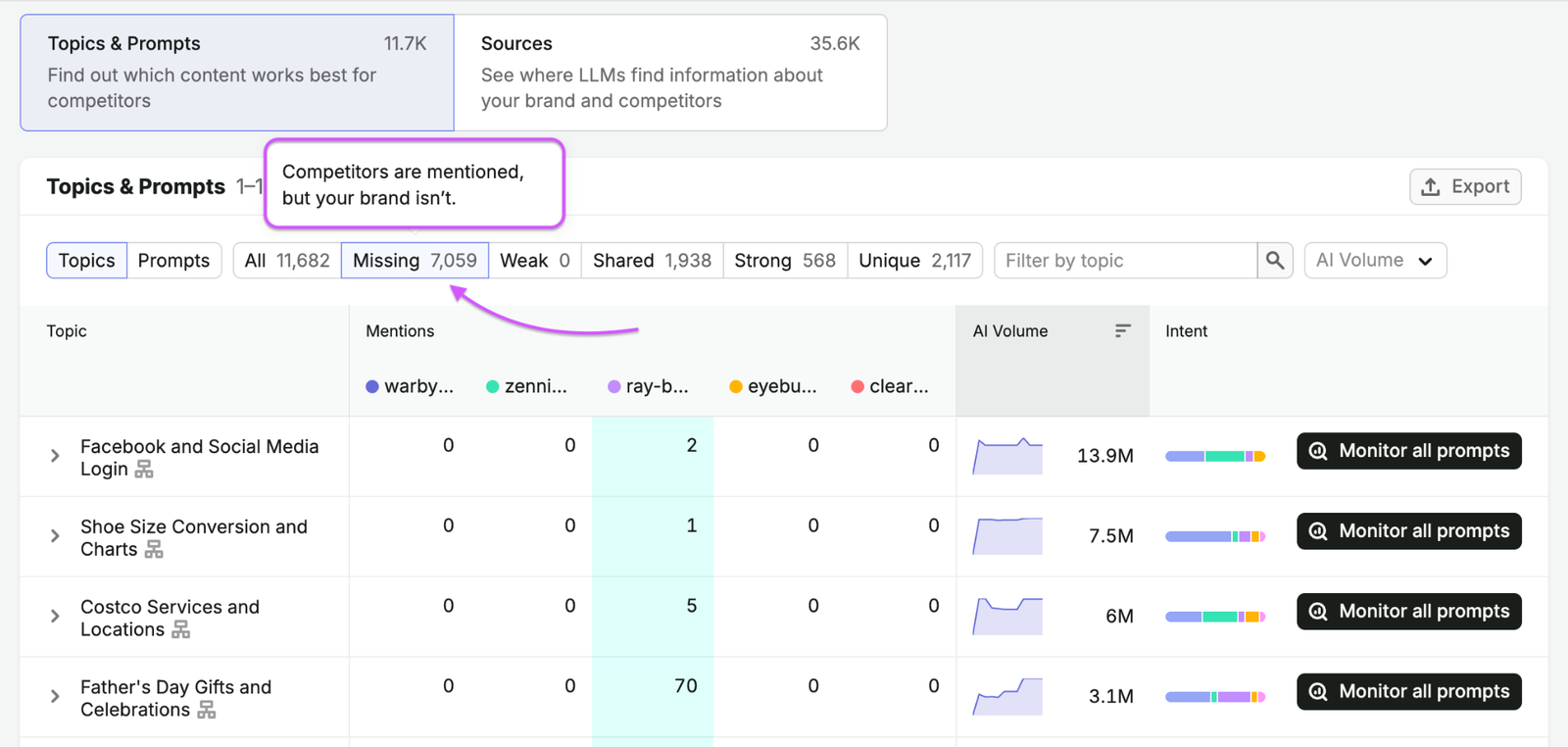
The Competitor Research report compares your brand's AI mentions with up to four competitors topic by topic. Its Missing filter lists topics where competitors are mentioned and you aren't, with AI search volume and intent for each. Sort by volume and you have a shortlist of categories worth a closer look.
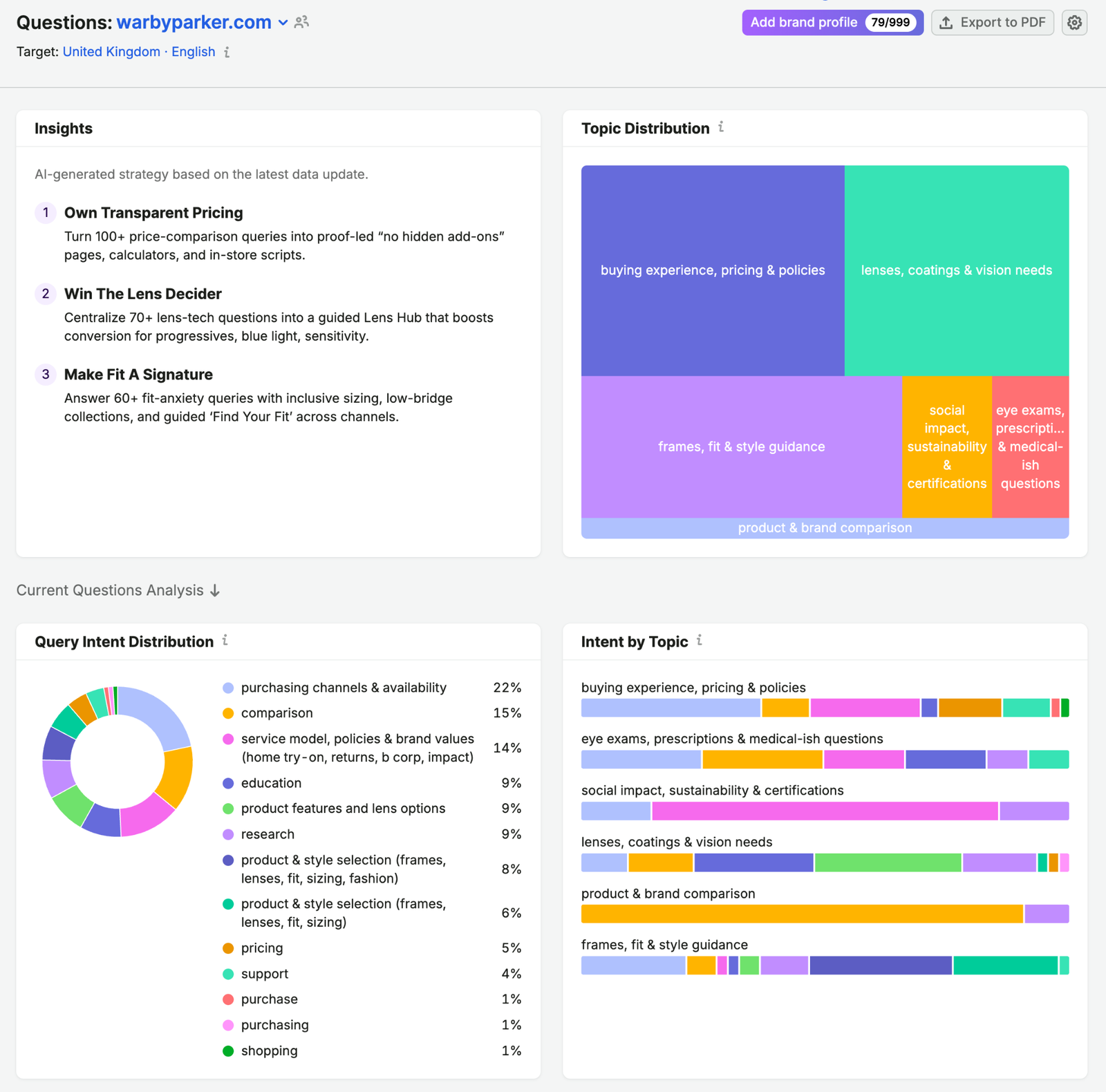
The Questions report in Brand Performance groups the questions people ask AI platforms about your brand and category into topics and intents, such as pricing, comparison and support, with AI-generated suggestions for content that would answer them. It's a good source for the five question types above.
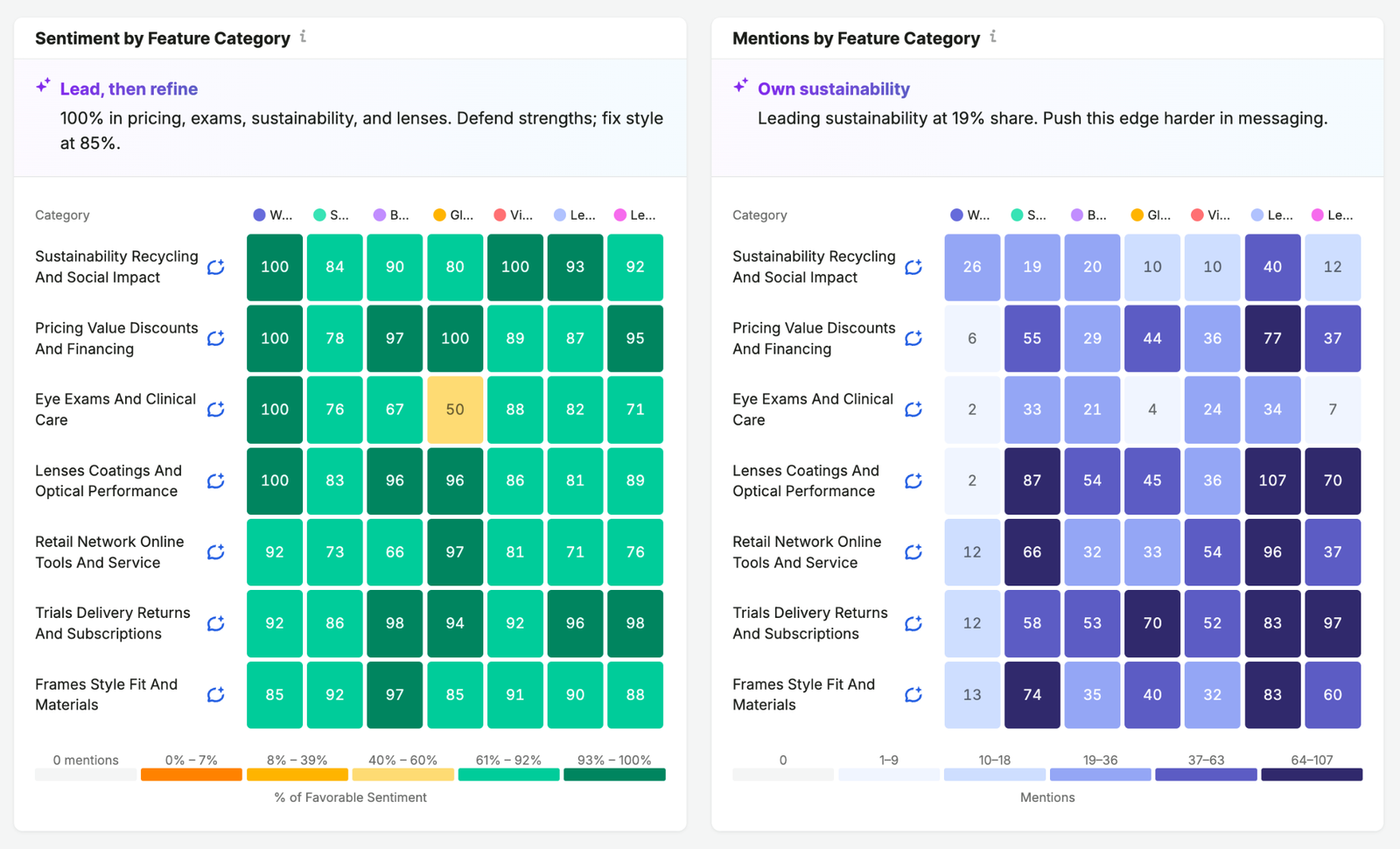
Brand Performance also breaks mentions and sentiment down by feature category for you and each competitor. In the example below, the brand is named only a handful of times on pricing, eye exams and lenses, while competitors collect dozens of mentions on each. Those rows show where depth would pay off, and the categories where it already does well show what to defend.
Check the same reports each month. In a category with no clear owner, the brand that keeps adding depth and earning outside mentions is the one most likely to become the default answer.
Sources for this section
The takeaways
- Only 15.2% of US categories in ChatGPT have a clear brand owner, and big categories are the most open.
- Authority Score and organic traffic predict ownership about as well as a coin flip. Branded demand helps a little.
- Owners rarely lose once their lead is wide, so a narrow race is the one worth entering now.
- Go deep in two or three categories, cover all five question types, and earn mentions on the sites models read.
- Track mentions and citations separately, by platform, every month.
Sources
Brian Weerasinghe is the founder and editor of AI Eating The World, where he covers artificial intelligence, tech companies, layoffs, startups, and the future of work. His reporting focuses on how AI is transforming businesses, products, and the global workforce. He writes about major developments across the AI industry, from enterprise adoption and funding trends to the real-world impact of automation and emerging technologies.