Image: Flickr / Wikimedia Commons / Unsplash
OpenAI's Revenue Gap: $50B or $70B? What It Means for the OpenAI IPO
OpenAI told investors its run rate was near $50 billion, not $70 billion. The October 8 selloff in CoreWeave, Oracle and Nvidia shows how much of the AI trade rides on that number.
Image: Flickr / Wikimedia Commons / Unsplash
This article was produced by the AETW editorial team. It is for information only and is not investment advice. OpenAI's revenue, valuation and IPO figures are reported by news outlets and have not been confirmed by OpenAI.
OpenAI's annualized revenue was about $50 billion at the end of September, not the $70 billion widely reported, mostly because of how partner sales are counted. The gap sent AI stocks lower on October 8 and changes the math on OpenAI's $1.4 trillion valuation talks and its 2027 IPO.
The OpenAI revenue number that moved the market
On October 8, 2026, the Financial Times reported that OpenAI told investors its annualized revenue was approaching $50 billion at the end of September. Just over a week earlier, Axios had reported that the same figure was nearing $70 billion. That $20 billion gap landed in the middle of OpenAI IPO planning and a new funding round, and it hit AI stocks within hours.
CoreWeave fell nearly 8%, Oracle dropped about 5.5% and Nvidia slid close to 3%, according to CNBC and The Next Web. Intel, AMD, Broadcom and Super Micro also declined, and the Nasdaq Composite lost about 1.25%, its worst day since mid-August. Rising oil prices and Treasury yields added pressure, so not all of the move was about OpenAI.
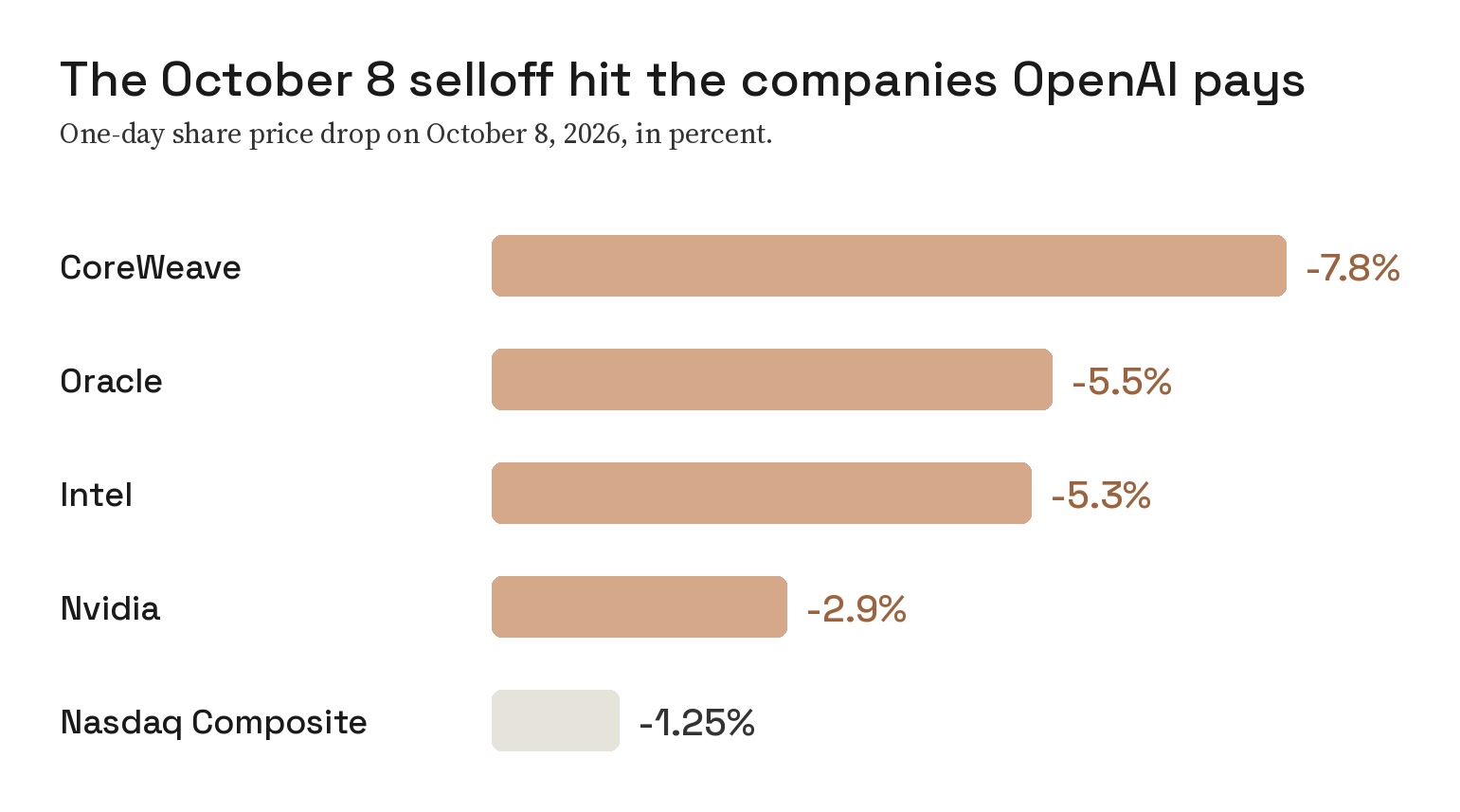
The reaction tells you how much of the US AI trade now rests on one private company. OpenAI is a top customer for CoreWeave and Oracle and one of the largest buyers of Nvidia hardware through its cloud partners. When the market questions OpenAI revenue, it questions the cash that is supposed to pay for all of that compute.
This piece is a follow-up to our report on the AI bubble in 2026. Here is what the two numbers actually mean, and what they change for investors and for the US companies whose revenue depends on OpenAI.
$50B or $70B: an accounting gap, not lost sales
The short version: both numbers describe roughly the same business, counted two different ways. A person familiar with the matter told CNBC that the higher figure, about $68 billion, included gross revenue from OpenAI's partners, and that the gap "does not reflect a loss of sales," as Quartz summarized.
Here is the mechanic. When a company buys OpenAI models through a cloud provider such as Microsoft Azure, the cloud provider collects the full sale and passes a share to OpenAI. OpenAI books only its share. Anthropic counts the gross value of Claude sales made through AWS, Google Cloud and Microsoft. According to the FT, the $70 billion figure came from OpenAI's own investors trying to put OpenAI on the same basis as Anthropic, whose run rate passed $65 billion at the end of July.
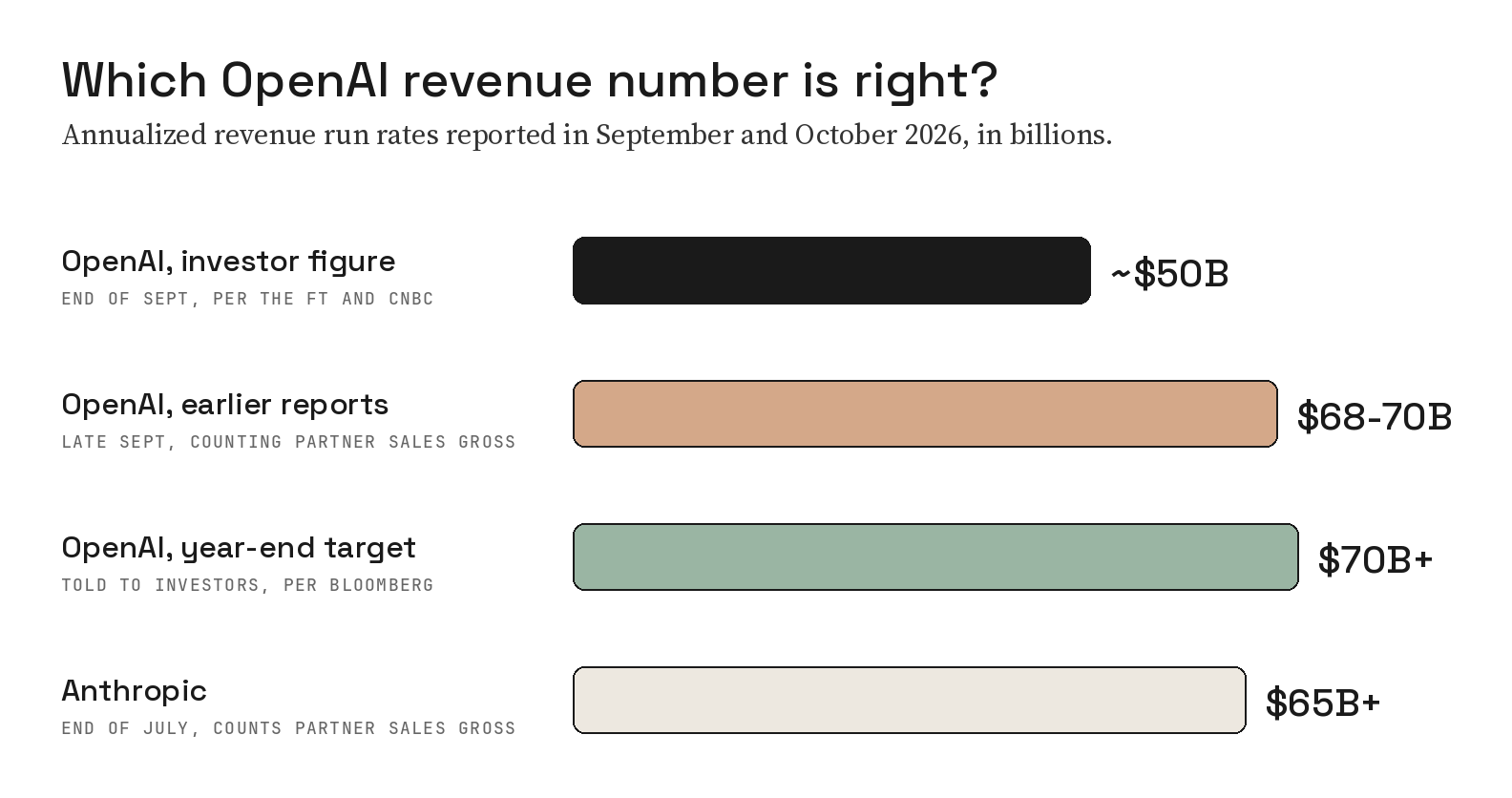
So the $50 billion figure is not a downgrade of the business, but it is a downgrade of the headline. Before October 8, many investors believed OpenAI and Anthropic were roughly level on revenue, with OpenAI slightly ahead. On OpenAI's own accounting, it is not ahead. In the second quarter, Anthropic's quarterly revenue of $11.5 billion passed OpenAI's $6.7 billion for the first time, The Next Web reported.
There is also a messier point. Reuters reported that OpenAI had indicated the higher figure to investors at a separate event, while a source told CNN it did not come from OpenAI. When a company's revenue story depends on which room you were in, markets mark it down. That is less about fraud or failure and more about a private company with no audited, public revenue line.
Sources for this section
Is OpenAI profitable? Not yet, and not close
The revenue debate matters because OpenAI still loses a lot of money. Audited 2025 financials, obtained by Ed Zitron and verified by the Financial Times in June, show $13.07 billion of revenue, up from $3.7 billion in 2024, against about $34 billion of costs. That works out to an operating loss of about $20.9 billion. The net loss was $38.5 billion, inflated by a large non-cash charge tied to OpenAI's conversion to a for-profit company, Quartz reported.
So the honest answer to "is OpenAI profitable" is no. Growth is real: OpenAI's own investor presentation showed the total run rate up 77% in the third quarter and the enterprise run rate up 107%, per CNBC. But revenue is not yet growing faster than the bill for chips, data centers and power.
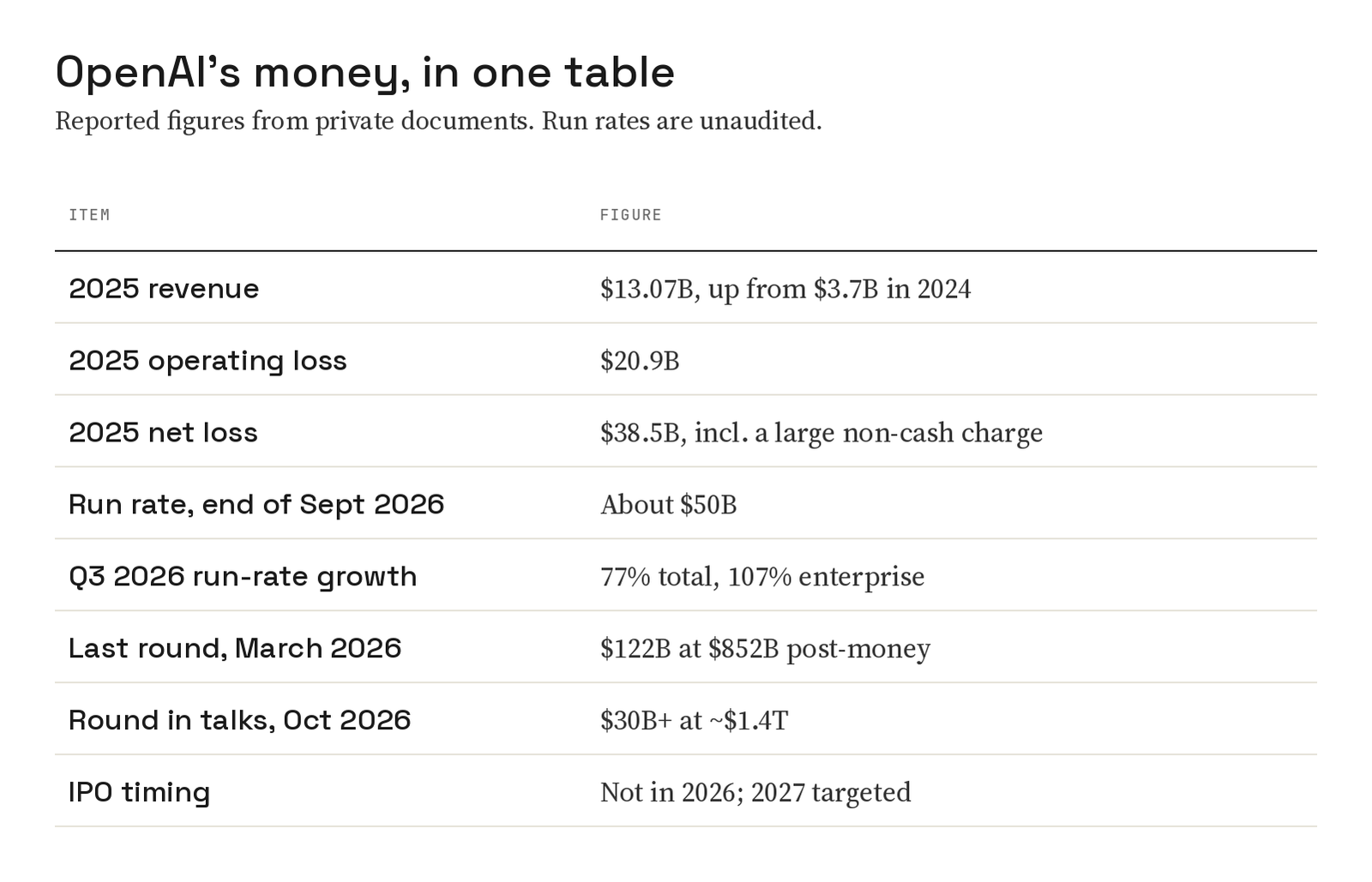
That bill is why OpenAI funding never stops. OpenAI closed a $122 billion round at an $852 billion post-money valuation on March 31, 2026, a raise that was supposed to be its last before going public. By late September it was back in talks to raise at least $30 billion more, Bloomberg reported. CFO Sarah Friar told CNBC the company remains well capitalized.
Sources for this section
What the gap means for the OpenAI IPO and OpenAI valuation
OpenAI confidentially filed for an IPO in June, according to CNBC, but Sam Altman has ruled out a 2026 listing. Executives are now targeting a 2027 debut. That means the OpenAI IPO date is at least a few months away, and the next private round sets the price investors will anchor to.
That round is where the $20 billion matters most. Bloomberg reported that OpenAI is seeking $30 billion or more at a valuation of about $1.4 trillion. At a $70 billion run rate, that is about 20 times revenue. At $50 billion, it is 28 times. Same company, same price, a very different multiple.
OpenAI's answer, shared with investors and reported by Bloomberg on October 9, is that it still expects a run rate of $70 billion or more by year-end, on its own accounting. If it gets there, the selloff will look like a bad day over a definitions fight. If it falls short, the OpenAI valuation conversation shifts from how high it can go to whether OpenAI is, as the title of a PitchBook Q4 note puts it, "priced on a target it has not hit."
The comparison US investors will make next is Anthropic, which Bloomberg says could go public as soon as November. A public Anthropic with audited numbers would give the market its first clean benchmark for what a frontier lab is worth, and OpenAI would be priced against it.
Sources for this section
Why CoreWeave stock fell hardest
The October 8 selloff was sharpest in the companies that carry OpenAI's commitments on their own balance sheets. CoreWeave reported a $104.2 billion backlog at June 30, and roughly $22.4 billion of that is tied to OpenAI, according to its results. Its largest single customer fell from 72% of revenue in early 2025 to 36% in the second quarter of 2026, but the market still treats CoreWeave stock as a bet on OpenAI paying its bills.
Oracle sits in a similar spot, with large, multiyear cloud contracts to build capacity for OpenAI. Nvidia fell least among the big names because its customer base is wider, though OpenAI demand flows to it through Microsoft, Oracle and CoreWeave.
This is the transmission channel we flagged in our AI bubble report: if the revenue at the top of the stack looks softer than expected, the pain shows up first in the companies that borrowed to build capacity for it. October 8 was a small, clean test of that idea. The number did not even change the business, only the label on it, and the suppliers still sold off.
The counterpoint is strong too. A 77% quarterly jump in run rate is not what a collapsing business looks like, and enterprise demand more than doubled. The AI bubble case is not that demand is fake. It is that the spending has been sized for growth that has to keep coming, at prices that leave little room for a miss.
Sources for this section
What to watch before the OpenAI IPO
- Whether OpenAI hits a $70 billion run rate by December 31 on its own net accounting, and whether it says so publicly.
- Terms of the $30 billion-plus round: the final valuation, and whether it closes at the reported $1.4 trillion or lower.
- Anthropic's IPO timing. A public filing with audited numbers sets the benchmark OpenAI will be priced against.
- CoreWeave and Oracle earnings commentary on OpenAI contracts, backlog and financing costs.
- Any move by OpenAI to publish revenue on a consistent basis. One clear number would do more for its IPO than another high one.
Sources
Brian Weerasinghe is the founder and editor of AI Eating The World, where he covers artificial intelligence, tech companies, layoffs, startups, and the future of work. His reporting focuses on how AI is transforming businesses, products, and the global workforce. He writes about major developments across the AI industry, from enterprise adoption and funding trends to the real-world impact of automation and emerging technologies.