Image: Flickr / Wikimedia Commons / Unsplash
Answer Engine Optimization Now Means Covering the Searches You Never See
Google's own research describes how AI search splits one prompt into many smaller queries. A rankings report only shows you the first one.
Image: Flickr / Wikimedia Commons / Unsplash
This article contains an affiliate link. AI Eating The World may earn a commission on qualifying purchases, at no extra cost to you.
AI search engines break each prompt into several background searches before they answer. Here's how query fan-out works, why AI visibility reports miss the sub-queries that decide answers, and how to plan content around them.
Google put query fan-out on paper
Answer engine optimization has mostly been judged by one outcome: did ChatGPT or Google's AI answer mention you for the prompt you care about? That outcome sits at the end of a longer process. Before an AI system answers, it often splits the prompt into a batch of smaller searches, reads what comes back and builds the answer from those results. Google has now published research on how it generates those searches, and the hidden step deserves more attention than it gets.
On September 15, 2026, Google Research described Retrieve-for-Train, a method for producing query fan-outs, the related sub-queries a system issues from one request. Its example is a search for camping gear. A useful result set covers a tent, a sleeping bag, a stove and a headlamp, where a naive system returns ten versions of the same tent. Google trains a larger model with reinforcement learning to write sub-queries that match real items in the index, differ from one another and stay tied to the original request. It then distills that behavior into a 53.9 million parameter diffusion model that writes the whole set in one pass, which Google says runs 12 to 20 times faster than generating sub-queries step by step.
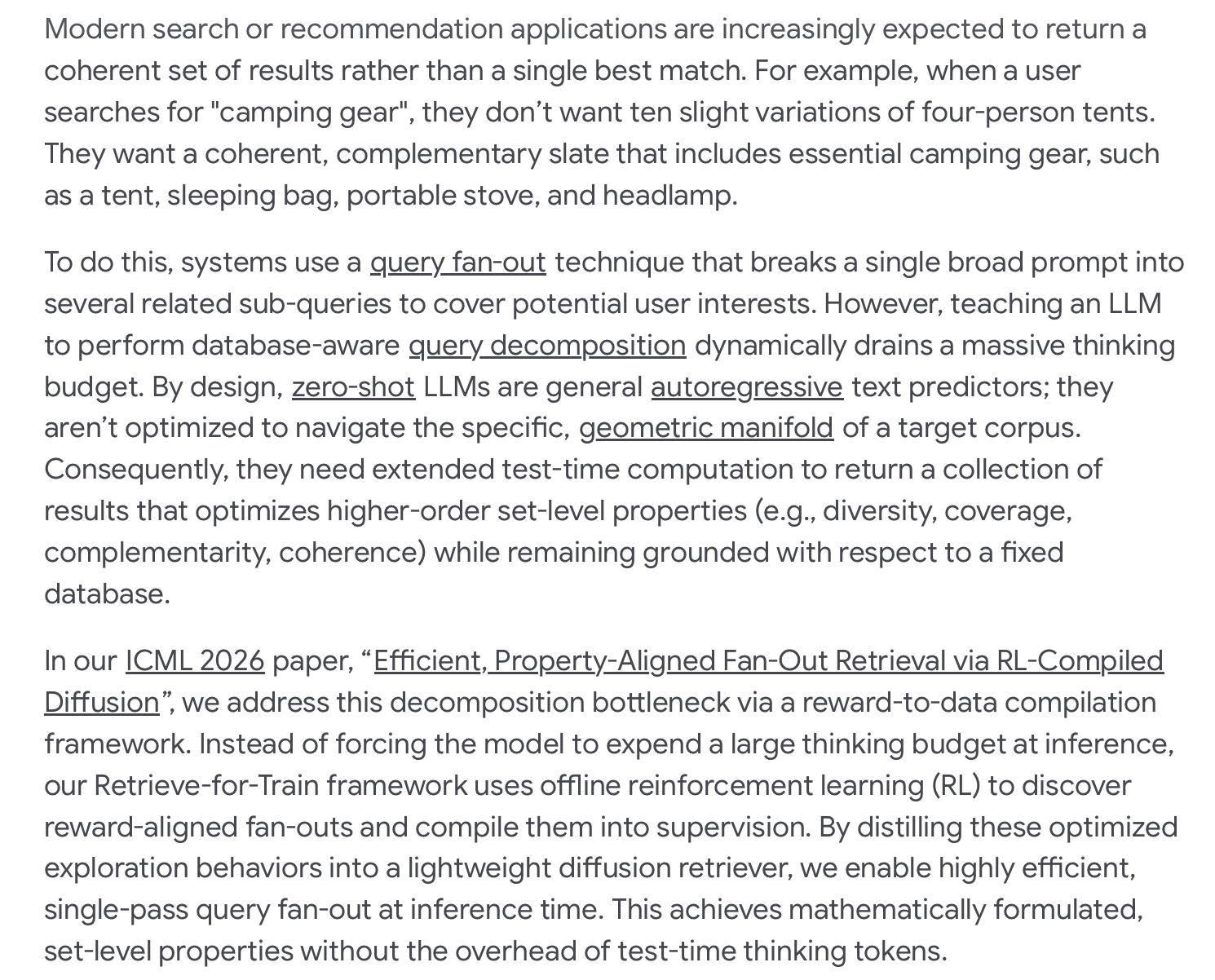
Search Engine Journal's Roger Montti noted that Google hasn't said this method is live in Search, and the paper itself asks for bias audits before deployment. The underlying idea is already in production, though. Google has described AI Mode as a fan-out system since its 2025 launch, and its Search Central documentation says AI Overviews and AI Mode may use the technique to build a response. A faster, cheaper fan-out is one Google can afford to run on more searches.
What the searches behind a prompt look like
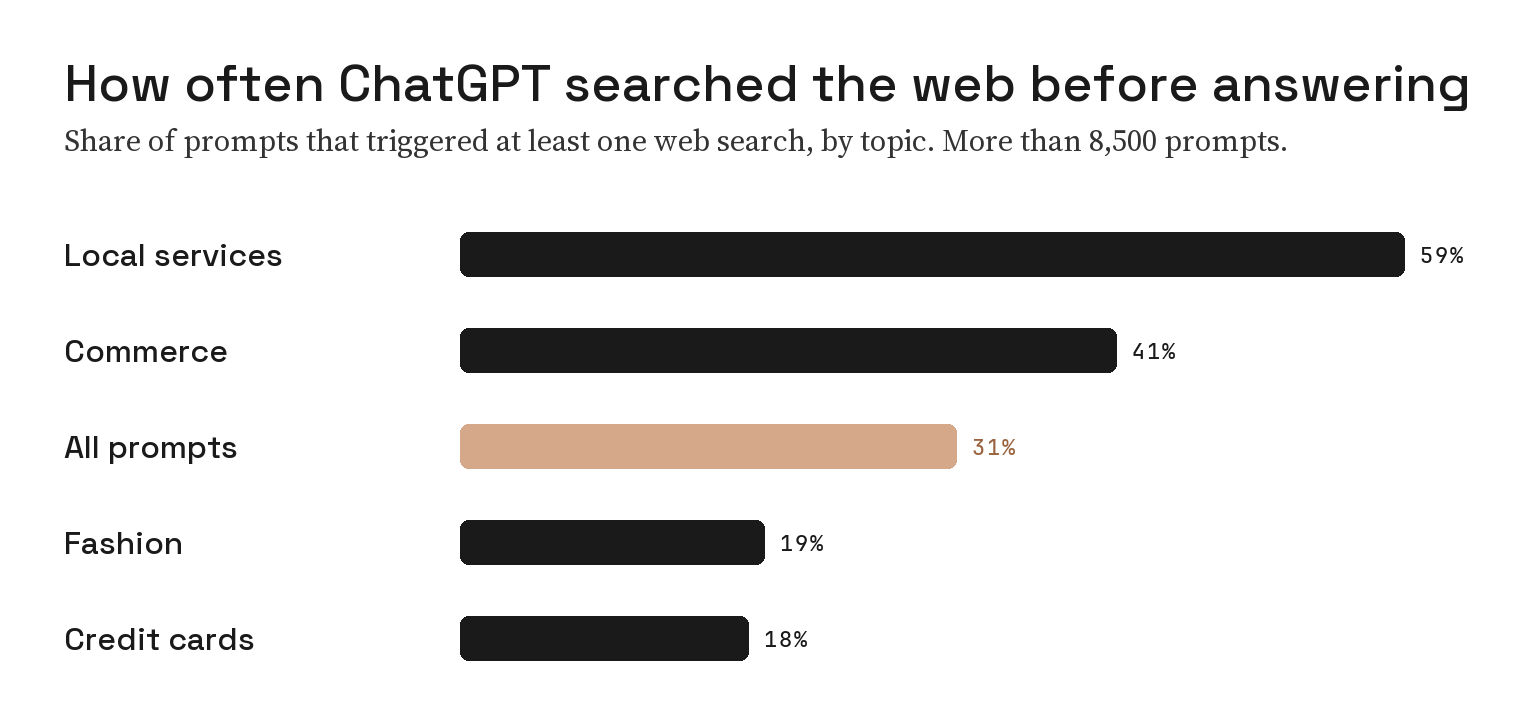
Nobody outside Google or OpenAI sees the full list of sub-queries, but researchers have logged the ones ChatGPT exposes. Nectiv, a search agency, analyzed more than 8,500 prompts across nine industries in late 2025. About 31% triggered at least one web search, and those averaged 2.17 searches each. The queries averaged 5.48 words, against roughly 3.4 words for a typical US Google search.
The rate swung by topic. Local service prompts triggered a search 59% of the time and commerce prompts 41%, while fashion and credit card prompts sat below 20%. The prompts closest to a purchase or a booking were the ones most likely to send the model out to the web.
Treat those numbers as a floor. ChatGPT's search behavior has changed several times since that study, and after its August 8 model update it was running roughly 70% more background searches per answer, as we covered in our piece on shifting ChatGPT citations. Google says the average Google AI Mode query is now about three times the length of a traditional search, and that AI Mode passed one billion monthly users in May.
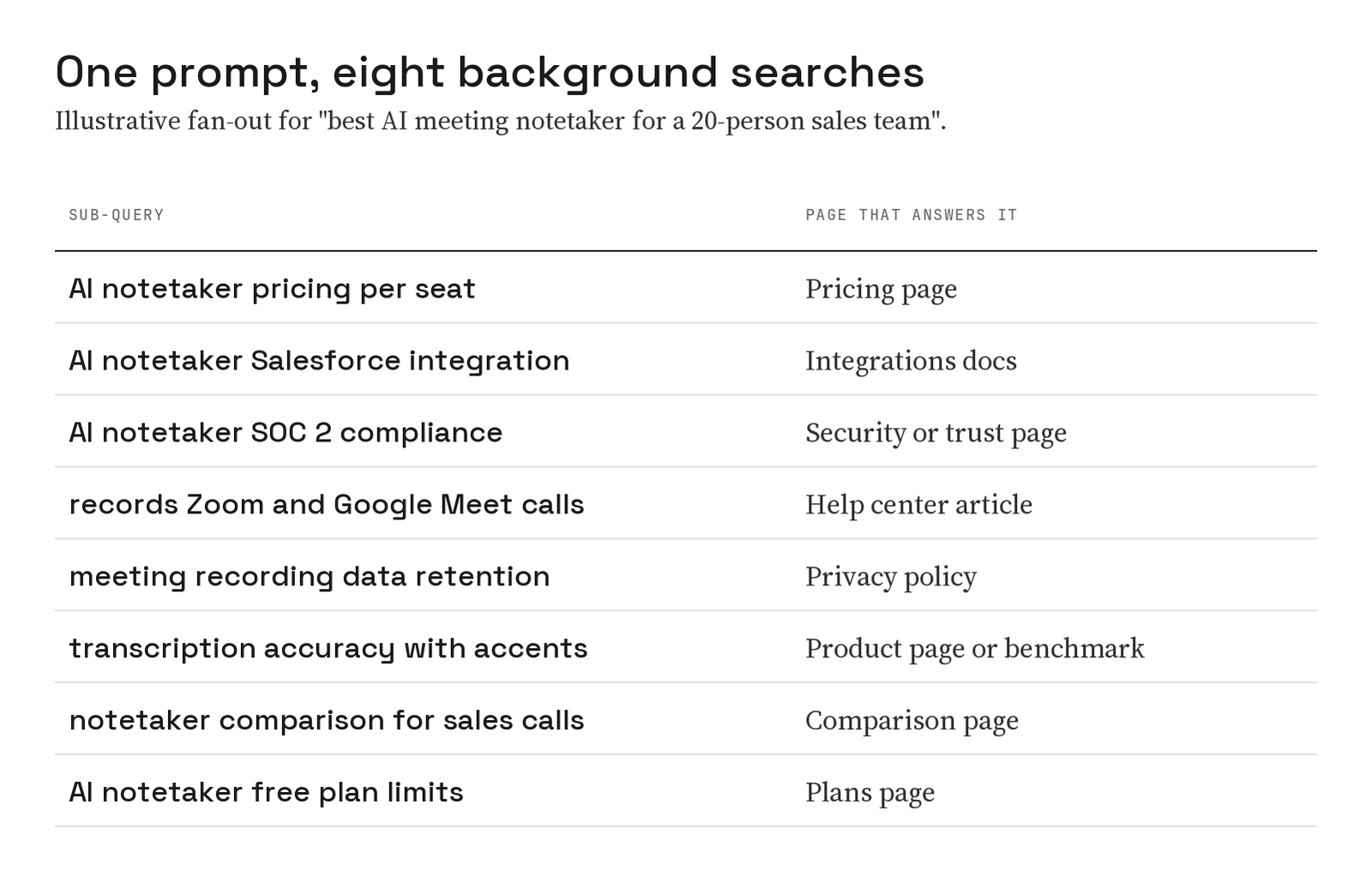
Look at the fan-out queries ChatGPT does show and most of them are plain. A prompt like "best AI meeting notetaker for a 20-person sales team" could reasonably break into searches about price per seat, CRM integrations, security certifications, data retention and head-to-head comparisons. Each is an ordinary search with a factual answer, and each maps to a page a vendor can publish.
Why AI visibility reports miss the losses
Most AI visibility reporting still tracks the headline prompt and the final citation. Both are outputs, and neither shows which background searches your site failed to answer.
Retrieval and citation are separate steps. A system can pull your page into its pool of candidates and still credit a review site. A page that never matches a sub-query never enters the pool at all, and in that case nothing in Search Console or your rank tracker moves. The buyer still gets an answer about your pricing or your security posture. It comes from a comparison site, a Reddit thread or a competitor's page instead.
This matters most for US B2B software companies, because their buyers ask the exact questions fan-out produces: price per seat, SOC 2 status, Salesforce sync, contract terms. When those facts live in a sales deck, a gated PDF or behind a "contact us" form, the model has to find them somewhere else. LLM visibility for a brand often comes down to whether its own site answers those small questions in plain text.
An AI search optimization workflow built on sub-questions
Plan around a prompt and the questions it's likely to spawn, instead of one target keyword per page. Start with 10 to 20 prompts that matter commercially, the ones a buyer types when they're close to choosing. For each, write down what a model would need to settle before recommending anyone: price, fit for company size, integrations, compliance, setup time and alternatives. Real prompt data beats guessing here, and the next section covers where to get it.
Then audit coverage. For every sub-question, find the URL on your site that answers it in plain HTML text, with a date and specific numbers, and mark it covered, partial or missing. Expect the gaps to cluster around detailed pricing, security documentation and honest comparison pages, which are the topics companies tend to keep off their sites.
Fill the gaps with pages or sections that answer one question each, in the first two sentences. Google's guidance for AI features says there's no special markup or extra requirement for AI Overviews or AI Mode, so the usual rules for crawlable, useful content apply. Check that AI crawlers can reach the new pages, too. Our crawler access checklist covers the firewall settings that block them without anyone noticing.
Finally, measure per prompt over time. One answer moves around too much to grade anything. The useful signal is whether AI search visibility and citations for a fixed prompt set rise in the weeks after you fill a gap.
Sources for this section
Finding the real prompts with AI visibility tools
Guessing at sub-questions is where most teams stall, so this is where I'd bring in data. Semrush's AI Visibility Toolkit has a Prompt Research report that works like keyword research for AI search. Enter a topic and it returns related topic clusters with an estimated AI volume, an intent breakdown, the brands mentioned in answers and the domains cited as sources. It draws on a database of more than 300 million AI queries across ChatGPT, Google AI Overviews, AI Mode and Gemini.
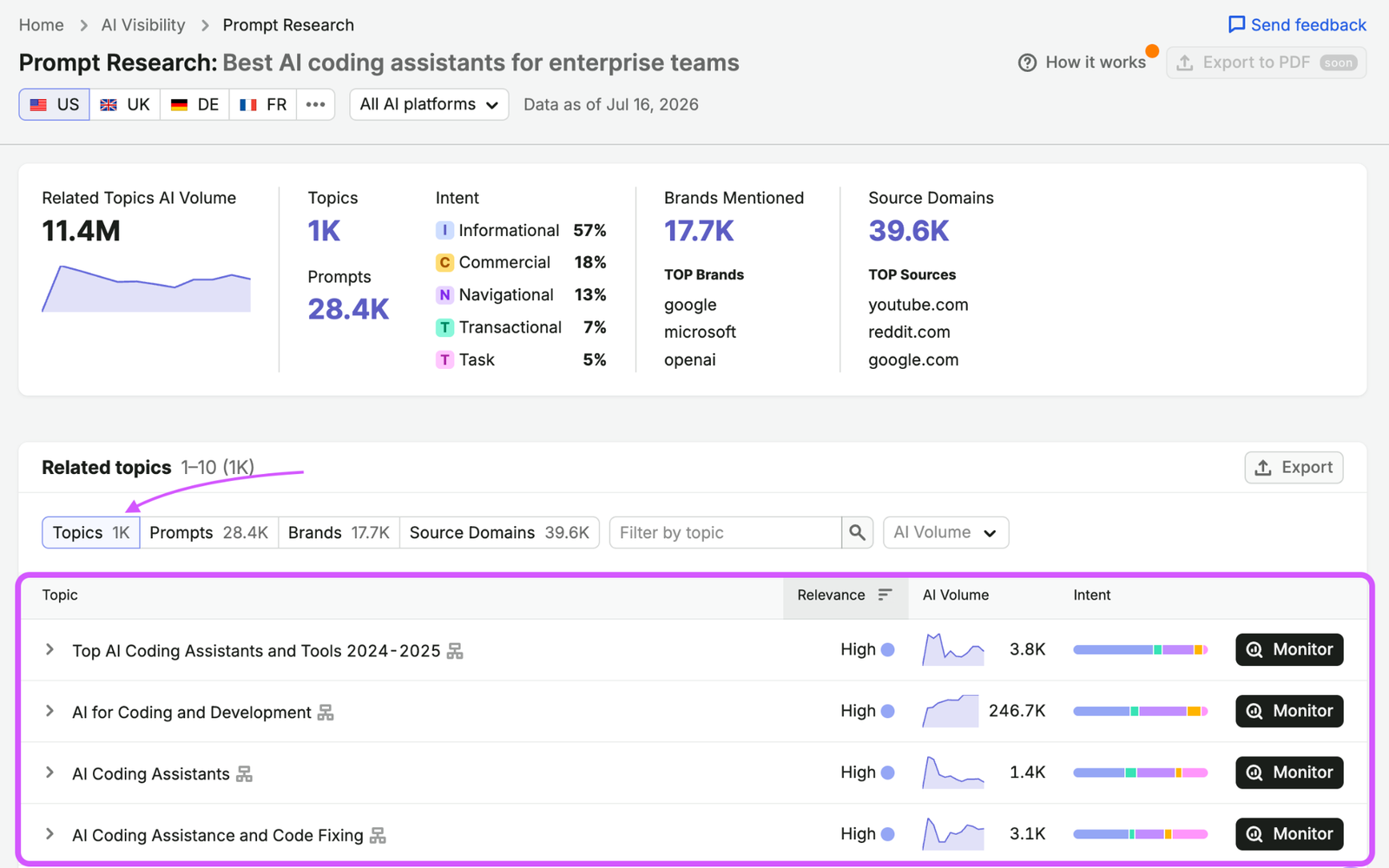
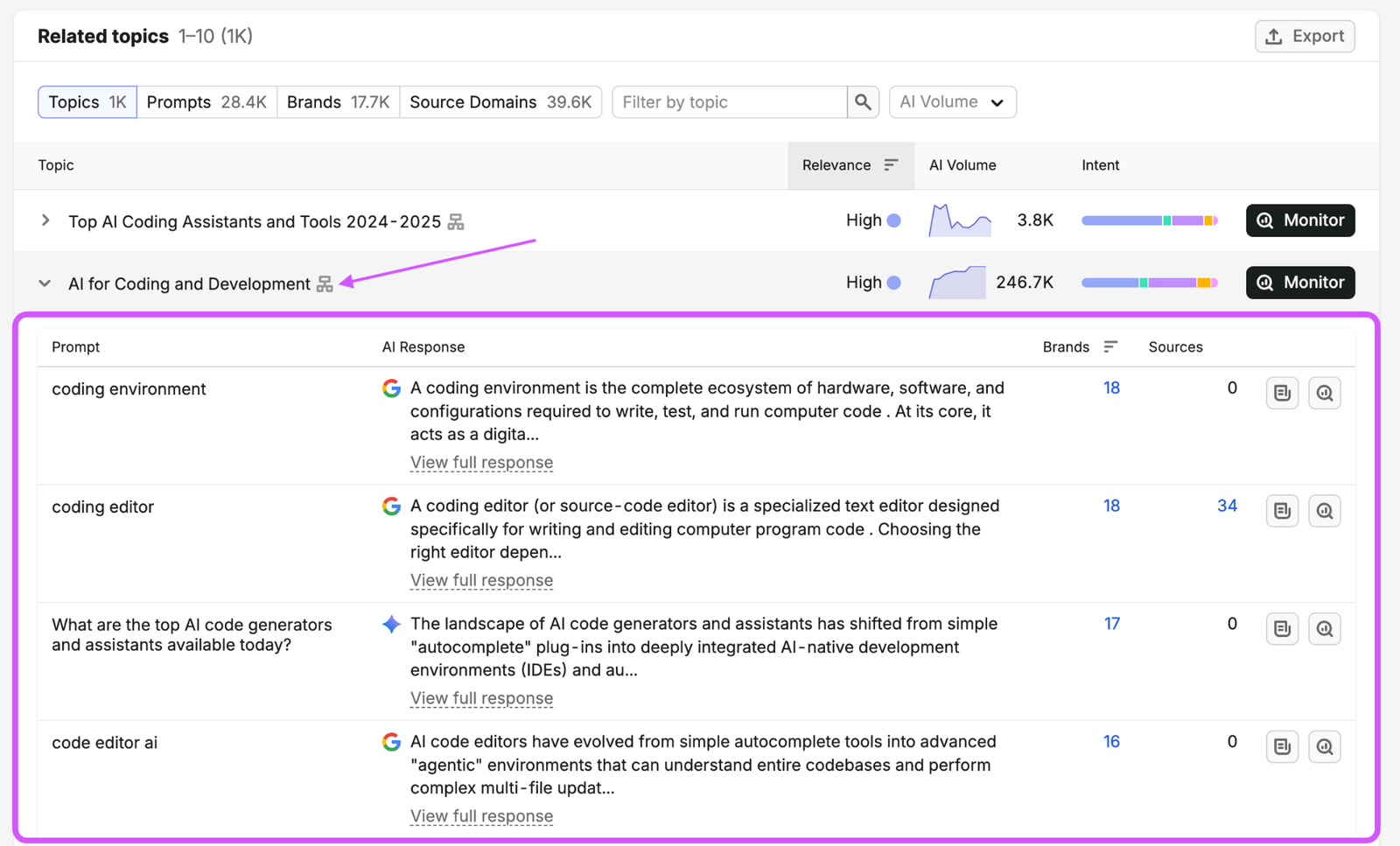
Open a topic and you get the individual prompts inside it, each with the AI response and the number of brands and sources it drew on. That's about as close as you can get to the sub-question map from the previous section without access to a model's logs. Prompts that mention plenty of brands but never yours belong at the top of your gap list.
The SEO Toolkit covers the classic search side, which matters because many fan-out queries run against an ordinary web index. Keyword Magic Tool's Questions filter pulls the question-style searches around a seed term, and its topic groups make it quick to spot clusters your site has never touched. Topic Research adds the subtopics and questions people raise around a subject, which is a good way to sanity-check the list you built by hand.
Sources for this section
Tracking fan-out coverage in Semrush One
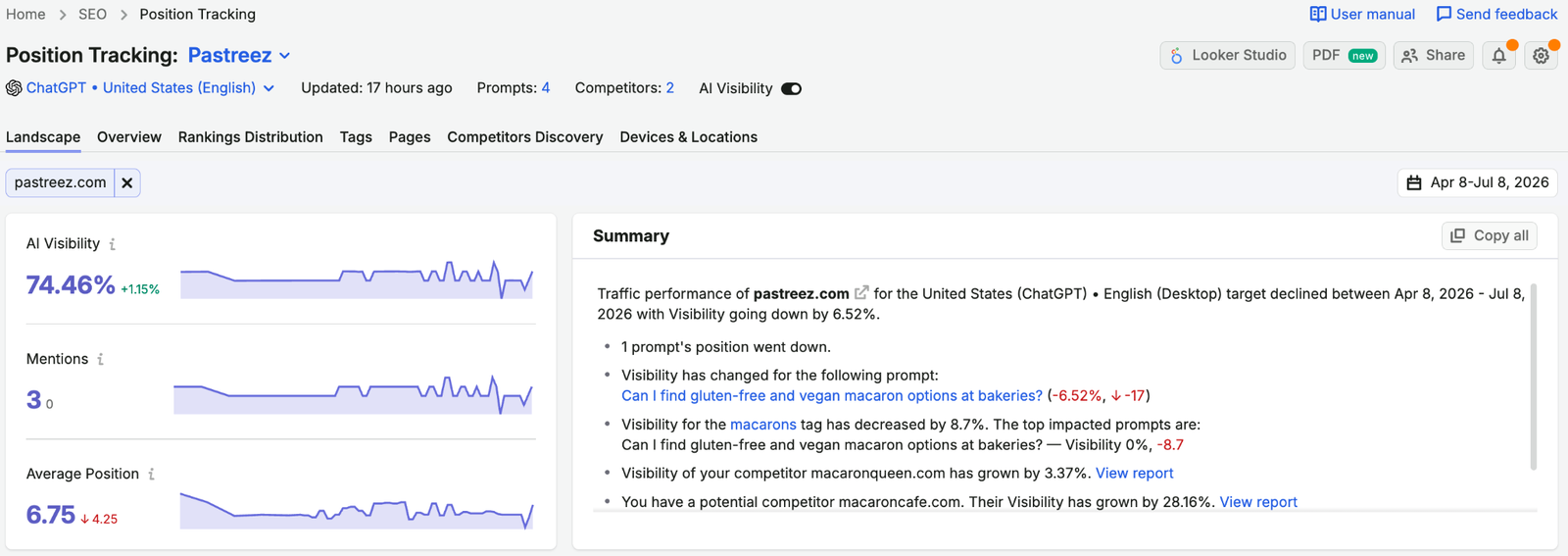
Once the pages exist, Prompt Tracking turns coverage into a number you can report. It reruns a fixed set of prompts every day on ChatGPT, Google AI Mode and Gemini, and records AI visibility, brand mentions and average position, along with a written summary of which prompts and competitors moved.
The Sources tab answers the retrieval question. It lists every domain and URL the AI platforms cited for your tracked prompts, how many prompts each one was cited for and how often your brand appeared alongside it. If a third-party page keeps getting cited for your pricing prompts and your own pricing page doesn't, you know which page to fix and which publication is worth pitching.
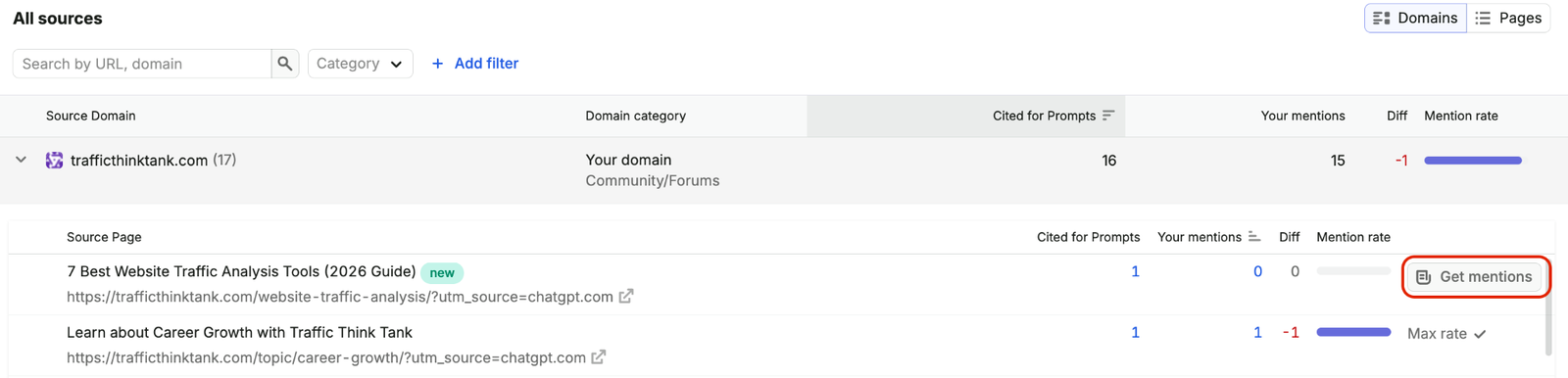
Semrush One bundles the AI Visibility Toolkit with the SEO Toolkit, so prompt data, question keywords, rankings and site audits live in one account. A week is enough to run Prompt Research on your three biggest topics, start daily tracking on your money prompts and see which sources AI answers already trust in your category.
Sources for this section
More on AI search from AETW
Sources
Brian Weerasinghe is the founder and editor of AI Eating The World, where he covers artificial intelligence, tech companies, layoffs, startups, and the future of work. His reporting focuses on how AI is transforming businesses, products, and the global workforce. He writes about major developments across the AI industry, from enterprise adoption and funding trends to the real-world impact of automation and emerging technologies.