Image: Flickr / Wikimedia Commons / Unsplash
AI Citations Are Link Building's New KPI. Most SEO Teams Can't Track Them Yet
Clients now want proof that links lead to ChatGPT and AI Overview citations. Here's how to vet placements and build a report that shows it.
Image: Flickr / Wikimedia Commons / Unsplash
This article contains an affiliate link. AI Eating The World may earn a commission on qualifying purchases, at no extra cost to you.
79.3% of SEO leaders have been asked to make AI citations a link building KPI, but only 21.6% track them. Here's how to vet links on relevance and traffic and log which placements actually get cited.
The AI citations KPI showed up before the tracking did
For most of the last decade, a link building report came down to two things: how many links you earned and how strong the linking sites looked. Clients and executives have started asking a third question: did any of these links earn us AI citations in ChatGPT or Google's AI Overviews?
uSERP's State of Backlinks Report 2027, published in September 2026, surveyed 116 SEO professionals, 47% of them at Director or Head of SEO level, and the numbers show how fast that question arrived. 79.3% have been asked by a client or leader to make AI citations a KPI. Only 21.6% track them as a core KPI. Another 51.7% track them informally, which in practice often means someone types a few prompts into ChatGPT before a quarterly review and screenshots the answer. 16.4% don't track them, and 10.3% haven't started yet.
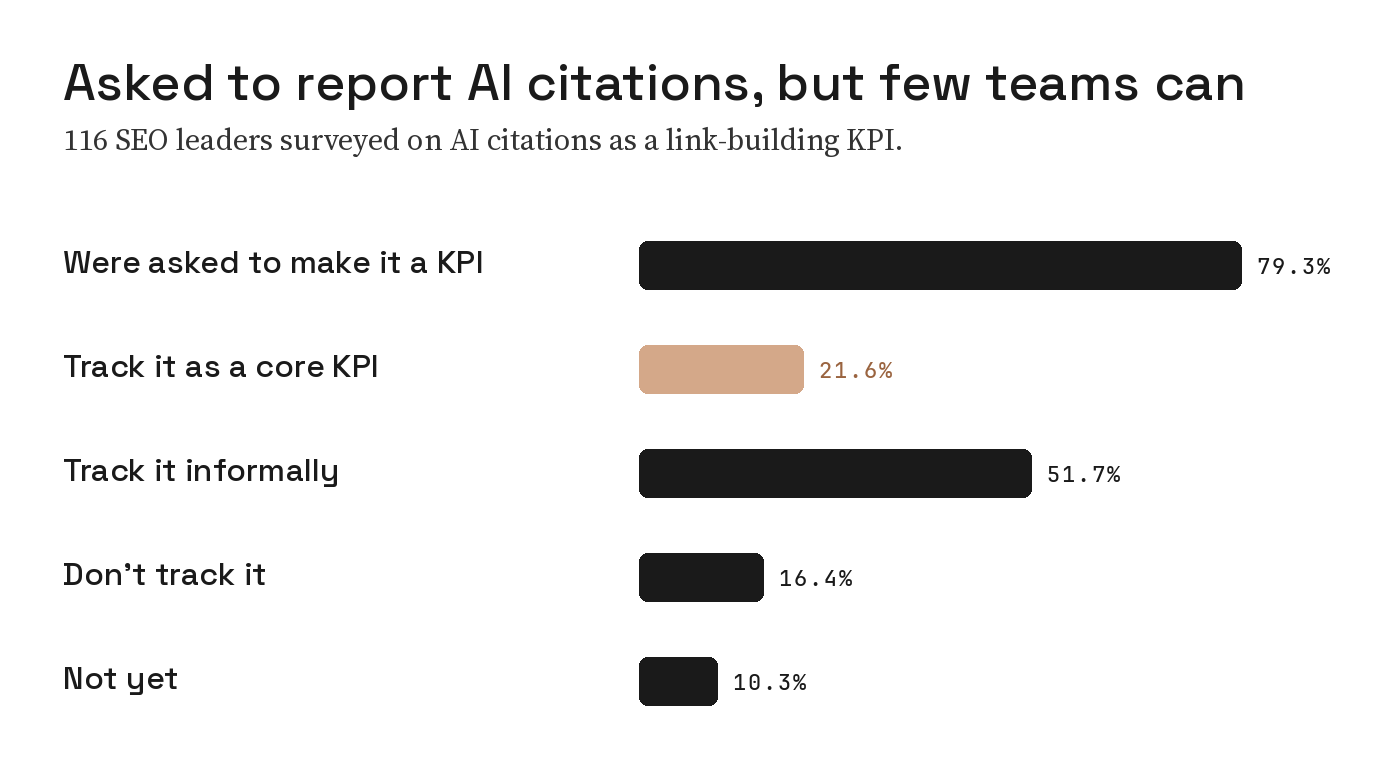
Most of them already believe the connection is real. 81.9% think backlinks influence whether AI engines cite a brand, and 46.6% say they have watched a backlink lead to an AI citation, with before and after evidence. A belief and a few remembered wins are hard to defend in a renewal meeting, though. For US agencies and in-house teams that sell link building on a monthly retainer, the distance between what leadership asks for and what the team can show is turning into a budget problem.
Links themselves aren't going anywhere. 87.1% of the same leaders said they would keep building links even if Google stopped using them as a ranking signal. What's changing is how teams judge backlinks for SEO and AI search, and the evidence they need to defend each one.
Sources for this section
Why authority scores stopped settling link building arguments
Asked for the single deciding factor when vetting a link, 58.6% of SEO leaders picked topical relevance. Real organic traffic came second at 13.8% and AI citation frequency third at 12.1%. A domain authority score, the number that opened almost every outreach conversation for years, came last at 11.2%.
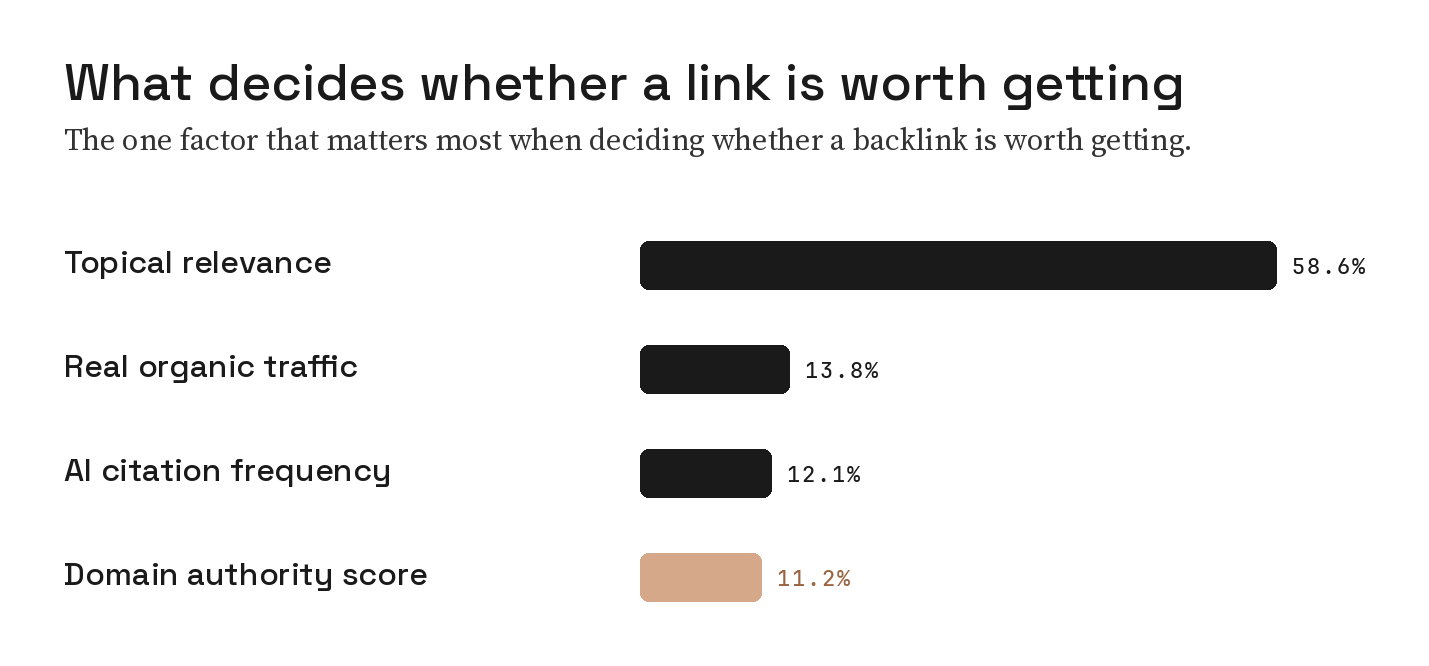
Relevance and traffic win because of how AI answers get built. ChatGPT search, Perplexity and Google's AI features pull pages at the moment someone asks, and they lean on pages that already rank and get read. Google's documentation says a page only needs to be indexed and eligible to show a snippet to appear as a supporting link in AI Overviews or AI Mode, with no extra technical requirements. A site with a strong authority score and almost no organic traffic is usually a site search engines have chosen not to show much. Pages that rarely get shown rarely get retrieved, so a link sitting on one has little chance of being read by a model.
Respondents are already walking away from the tactics that chase that number. Asked which link building tactic that worked two years ago is now dead or dying, the 67 who answered most often named guest posting (19.4%), buying placements and paid links (17.9%) and PBNs (16.4%).
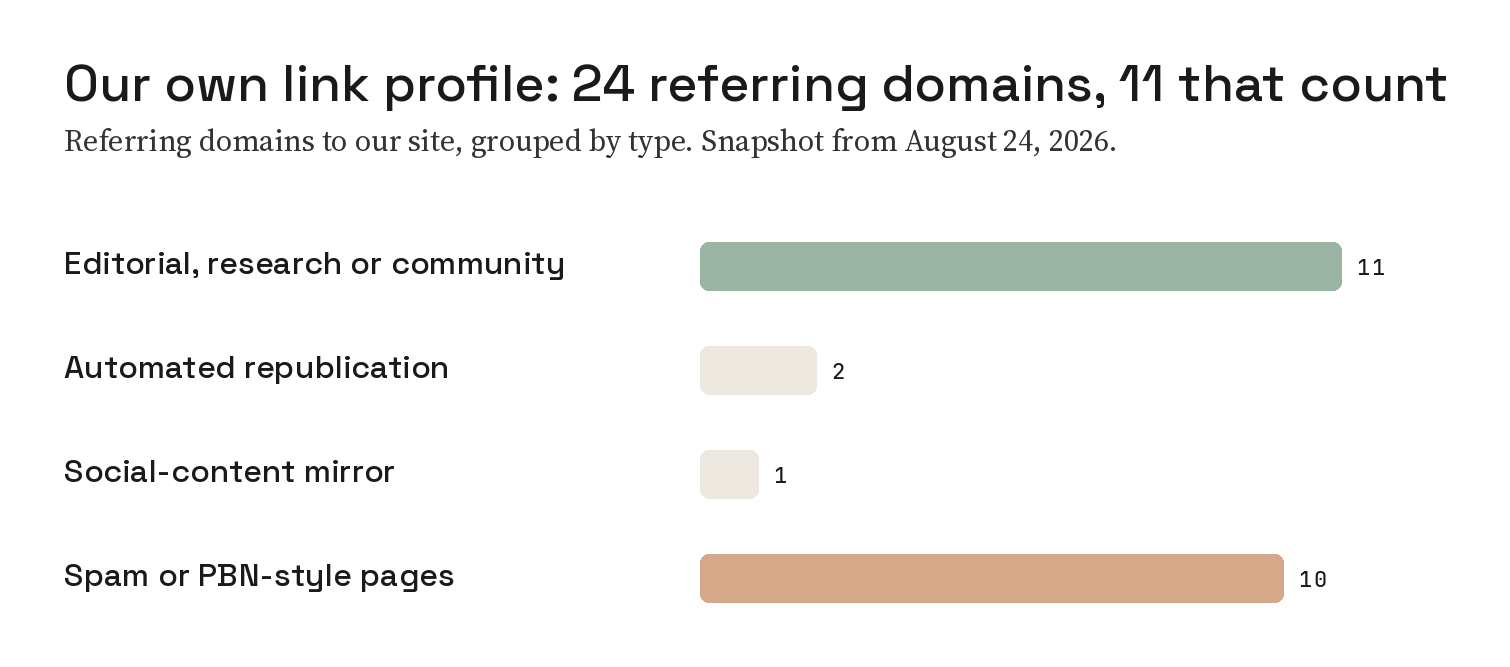
We saw the same thing in our own profile. When we audited the links pointing to AI Eating The World in August 2026, a backlink index counted 24 referring domains. After we classified each one by hand, 11 were real editorial, research or community references. Ten were obvious spam or PBN-style pages that linked to us without anyone asking. The raw count said our link profile had roughly doubled in a month. Read properly, about half of it would never be visited by a person or quoted by a model.
Sources for this section
Digital PR and brand mentions now do the job guest posts used to
The tactics follow the same logic. 53.4% of respondents say digital PR delivered their strongest results in the last 12 months. Guest posting went the other way: 40.5% named it the tactic with the biggest gap between how widely it's used and how well it works. Digital PR tends to put a brand inside pages people actually read, like reporting, data stories and expert roundups, and those are the pages AI systems tend to retrieve.
Outside research points the same way. Muck Rack's Generative Pulse report, which analyzed more than 25 million links cited by ChatGPT, Claude and Gemini, found that earned media made up 84% of AI citations in its May 2026 edition. Paid and advertorial content made up 0.3%.
That gives link builders a sharper brief. A full paragraph about your product, with a link, on a page that ranks for your category gives a model something specific to quote. A one-line insertion or a footer link on a page nobody visits gives it very little. Bought placements carry their own risk: Google's spam policies treat links bought for ranking purposes as link spam unless they carry rel="sponsored" or rel="nofollow", and 35.3% of uSERP's respondents paid for, or approved payment for, a sponsored backlink in the past year.
How to track AI citations from each link placement
Tracking AI citations doesn't need a research team. It needs a fixed set of prompts, a baseline taken before a placement goes live, and someone who checks the same prompts on a schedule. The log below is the minimum we'd keep for every placement.
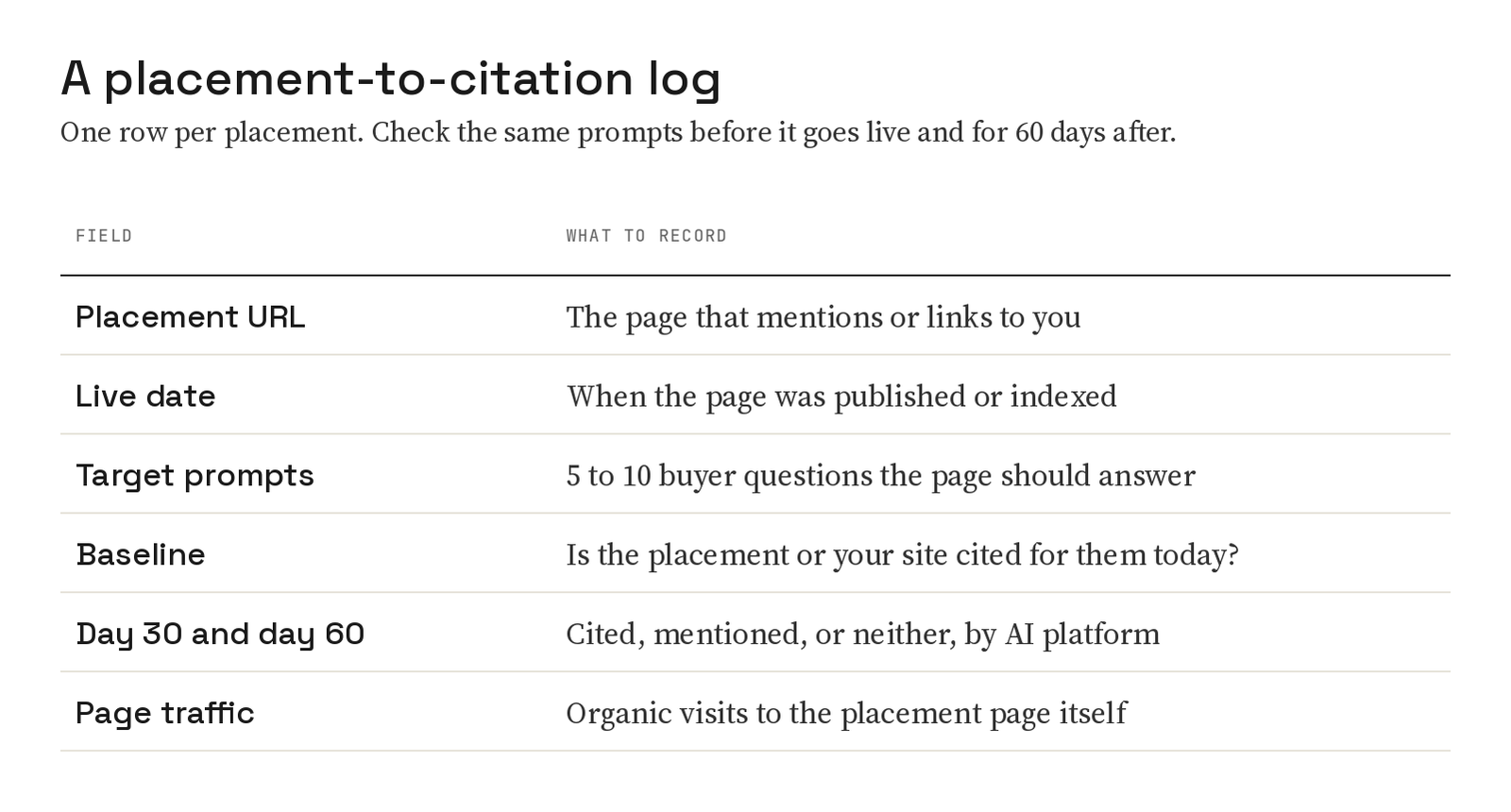
A log like this turns "we think the link worked" into a line a client can check: this page went live on this date, and this prompt cited it six weeks later. It also shows which placements did nothing, which is how you stop paying for more of them. Here's the routine a small agency or a one-person SEO team can run:
- Write down 20 to 50 prompts per client that a real buyer would type, grouped by topic, before any outreach starts.
- For each prompt, record which domains and pages AI answers cite today. That's your baseline, and it doubles as a prospect list, since sites already cited for your topic are the first ones worth pitching.
- Vet each prospect on topical relevance and real organic traffic, and check the specific page you'd appear on as well as the domain.
- Log every placement with its URL, live date and the prompts it should influence.
- Re-run the same prompts at 30 and 60 days and note whether the placement page, your own site or neither got cited.
- Report placement, prompt and citation together, next to rankings and clicks, and keep placements with no outcome yet in a separate column.
Measuring link building and AI visibility in Semrush One
Doing this by hand works for one client and a dozen prompts. Past that, the 30-day check-ins start getting skipped, and that's where AI visibility tools earn their cost. Semrush One bundles the Semrush SEO Toolkit and the AI Visibility Toolkit in one plan, which covers both halves of the routine: vetting and auditing links, then seeing whether they show up in AI answers.
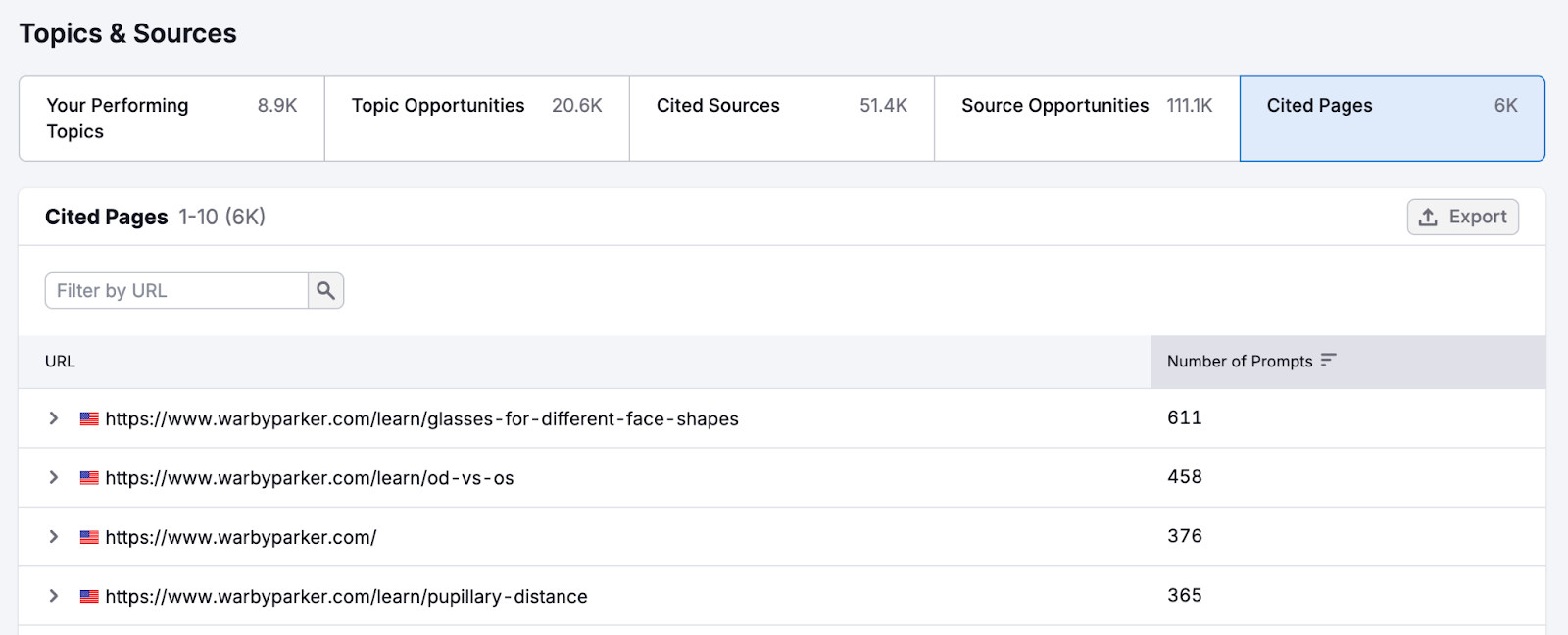
On the AI side, Prompt Tracking runs your prompt set on a schedule and records whether your brand is mentioned and which sources each answer cites, on the AI platforms you choose. The Visibility Overview report in the AI Visibility Toolkit adds a Topics & Sources table, and its Cited Pages tab lists which of your own URLs AI answers draw on and for how many prompts. For a link builder, that's the before and after view: you can see whether the page you were trying to support starts showing up.
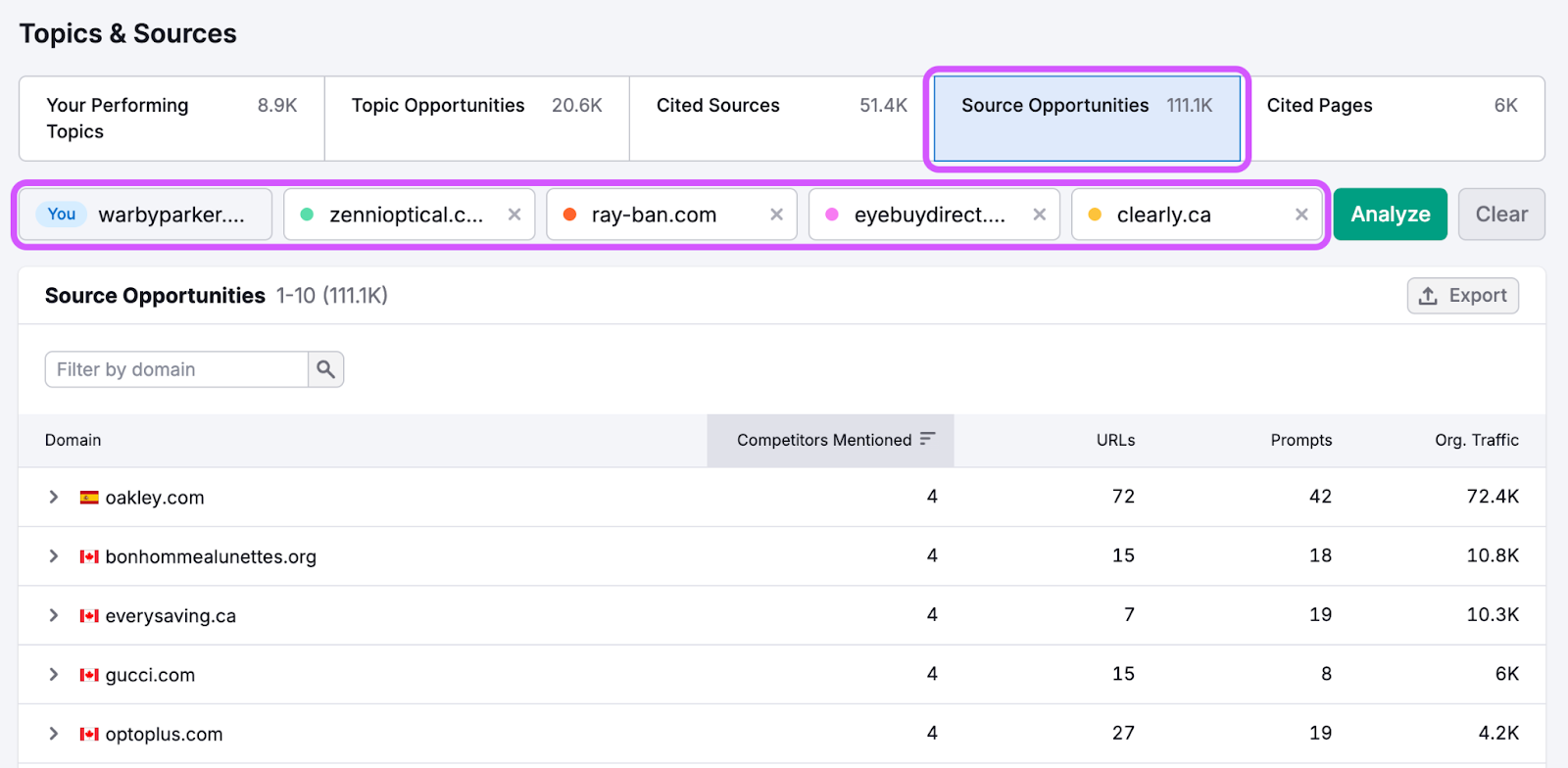
The Source Opportunities tab is the one to hand your outreach team. It lists domains that AI answers cite when they mention your competitors but not you, with how many competitors each domain mentions, how many prompts it shows up for and its organic traffic. Those are pages AI already reads for your topic, which makes them a better starting prospect list than any authority-score filter.
Over time, the same report charts your AI visibility against competitors, so a placement that works shows up as a movement in a trend line instead of a one-off screenshot. Brand Performance adds share of voice and sentiment, which helps you compare what a full feature in a trade publication did against a one-line mention elsewhere.
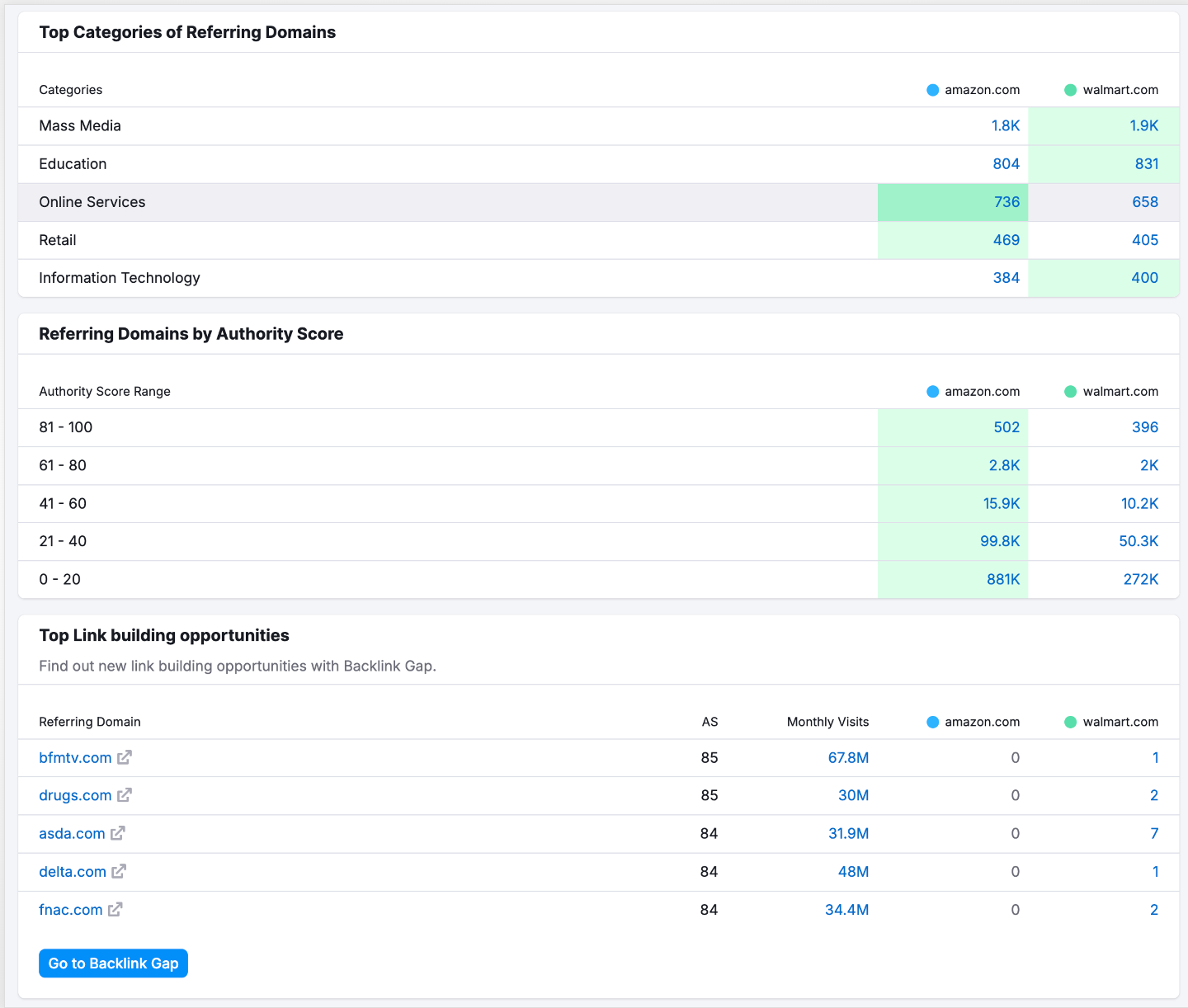
On the SEO side, the Backlink Analytics overview covers vetting. It breaks a domain's referring domains down by category and Authority Score, and its link building opportunities widget lists sites that link to a competitor but not to you, with each site's monthly visits next to its score. That puts relevance and real traffic in front of you before you pitch anyone.
Backlink Audit handles the cleanup. It scores every link you've earned against more than 45 toxic markers, including signs of link networks such as shared analytics IDs and mirrored pages, and splits your profile into toxic, potentially toxic and non-toxic links. Run it on a schedule and a batch of spammy placements shows up in a weekly audit instead of at renewal time.

If you're the one who has to answer "which of these links got us cited?" at the next renewal, Semrush One runs the whole loop in one place, from vetting a prospect to seeing the citation it earned. Start the 7-day free trial, load your prompt set, and take your baseline before your next placement goes live.
Sources for this section
What to bring to the next renewal meeting
- Leadership demand for AI citation reporting is running well ahead of most teams' tracking. The teams that close that gap first will have the easier budget conversations.
- Topical relevance and real organic traffic now beat authority scores for vetting links. Check the page you'll appear on as well as the domain.
- Earned media makes up most AI citations in Muck Rack's data, so digital PR and full brand mentions deserve a larger share of the link budget than guest posts.
- A baseline taken before each placement is what turns a citation into proof.
- AI citation patterns shift when models change, so judge placements on trends over several weeks, never on a single answer.
Sources
Brian Weerasinghe is the founder and editor of AI Eating The World, where he covers artificial intelligence, tech companies, layoffs, startups, and the future of work. His reporting focuses on how AI is transforming businesses, products, and the global workforce. He writes about major developments across the AI industry, from enterprise adoption and funding trends to the real-world impact of automation and emerging technologies.