Image: Flickr / Wikimedia Commons / Unsplash
Before You Renew a Link Building Agency, Audit What It Actually Built
SEO leaders now rank authority scores last when they vet links. Here's a six-check audit for every placement your vendor delivered, and the reports that make it quick.
Image: Flickr / Wikimedia Commons / Unsplash
This article contains affiliate links to Semrush. AI Eating The World may earn a commission on qualifying purchases, at no extra cost to you.
Only 11.2% of SEO leaders say an authority score decides whether a link is worth it. Here's how to audit a link building agency's placements for traffic, relevance, PBN risk and AI citations before you renew.
The questions a link building agency should expect at renewal
If you pay a link building agency every month, the report you get back probably leads with a count of links and an authority score for each linking site. Those numbers are easy to produce and easy to inflate. The people who run SEO programs have mostly stopped trusting them.
uSERP's State of Backlinks Report 2027, a survey of 116 SEO professionals published in September 2026, asked what single factor decides whether a link is worth getting. 58.6% said topical relevance. Real organic traffic came next at 13.8%, and a Domain Rating or Domain Authority score came last at 11.2%. 62.9% said those scores aren't a primary factor in a link's return at all.
That doesn't mean link building stopped working. It means the evidence an agency owes you has changed. Before you renew, it's worth checking what the last six months of placements actually are: whether they still exist, whether anyone reads the pages, and whether those pages show up anywhere that matters, including AI answers.
Sources for this section
The tactics SEO leaders have written off
The same survey asked which link building tactic that worked two years ago is now dead or dying. Of the 67 people who answered, the most common replies were guest posting, paid links and placements, and PBN links, the private blog networks built to pass ranking value.
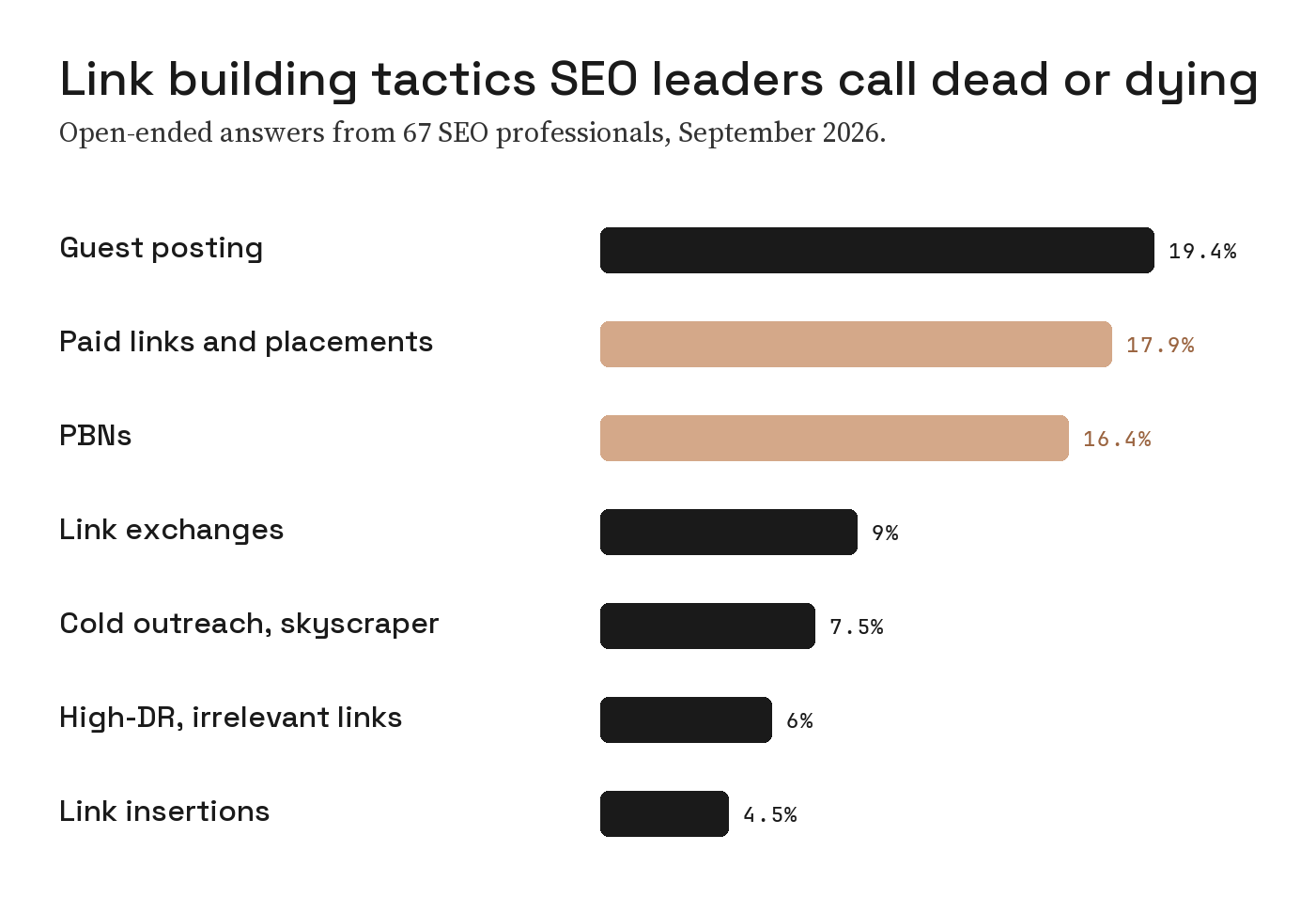
Guest posting stands out for another reason. 40.5% of respondents named it the tactic with the biggest gap between how widely it's used and how well it works, more than three times the next answer. Yet buying is still common: 35.3% said they had paid for, or approved payment for, a sponsored backlink in the past year.
Paid links aren't banned outright. Google's link spam policy allows them if they're labeled with rel="sponsored" or rel="nofollow". The risk sits in unlabeled placements sold as editorial. Google's spam update documentation is blunt about the downside: once its systems neutralize spammy links, any ranking benefit they provided is lost and "cannot be regained." A vendor that quietly relies on PBN links is selling you value with an expiry date you can't see.
How to check backlink quality, placement by placement
Ask the agency for a list of every placement from the last two quarters: the URL of the linking page, the date it went live, the anchor text and the target page. Then run each row through six checks.
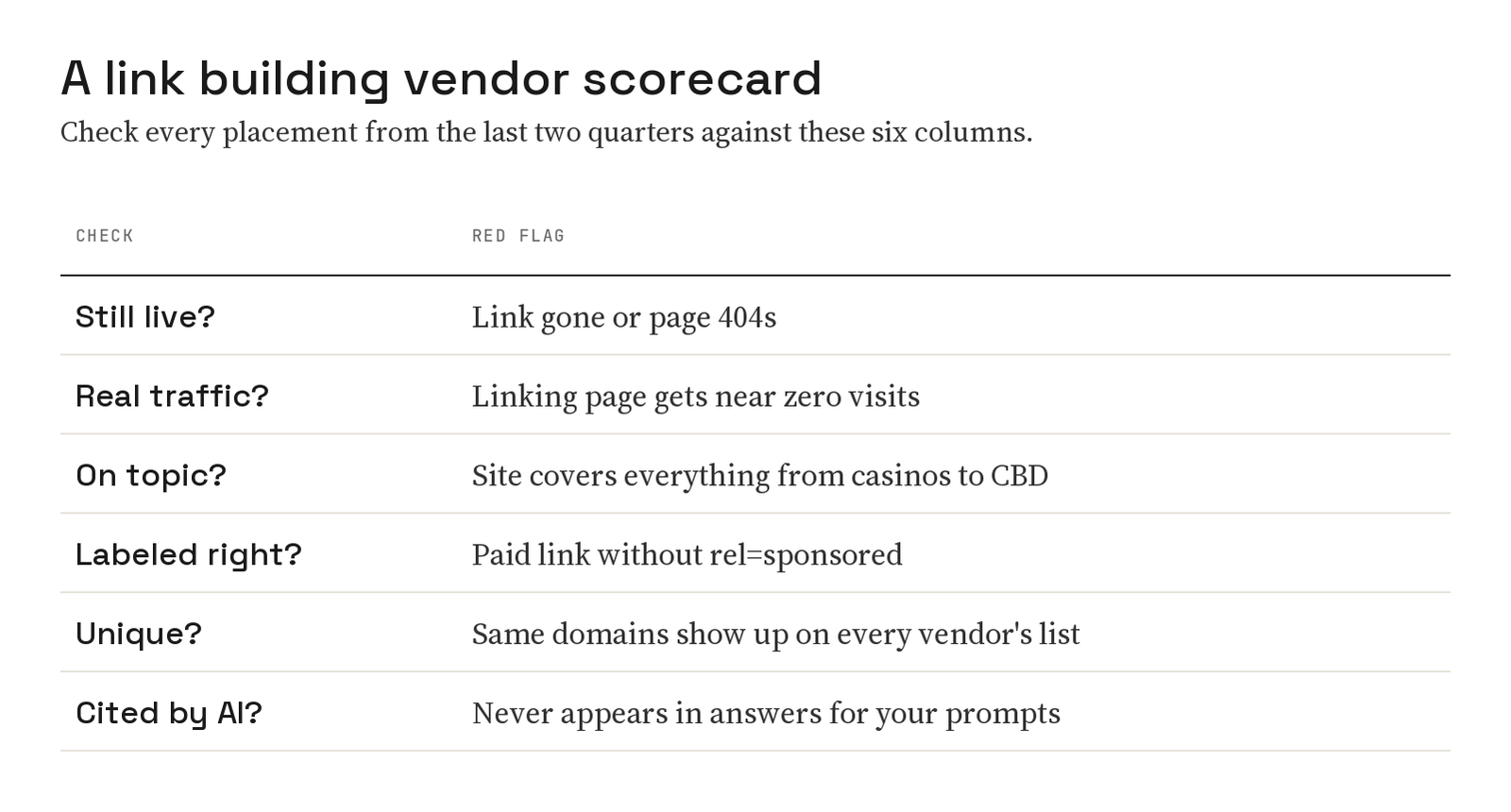
Two of these catch most of the problems. A linking page with near-zero organic traffic usually belongs to a site search engines have stopped showing, and a page nobody visits is also unlikely to be retrieved and quoted by an AI assistant. Overlap is the other tell. If you've used two vendors, or you can see a competitor's profile, compare the referring domains. When the same handful of multi-topic blogs shows up for everyone, you're looking at a shared inventory list.
Score the results honestly. A healthy program will have some dead links and some weak placements. The question for renewal is the ratio, and whether the agency spots the bad ones before you do.
What good link building services look like now
In the uSERP data, 53.4% of respondents said digital PR delivered their strongest results in the last 12 months. Digital PR link building earns mentions in reporting, data stories and expert roundups, pages that people read and that tend to rank. It's slower and harder to promise in a contract, which is exactly why it holds value.
That gives you a better brief for any agency pitch. Ask for placements on pages that already rank for your topic. Ask for a full paragraph about your product over a one-line insertion. And ask how they'll show the effect, in organic traffic to the target page and in whether AI answers start citing the placement for the questions your buyers ask.
Sources for this section
Running the audit in Semrush One
You can do the audit above with spreadsheets and a lot of patience. A backlink database makes it much faster. Semrush One bundles the SEO Toolkit, which covers Backlink Analytics, Backlink Gap and Backlink Audit, with the AI Visibility Toolkit, which tracks whether AI answers cite the pages your links sit on.
If you're heading into a renewal conversation, the 7-day free trial is long enough to pull your referring domains, check what was gained and lost during the contract, and compare your profile against two or three competitors.
Three Semrush reports that answer the renewal questions
Start with the Referring Domains report in Backlink Analytics. The New and Lost chart shows how many referring domains you gained and lost each week. Line it up with your contract dates: links an agency built should appear as new, and a cluster of them turning up as lost a few months later is worth a direct question.
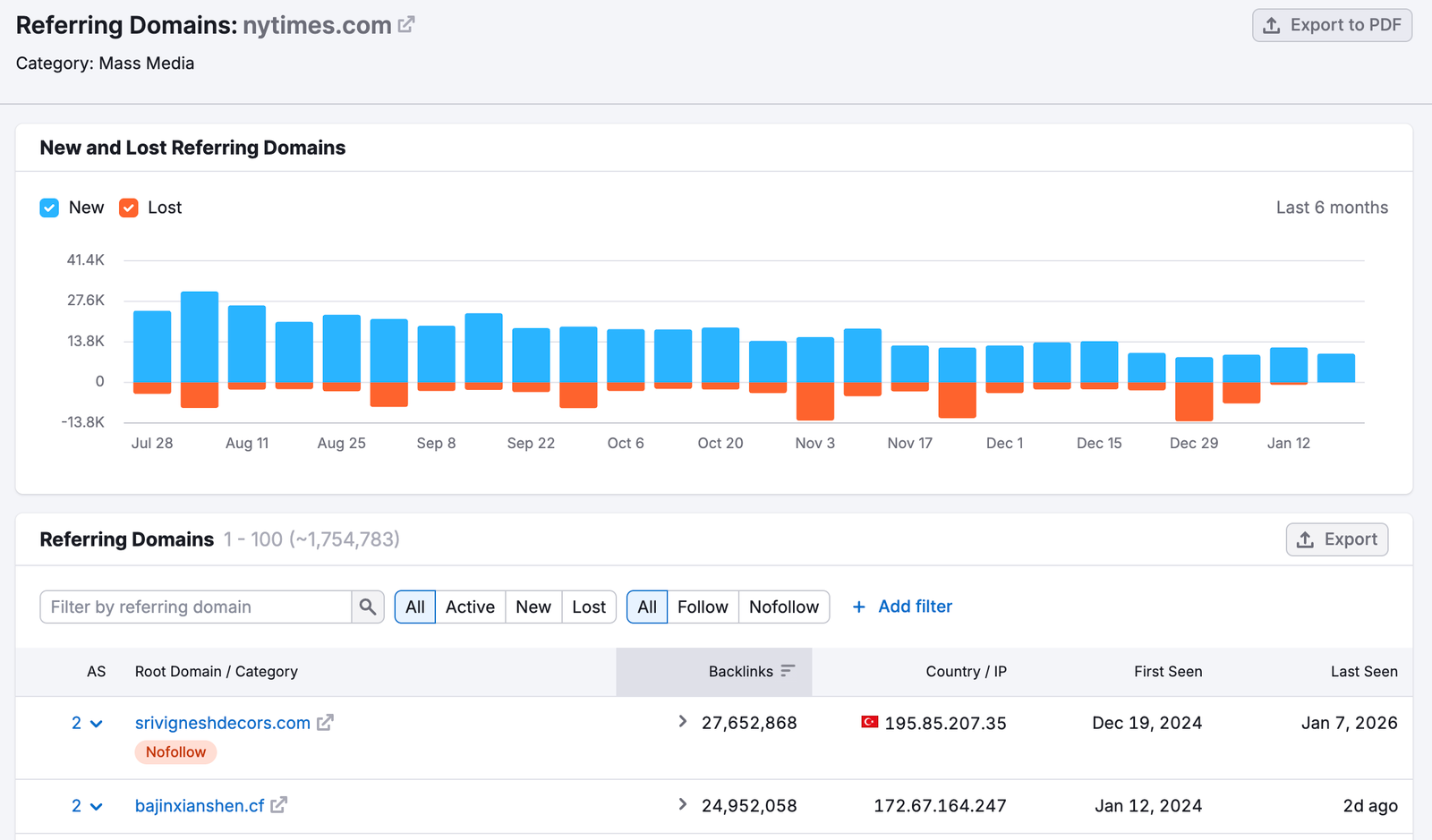
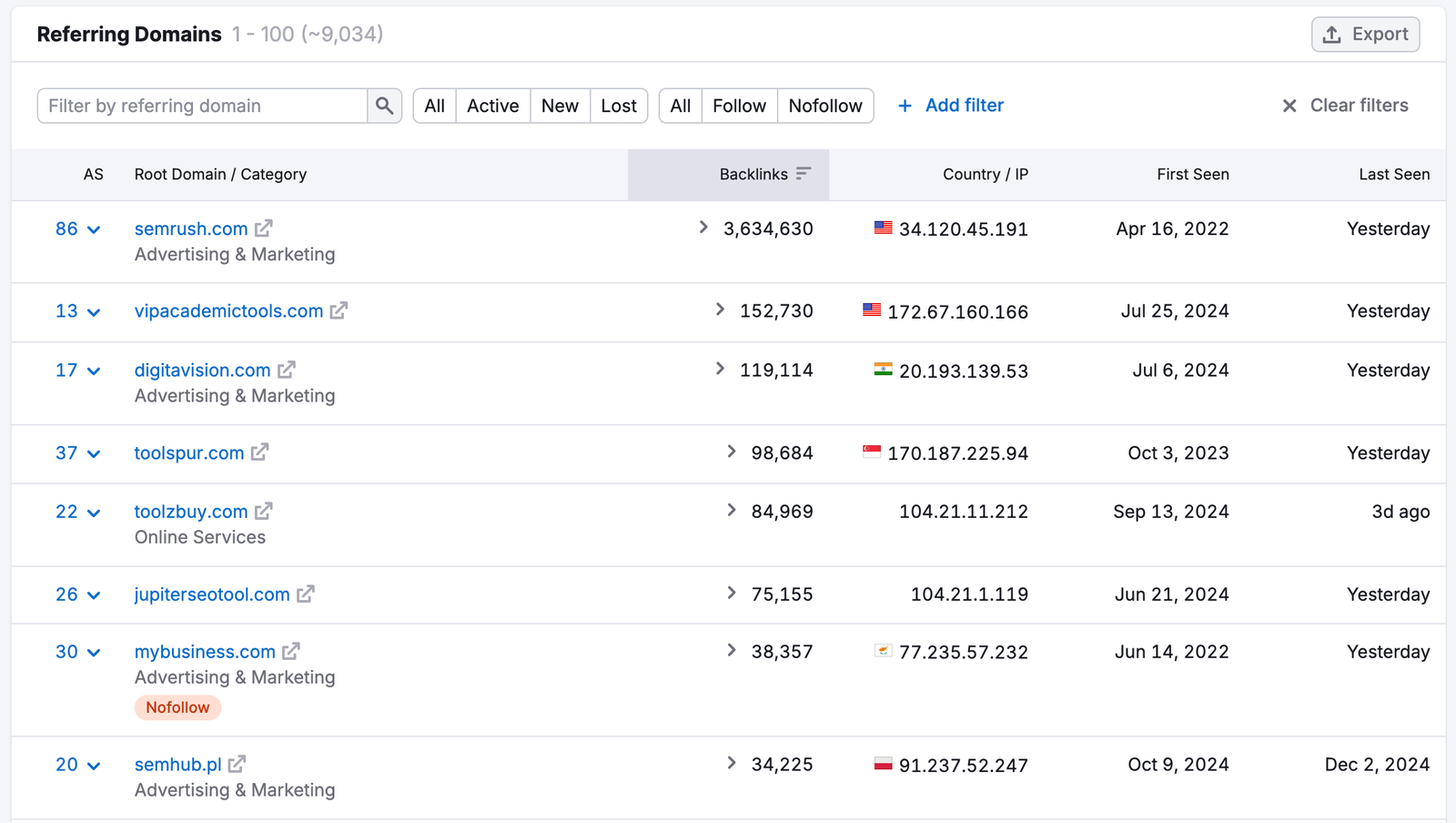
The list underneath has the details for each domain: Authority Score, category, country and IP, backlink count, a nofollow label where it applies, and First Seen and Last Seen dates. Filter to New for the contract period and you have the agency's work in one table. The category column makes off-topic sites easy to spot, and the IP column helps when several "different" blogs share a server.
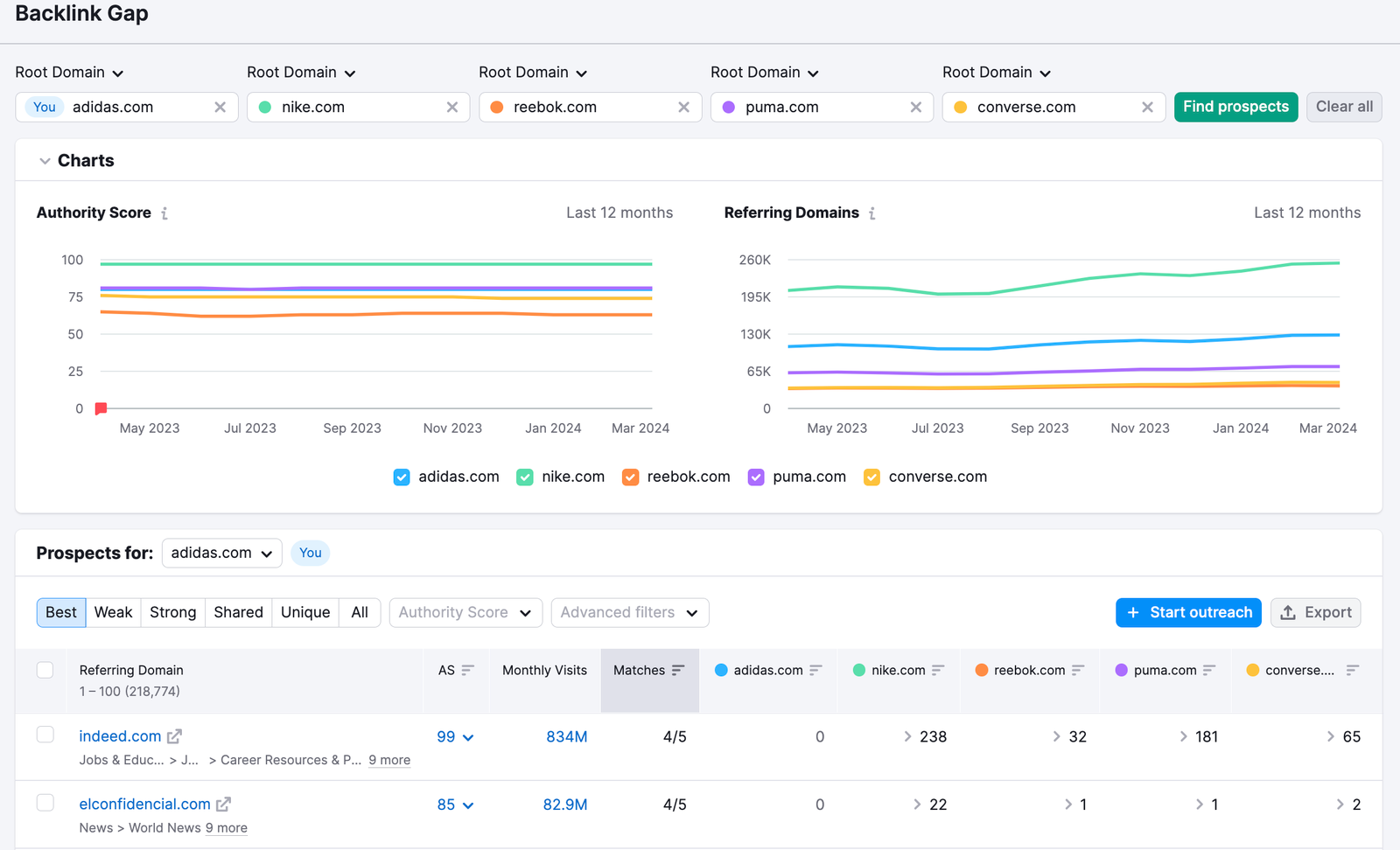
Backlink Gap answers the overlap question and the prospecting question at once. Enter your domain and up to four competitors, and it lists the referring domains that link to them and not to you, with each site's Authority Score, monthly visits and how many of the compared domains it links to. A site linking to four of your competitors with real monthly traffic is a better target than anything on a generic vendor list.
Backlink Audit handles cleanup, flagging links with toxic signals and building a disavow file if you need one. On the AI side, Prompt Tracking runs your buyer prompts daily in ChatGPT, Google AI Mode and Gemini and lists the domains each answer cites, so you can see whether a placement page starts showing up. Together they turn "trust us, the links are working" into a report you can check line by line.
Sources for this section
Before you sign the next contract
- Ask for a full placement list with URLs and live dates, and audit it yourself.
- Judge links on topical relevance and real traffic to the linking page. Authority scores came last in the survey for a reason.
- Treat PBN links and unlabeled paid placements as a liability. Google says their benefit can't be recovered once it's removed.
- Compare referring domains across vendors and competitors to catch recycled inventory lists.
- Put digital PR and full-paragraph mentions on pages that rank in the next brief.
Sources
Brian Weerasinghe is the founder and editor of AI Eating The World, where he covers artificial intelligence, tech companies, layoffs, startups, and the future of work. His reporting focuses on how AI is transforming businesses, products, and the global workforce. He writes about major developments across the AI industry, from enterprise adoption and funding trends to the real-world impact of automation and emerging technologies.