Image: Flickr / Wikimedia Commons / Unsplash
AI-Generated Content SEO in 2026: Why Originality Now Decides Rankings
About half of new web articles are machine-written. Google's guidance and the industry's own survey data point to the same tiebreaker: what your page adds that the others don't.
Image: Flickr / Wikimedia Commons / Unsplash
This article contains affiliate links to Semrush. AI Eating The World may earn a commission on qualifying purchases, at no extra cost to you.
Roughly half of newly published articles are now AI-generated. Here's what Google actually says about originality, what it hasn't confirmed, and a simple information gain check for every draft.
Half the new articles on the web are now machine-written
AI-generated content SEO used to be a question about detection: would Google catch it, and would it care? In 2026 the more useful question is what happens when every competitor can publish the same competent article on the same day. Graphite's latest study, published in May 2026, sampled 55,400 English-language articles from Common Crawl and ran each through three AI detectors. Since the first quarter of 2025, roughly half of all newly published articles have been primarily AI-written.
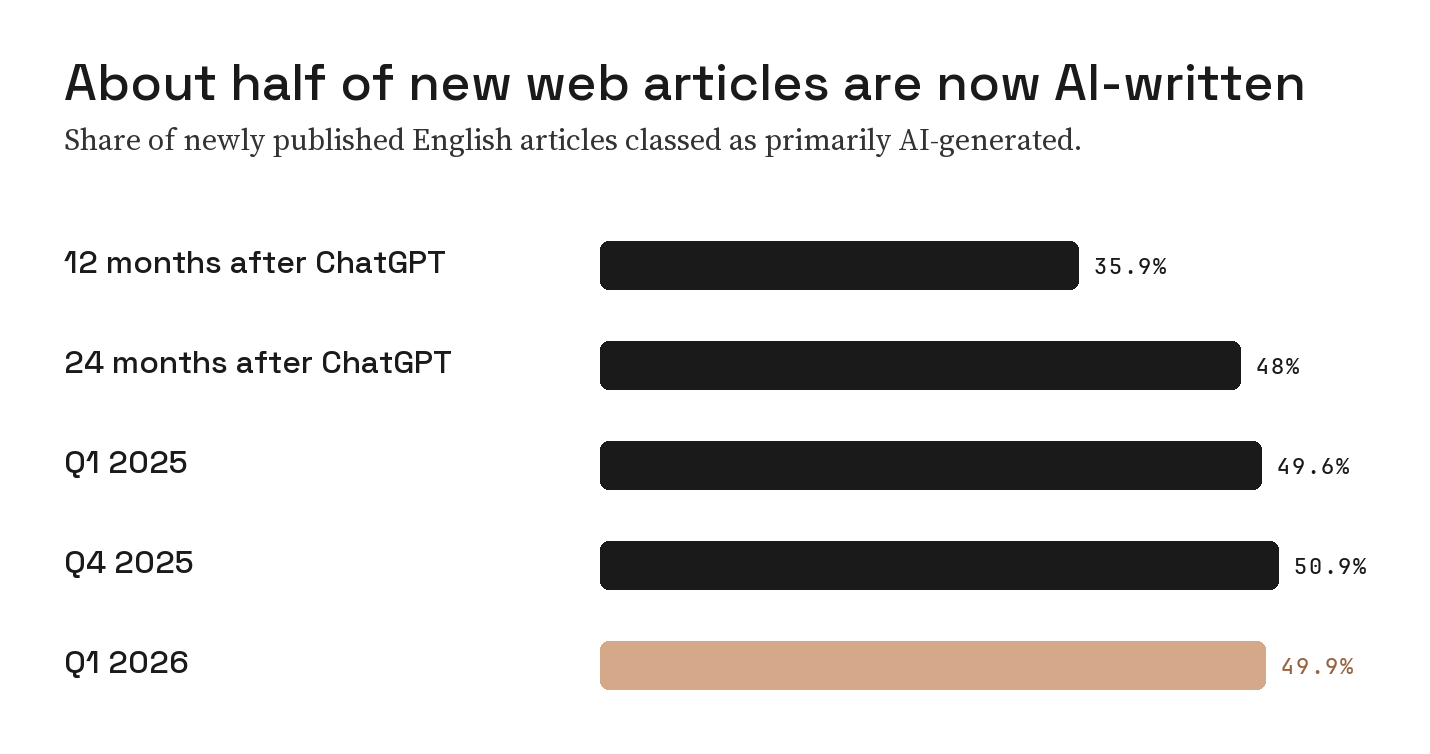
The curve flattened about five quarters ago and hasn't moved since. Graphite's own guess is that AI articles stopped spreading because they don't perform well in search. That's a hypothesis, and the study doesn't measure rankings, but it matches what a lot of US content teams describe on forums and in client calls: output went up, traffic didn't follow, and someone now has to explain the budget.
The problem with publishing an average answer is that thousands of other sites can publish the same one by lunchtime. Machine-written copy is just the cheapest way to get there.
Sources for this section
What Google says about originality, and what it hasn't confirmed
Google has been fairly direct about this in its public documentation. Its guide to helpful content, updated October 5, 2026, asks site owners whether a page provides "original information, reporting, research, or analysis" and whether it offers "substantial value when compared to other pages in search results." It also asks whether content that draws on other sources avoids simply copying or rewriting them.
The generative AI guidance adds the enforcement side. Using AI tools to generate many pages without adding value for users may break the scaled content abuse policy, which covers mass-produced, low-value pages whether a model, a scraper or a team of freelancers made them. How the words got written matters less to Google than whether the page earns its place.
Two other documents get quoted a lot in SEO circles, and both need a caveat. Google holds a patent on an information gain score, first granted in 2022 and extended by continuations through 2024, that rates how much new information a document adds beyond what a user has already seen. A patent shows what Google's engineers have worked on. It doesn't prove the idea runs in Search today.
The second is a Google Research post from September 15, 2026 on a system called Retrieve-for-Train. It trains a retriever to return a set of results that covers a question from different angles, and it uses a diversity measure called the Vendi Score to stop the model from producing near-duplicate sub-queries. Some SEOs have read it as proof that Google now filters out pages that repeat each other. The post says no such thing. The experiments ran on open models with fashion and music datasets, and Google hasn't said the method is used in Search. What it does show is the direction of the research: systems that reward a varied set of results and treat a tenth paraphrase of the same answer as waste.
Does AI content rank on Google? The practitioner view
Search teams don't agree on much, but they mostly agree on this. In Zyppy's 2026 ranking factors survey, published September 9, 131 SEOs rated more than 100 possible factors. Relevance came first, named as a top-three factor by 57.1% of respondents, with backlinks at 54.8% and content quality at 47.6%. Inside content quality, original research and first-party data topped the list.
On AI-written pages the respondents split along one line. Many rated AI content as a negative, but only when it was scaled with little added value. At least one reported good results from AI drafts that people had edited heavily. That's roughly where Google's own wording lands too: whether AI content ranks on Google depends on what the page adds, more than on who or what typed it.
Readers seem to notice the difference even when they can't name it. Ipsos and Syracuse University showed 3,000 US consumers 20 TV-style ads, half made by people and half generated with Gemini and Sora 2. Only 25% of viewers of the AI versions felt confident they were AI-made, yet the human ads scored about 14% higher on short-term sales impact and 17% higher on long-term brand effect. Ads aren't articles, so I wouldn't stretch the numbers. The pattern fits, though. People didn't spot the machine. The AI ads simply had less in them that stuck.
An information gain SEO check that fits in a content workflow
Information gain SEO sounds like a research project. In practice it's a short list of questions an editor asks before a page goes live. The point is to stop briefing writers with "read the top 10 and write something better," because that brief produces the 11th version of the same article.
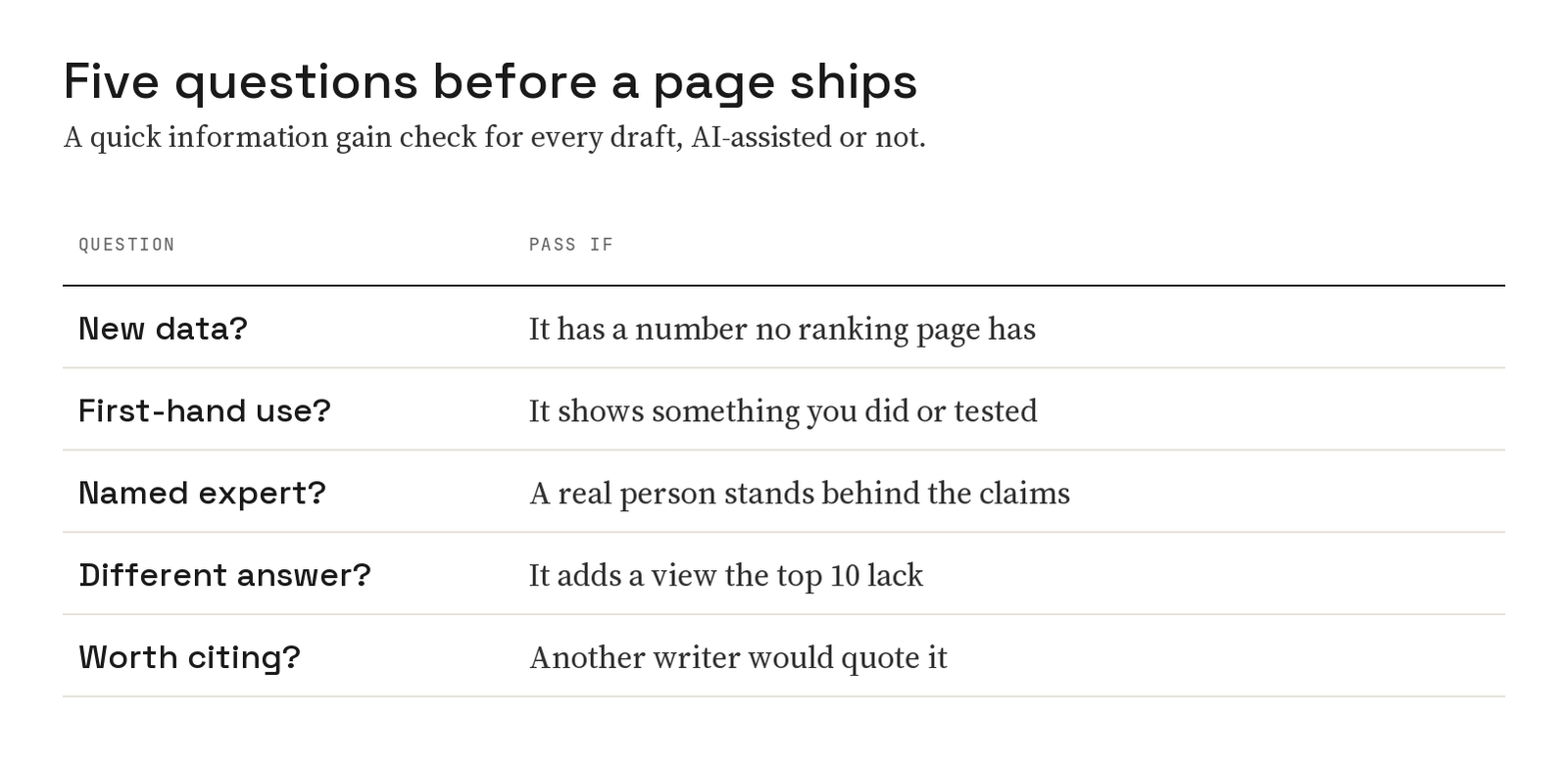
A page doesn't need all five. One strong yes is usually enough: a number from your own product data, a test you actually ran, a screenshot of a workflow nobody else documented. AI tools are fine for the outline, the first draft and the copy edit. Before a draft ships, a person should add the part nobody else has, and check that a content originality scan doesn't flag passages lifted from elsewhere.
This also changes the volume question. If the team can't add something new to 40 pages a month, publish 10 that each carry a proprietary detail, and point the saved hours at research or interviews.
Where Semrush One fits in an originality workflow
Two parts of the check above are hard to do by eye: knowing where competitors already cover a topic thoroughly, and catching borrowed text before it ships. Semrush One handles both from one account. It bundles the SEO Toolkit, which includes Topic Research and the SEO Writing Assistant, with the AI Visibility Toolkit, which shows the topics where AI assistants mention your competitors and not you.
That pairing is useful for picking what to write next, because a topic with search demand and thin AI coverage is a good place to spend original research. Semrush One comes with a 7-day free trial, which is enough time to run your next five briefs through it and see what changes.
Using Semrush One to plan and check original content
Start in the AI Visibility Toolkit's Visibility Overview report. Its Topic Opportunities tab lists topics where AI answers mention your competitors but not your brand, with the number of competitors mentioned and an estimated AI search volume for each. Those gaps are where a well-researched page has the most room to stand out.
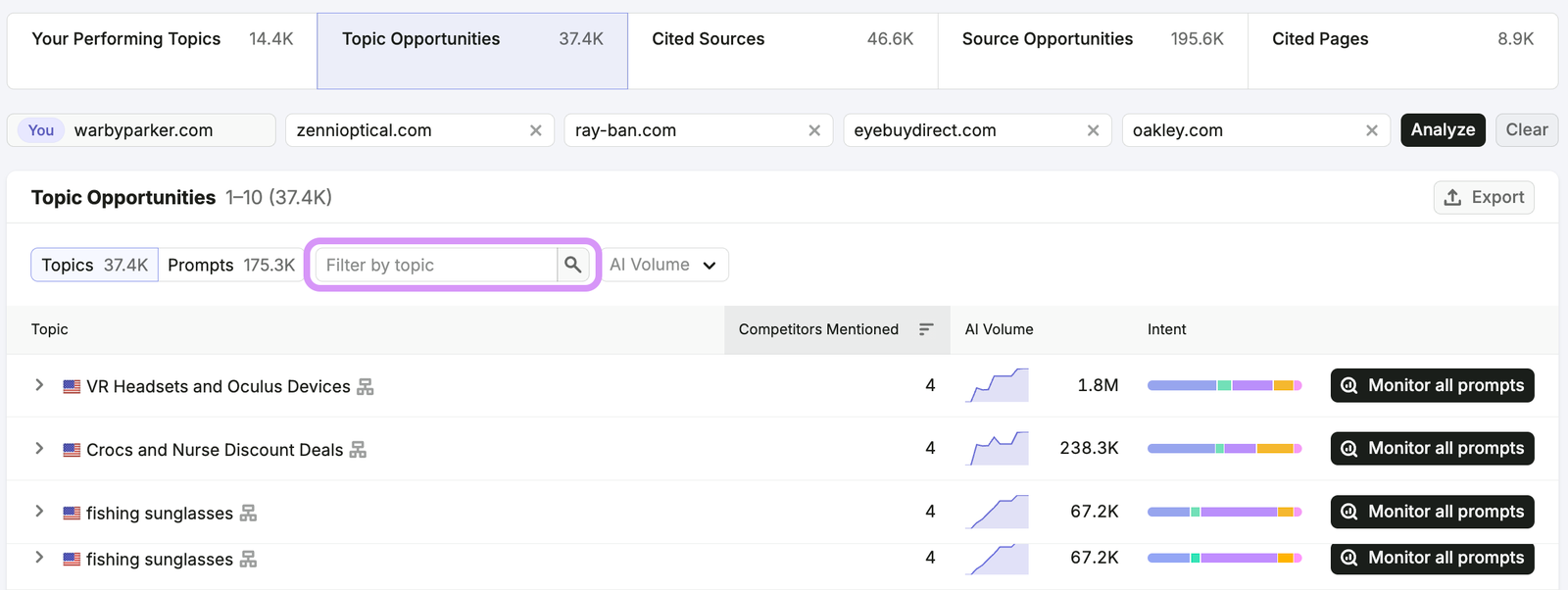
Topic Research in the SEO Toolkit does the same job for classic search. Enter a topic and it returns subtopic cards, popular headlines and the questions people ask, so you can see which angles already have a dozen strong answers and which have none.
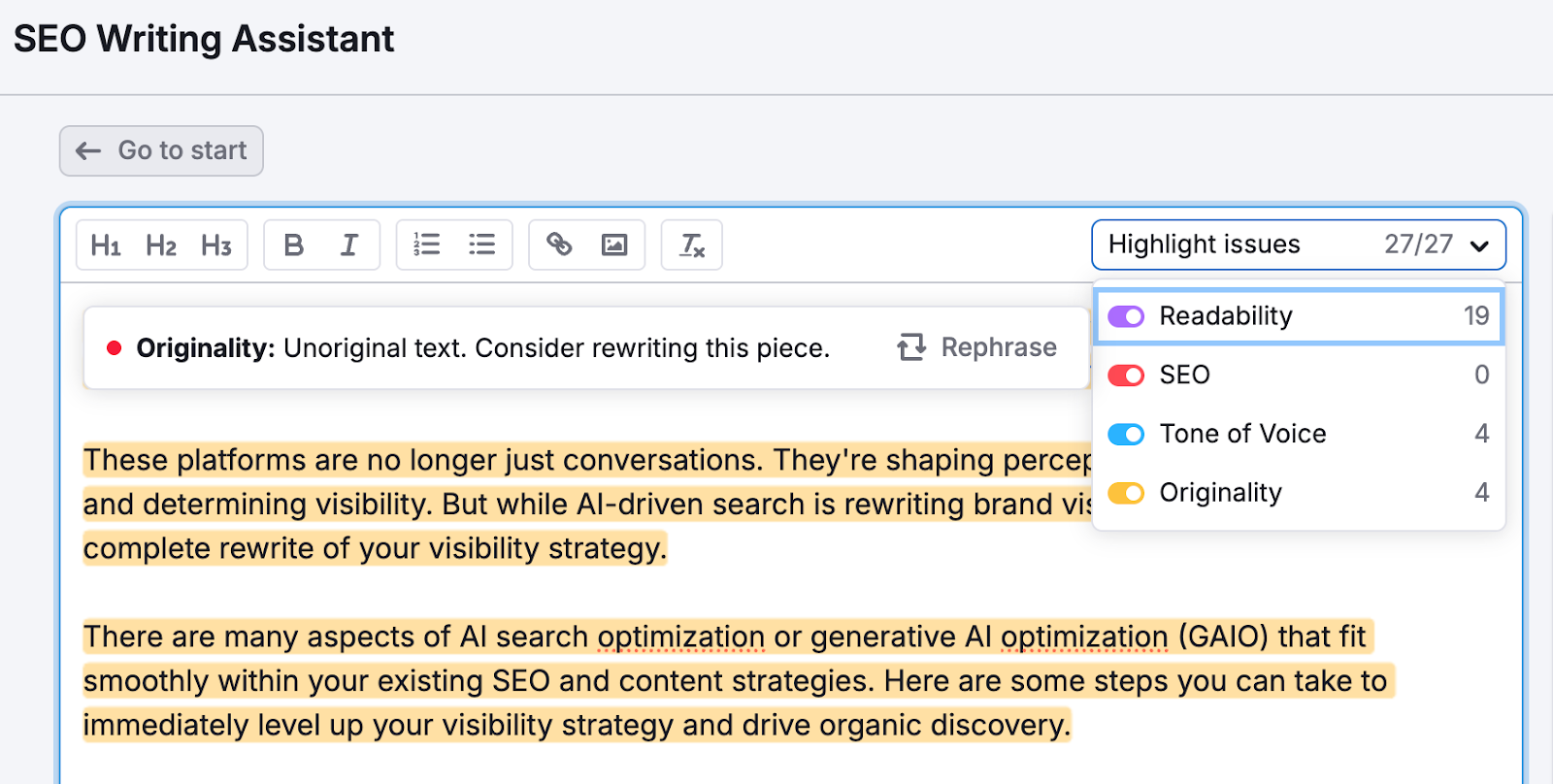
Once a draft exists, the SEO Writing Assistant scores it on four things: readability, SEO, tone of voice and originality. It works inside Semrush, Google Docs, WordPress and Microsoft Word, so writers don't have to change tools.
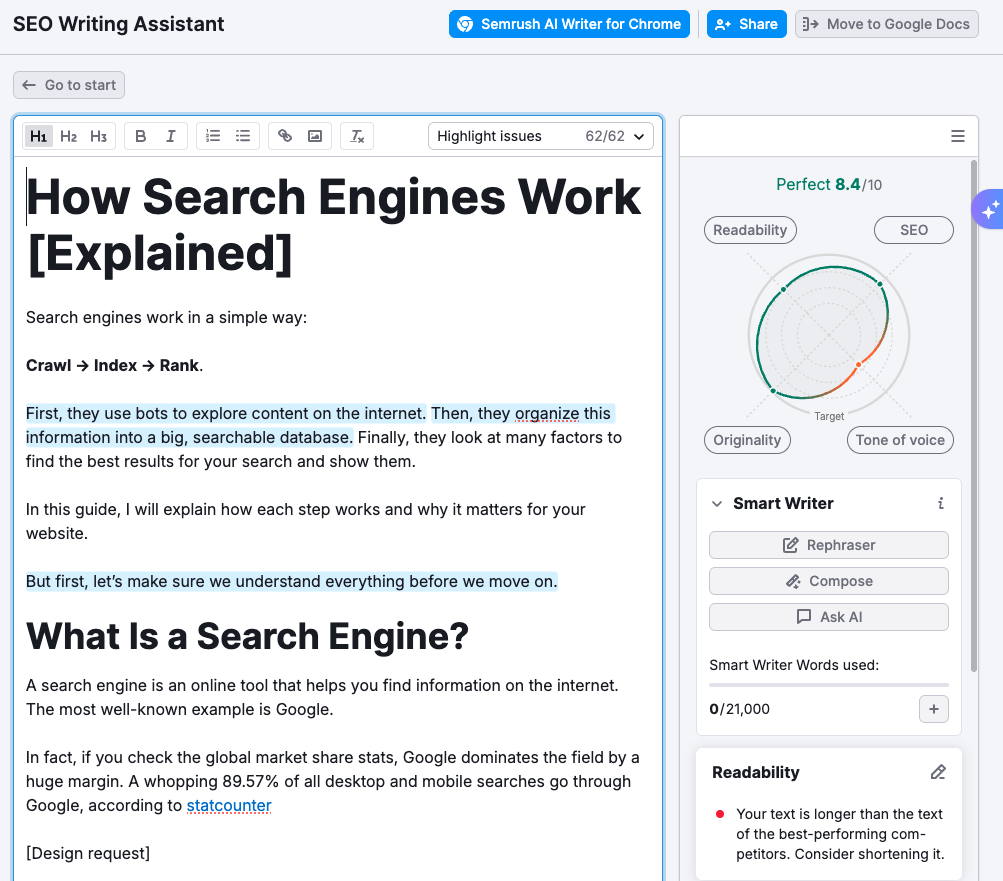
The originality score runs a plagiarism check based on Copyleaks and highlights passages that match existing pages, with a Rephrase option next to each one. That's the last gate before publishing, and it catches the paragraphs an AI draft quietly borrowed from a top-ranking page.
Semrush lists content optimization from the Pro+ plan up, so pick that tier if the writing checks matter to your team. Put the trial on your next few briefs: pick topics from the opportunity reports, add one thing nobody else has, then run the draft through the originality check before it goes live.
Sources for this section
What to change on Monday
- Stop briefing writers with "beat the top 10." Brief them on what the top 10 are missing.
- Treat Google's helpful content questions as an editorial checklist. Original information and substantial added value come first.
- Read the information gain patent and the Retrieve-for-Train post for direction only. Neither is confirmed as a live ranking system.
- Use AI for drafts and edits, and have a person add the data, test or opinion the page is built around.
- Publish fewer pages if that's what it takes for each one to carry something new.
Sources
Brian Weerasinghe is the founder and editor of AI Eating The World, where he covers artificial intelligence, tech companies, layoffs, startups, and the future of work. His reporting focuses on how AI is transforming businesses, products, and the global workforce. He writes about major developments across the AI industry, from enterprise adoption and funding trends to the real-world impact of automation and emerging technologies.