OpenRouter Free Models: The Best Picks, Checked Live (October 2026)
We pulled OpenRouter's live model list, endpoint uptime and rate-limit docs on October 14, 2026. Here are the free models worth using, the two to skip, and the catch nobody puts in the headline.
AI Eating The World has no financial relationship with OpenRouter or the model providers mentioned in this article. The Token Saver Kit is our own product.
OpenRouter's API listed 15 free text models on October 14, 2026. The best picks are Laguna S 2.1 for coding, Inkling as an all-rounder, Nemotron 3 Super for long documents and Gemma 4 31B when privacy matters, with a hard cap of 50 free requests a day until you buy $10 in credits.
15 OpenRouter free models are live right now
OpenRouter free models let you call real, current LLMs through one OpenAI-compatible API without paying per token. The catch is that the list changes every week, so most "best free models" roundups are out of date by the time you read them. We skipped the roundups and checked the source.
On October 14, 2026, OpenRouter's public models API listed 462 models. 17 of them cost $0. Two of those are Google's Lyria 3 music previews, and one is openrouter/free, a router that hands your request to a random free model. That leaves 15 free text models with a :free model ID you can call by name.
That number moves fast. TrueFoundry counted 19 free text models on October 5. Nine days later, four were gone, including a stealth model and Qwen 3.8 27B. OpenRouter's pricing page still says "25+ free models." If you build on a free model, plan for it to disappear.
How we checked: we pulled the full model list, each free model's endpoint data (provider, uptime over the last day, context window, max output, tool support) and OpenRouter's rate-limit docs, all on October 14, 2026. We matched that against each host's published data policy. We did not run a quality benchmark, so where we mention benchmark scores, they are the vendor's own claims.
Sources for this section
The best OpenRouter free models, by job
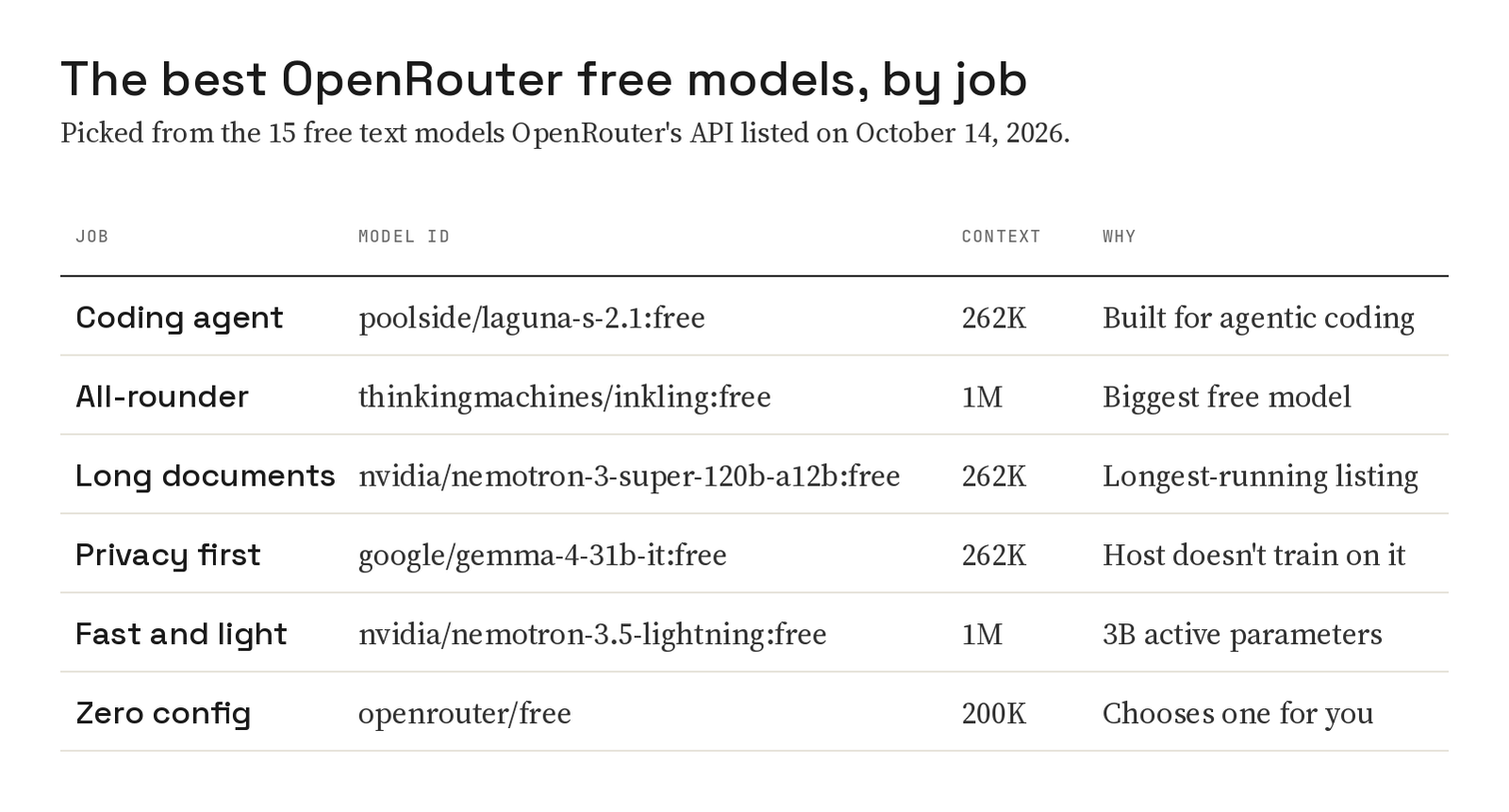
Best for coding agents: Poolside Laguna S 2.1 poolside/laguna-s-2.1:free. A 118B mixture-of-experts model with 8B active parameters, built for agentic coding. Poolside reports 70.2% on Terminal-Bench 2.1. It supports tool calling, has a 262K context window and held 99.9% uptime over the day we checked. If your code is sensitive, Cohere's North Mini Code (cohere/north-mini-code:free) is the smaller alternative, on a host that says it does not train on prompts.
Best all-rounder: Thinking Machines Inkling thinkingmachines/inkling:free. The biggest model on the free list: 975B total parameters with 41B active, a 1M-token context window and text, image and audio input. It is the closest thing to a frontier-class model you can call for $0 today. Inkling Small is the lighter sibling, with 12B active parameters.
Best for long documents: NVIDIA Nemotron 3 Super nvidia/nemotron-3-super-120b-a12b:free. Listed since March 11, 2026, it is the longest-running free model on OpenRouter, which matters when models vanish weekly. It takes 262K tokens in and can write up to 235,929 tokens out, the largest output cap among the reliable picks.
Best when privacy matters: Google Gemma 4 31B google/gemma-4-31b-it:free. Served by Google AI Studio, which retains prompts for 55 days but does not train on them, according to TrueFoundry's review of host policies. It reads images and video, supports tool calls and structured output, and had 100% uptime.
Best for speed: NVIDIA Nemotron 3.5 Lightning nvidia/nemotron-3.5-lightning:free. Only 3B active parameters out of 30B, built for high-volume agent steps such as classifying, extracting and routing. It has a 1M-token window and 97.2% uptime.
Zero config: openrouter/free. OpenRouter's own router picks a free model at random and filters for what your request needs, such as tool calling or image input. Good for prototypes. Bad for anything where you need the same model, and the same behavior, twice.
OpenRouter rate limits and uptime: the real cap on free
The OpenRouter free tier is limited by requests, not tokens. OpenRouter's docs set every :free model at 20 requests per minute. The daily cap depends on whether you have ever bought credits: 50 requests a day if you have bought less than $10, and 1,000 a day once you have bought at least $10. The docs add that the higher cap actually starts at 9 credits, to absorb top-up fees.
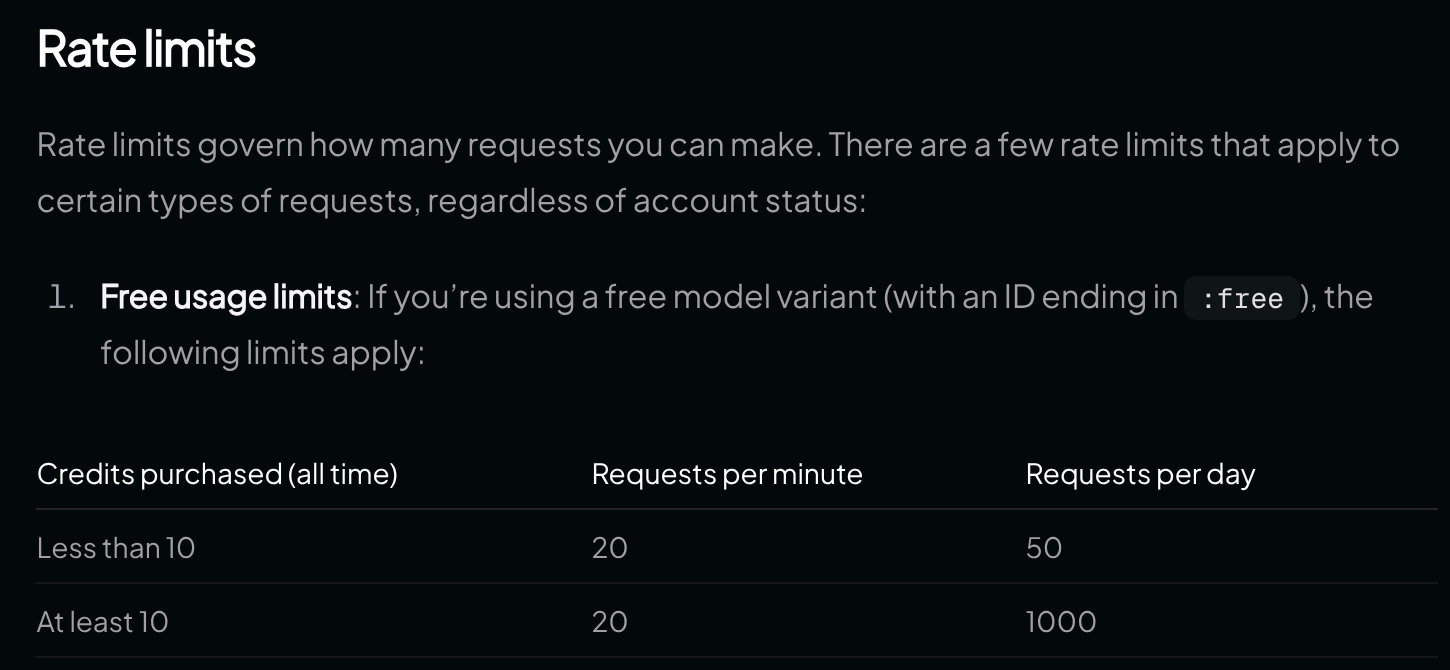
Fifty requests sounds like a lot until you plug a free model into a coding agent. Agents make one request per step, so a single bug fix can use 20 to 40 calls. For agent work, a one-time $10 top-up is the most useful thing you can spend on OpenRouter pricing: you keep using free models, the credits stay in your account for paid ones, and your daily cap goes up 20 times.
The second limit is reliability. Every free model we checked runs on exactly one provider, so there is no automatic failover when that host has a bad day. Over the day before our check, most held 99.8% to 100% uptime. Three did not: Dots3-Note Preview at 90.8%, Nemotron 3 Ultra at 75.7% (30% in the last half hour) and Nemotron 3 Nano Omni at 7.8%. Skip those two Nemotrons until their numbers recover.
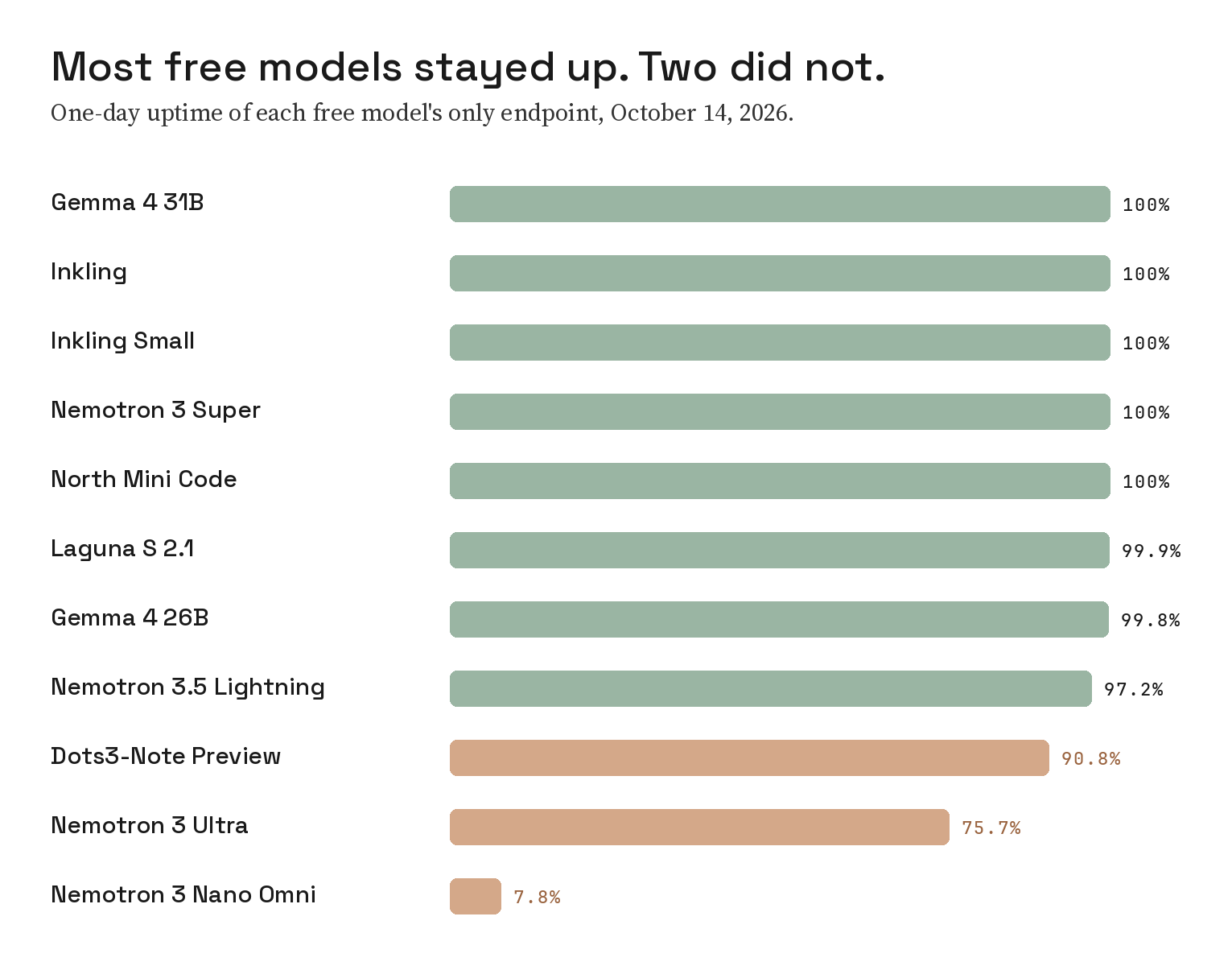
The fix is cheap: pass a models array with two or three free models in your request instead of a single model. OpenRouter tries them in order, so a 429 or an outage on one falls through to the next.
Sources for this section
What a free LLM API really costs: your prompts
Free inference gets paid for somehow. TrueFoundry checked the published policy of every host behind OpenRouter's free models on October 5. Nine of the 19 free models ran on hosts whose terms allow training on your prompts, including all five NVIDIA models, both Inkling models and Liquid's LFM. Six more kept prompts without training, for example 55 days at Google AI Studio and 30 days at Cohere.
You control this in your OpenRouter privacy settings. OpenRouter's logging docs say there are separate settings for free and paid models, and that opting out of training stops routing to hosts that train. For free models, opting out means roughly half the list stops working for you, including our all-rounder and long-document picks.
The practical rule for US teams: free models are fine for public code, side projects, tests and evals. Do not send customer data, anything covered by an NDA or a client contract, or regulated data such as health records. For that work, pay for the same open model on a host that neither trains nor retains. TrueFoundry estimates that costs about $6 a month at 1,000 requests a day for a small model like Nemotron 3.5 Lightning, before OpenRouter's 5.5% fee on credit purchases.
Sources for this section
How to use the OpenRouter API for free in five minutes
Sign up at openrouter.ai, create an API key, and point any OpenAI-compatible client at https://openrouter.ai/api/v1. Use a model ID that ends in :free, and add one or two fallbacks in the models array. No card is needed until you want the higher daily cap.
Before you hard-code a model, check it is still free on OpenRouter's models page filtered to $0. Free variants get withdrawn without much notice, as Qwen3 Coder and DeepSeek R1 already were.
If you want a free model inside a coding agent, our guide on running Claude Code on OpenRouter's free API walks through the setup. Pair it with Laguna S 2.1 or North Mini Code, and keep a paid model for the hard parts.
Free models help most when the expensive model only does expensive work. Our Token Saver Kit for Claude Code and Codex ($24, our own product) packages that setup: lean memory files, read limits, cheap subagents for searches and test runs, and a cheaper-model routing example, so you hit usage limits less often.
What to watch next
- The free list itself. Four models left in nine days in October. Recheck your model IDs monthly, and keep fallbacks in every request.
- Rate limits. The 50 and 1,000 daily caps were the same in July and October 2026, but they are a policy, not a contract.
- Stripe. OpenRouter agreed to join Stripe this year. Watch whether free inference and credit pricing change after the deal closes.
- Nemotron 3 Ultra. It is NVIDIA's largest free model, but at 75.7% uptime it is not usable yet. If it stabilizes, it becomes a strong long-context pick.
Sources
Brian Weerasinghe is the founder and editor of AI Eating The World, where he covers artificial intelligence, tech companies, layoffs, startups, and the future of work. His reporting focuses on how AI is transforming businesses, products, and the global workforce. He writes about major developments across the AI industry, from enterprise adoption and funding trends to the real-world impact of automation and emerging technologies.