GPT-6.2 is two models: Astra for the hardest projects at $8 and $40 per million tokens, 20% below GPT-6 Astra, and Sol for everyday work at $2 and $10. Both are in ChatGPT Work and Codex for Plus, Pro, Enterprise and Edu, but early reviews from power users are harsh.
GPT-6.2 is two models, not one
OpenAI released GPT-6.2 on November 17, 2026, and like GPT-6 it comes as a pair. GPT-6.2 Astra is the frontier model OpenAI pitches for your hardest projects: science, law, finance, large codebase changes and documents that follow a company's templates. GPT-6.2 Sol is the efficient everyday model for coding, writing and multistep agent work. OpenAI says many of its own employees already use Sol as their default.
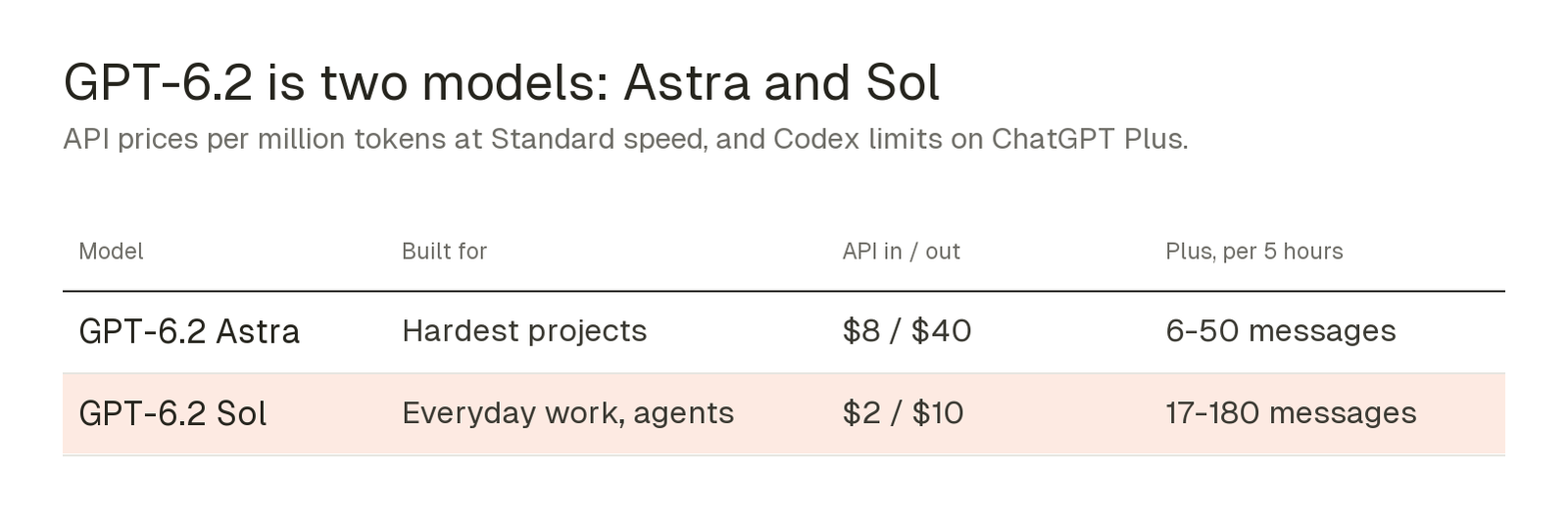
Both models are rolling out in ChatGPT Work and Codex for Plus, Pro, Enterprise and Edu users. They are not in regular ChatGPT chat, and Enterprise and Edu admins have to switch them on first. Developers get them in the API as gpt-6.2-astra and gpt-6.2-sol, each with a 1.05 million token context window and up to 128,000 output tokens.
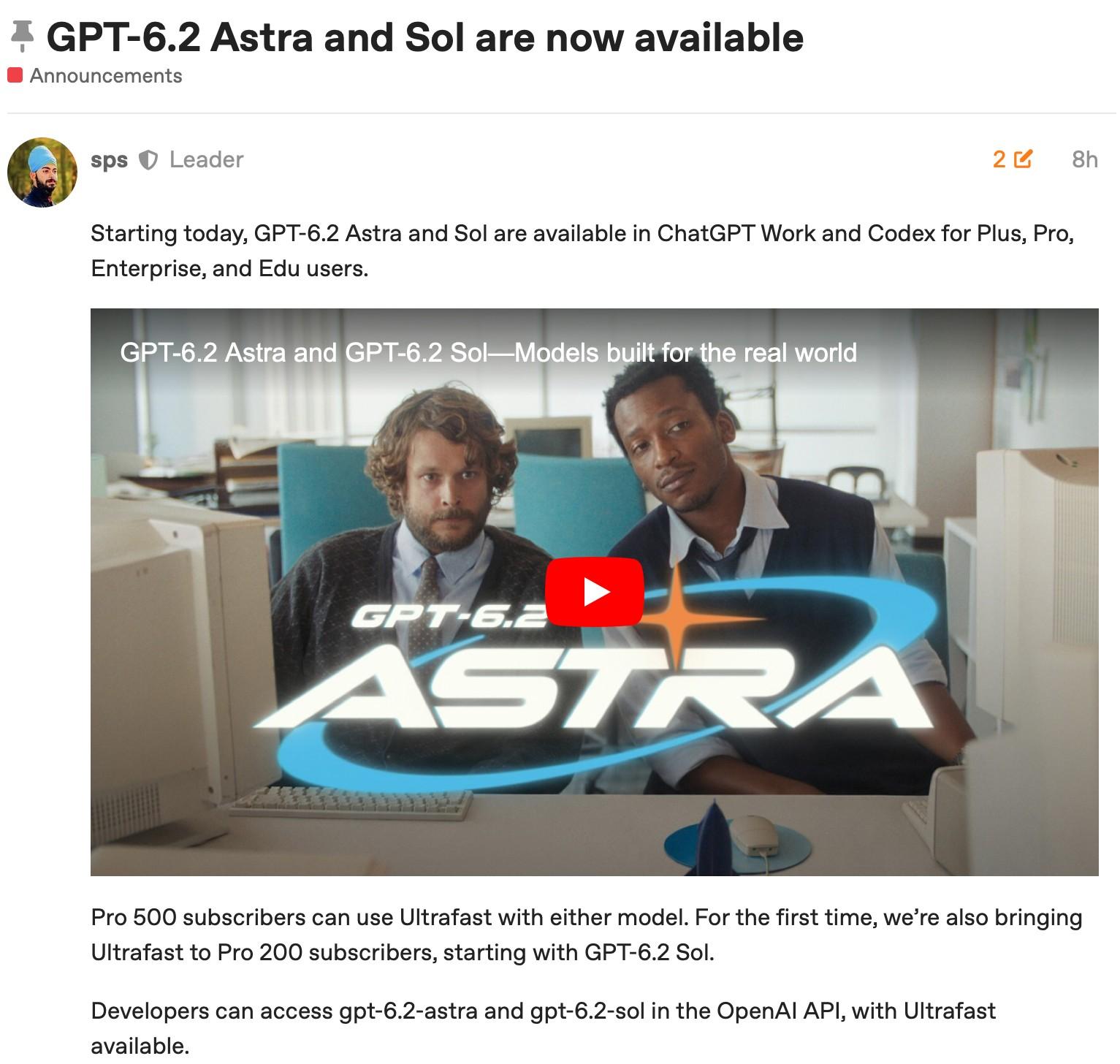
The release lands two months after GPT-6 Astra and eight days after Anthropic's Claude Fable 5.2. There was no GPT-6.1 Astra: OpenAI scrapped it in late September after researchers raised safety concerns, as Seeking Alpha reported, citing the Wall Street Journal.
GPT-6.2 Astra vs Sol on the benchmarks
On OpenAI's own charts, Astra beats GPT-6 Astra on all nine head-to-head benchmarks and Sol beats GPT-6.1 Sol on eight of nine. On Agents' Last Exam, Astra scores 78.3%, 5.2 points above GPT-6 Astra, and OpenAI says it does so at less than half the cost per task.
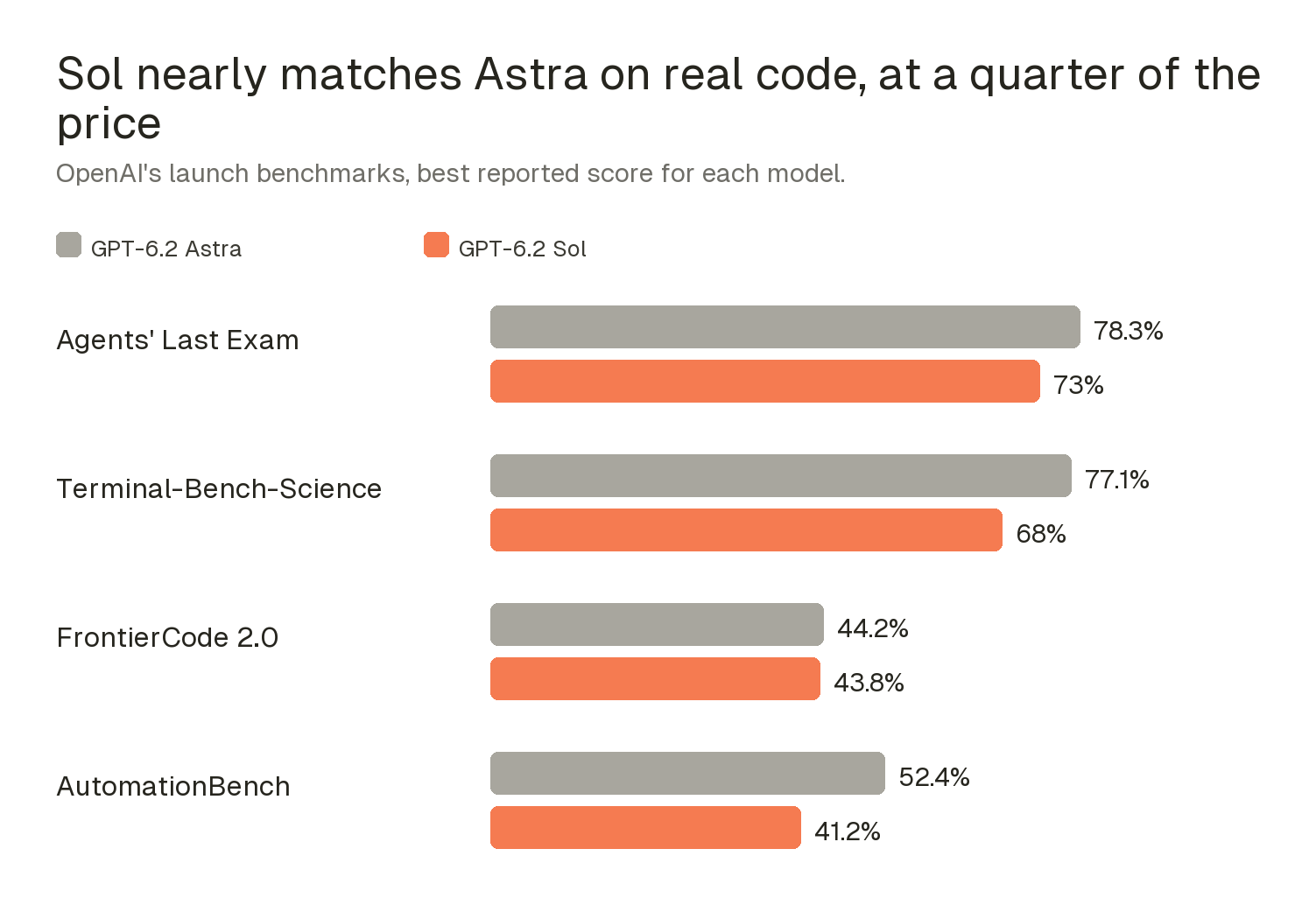
The number to notice is FrontierCode 2.0, OpenAI's test of merge-ready changes to real codebases. Sol scores 43.8% against Astra's 44.2%, at about one fifth of the cost per OpenAI. Astra pulls ahead on science and automation tasks, where the gap is 9 to 11 points.
Independent tests are less flattering. On the Artificial Analysis Intelligence Index, Astra scores 62, second behind Claude Fable 5.2 at 65, with Sol at 57. On the Artificial Analysis Coding Agent Index in the Codex harness, Astra is flat against GPT-6 Astra and Sol drops 3 points against GPT-6.1 Sol. Epoch AI puts Astra at 174 on its Capabilities Index, tied with Fable, but found it weaker than Fable on real-world research tasks.
GPT-6.2 pricing: Astra gets 20% cheaper, Sol stays put
In the API, GPT-6.2 Astra costs $8 per million input tokens, $0.40 cached and $40 output, down from $10 and $50 for GPT-6 Astra. GPT-6.2 Sol keeps GPT-6.1 Sol's $2 input, $0.10 cached and $10 output. Prompts over 272,000 tokens cost more: $16 and $60 for Astra, $4 and $15 for Sol.
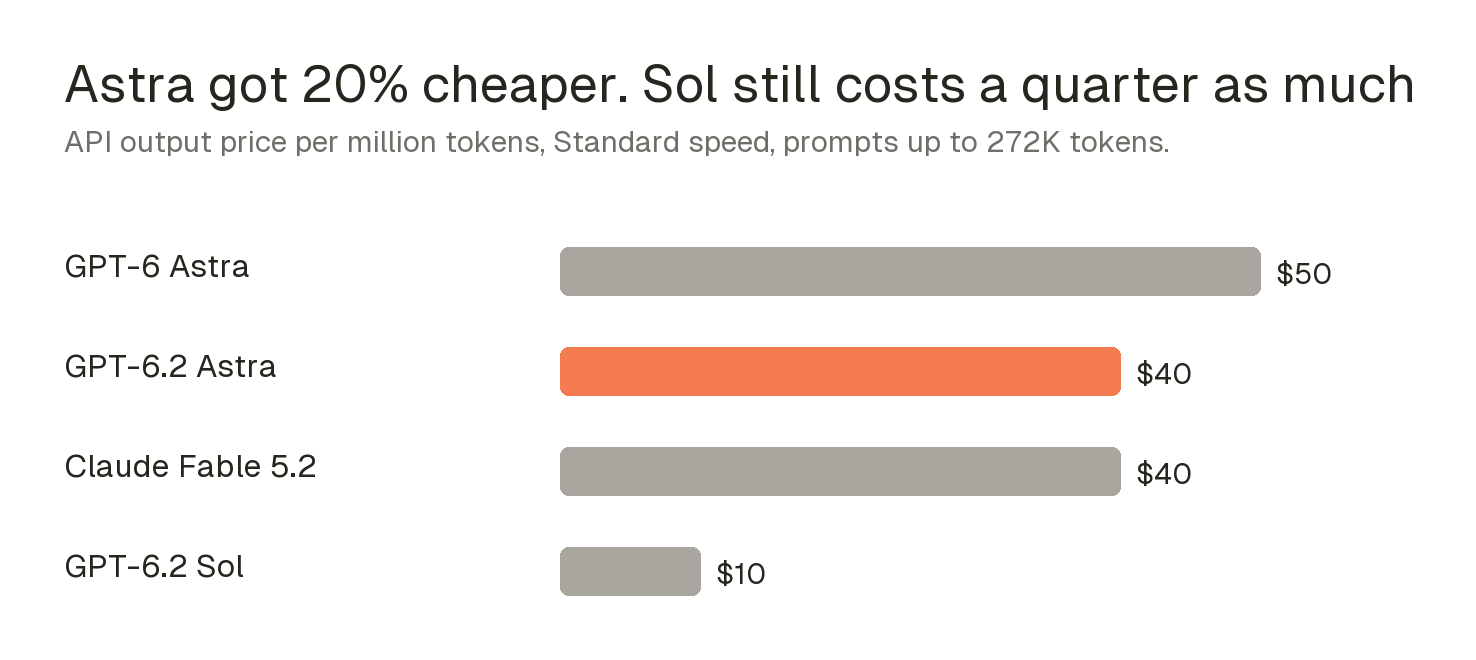
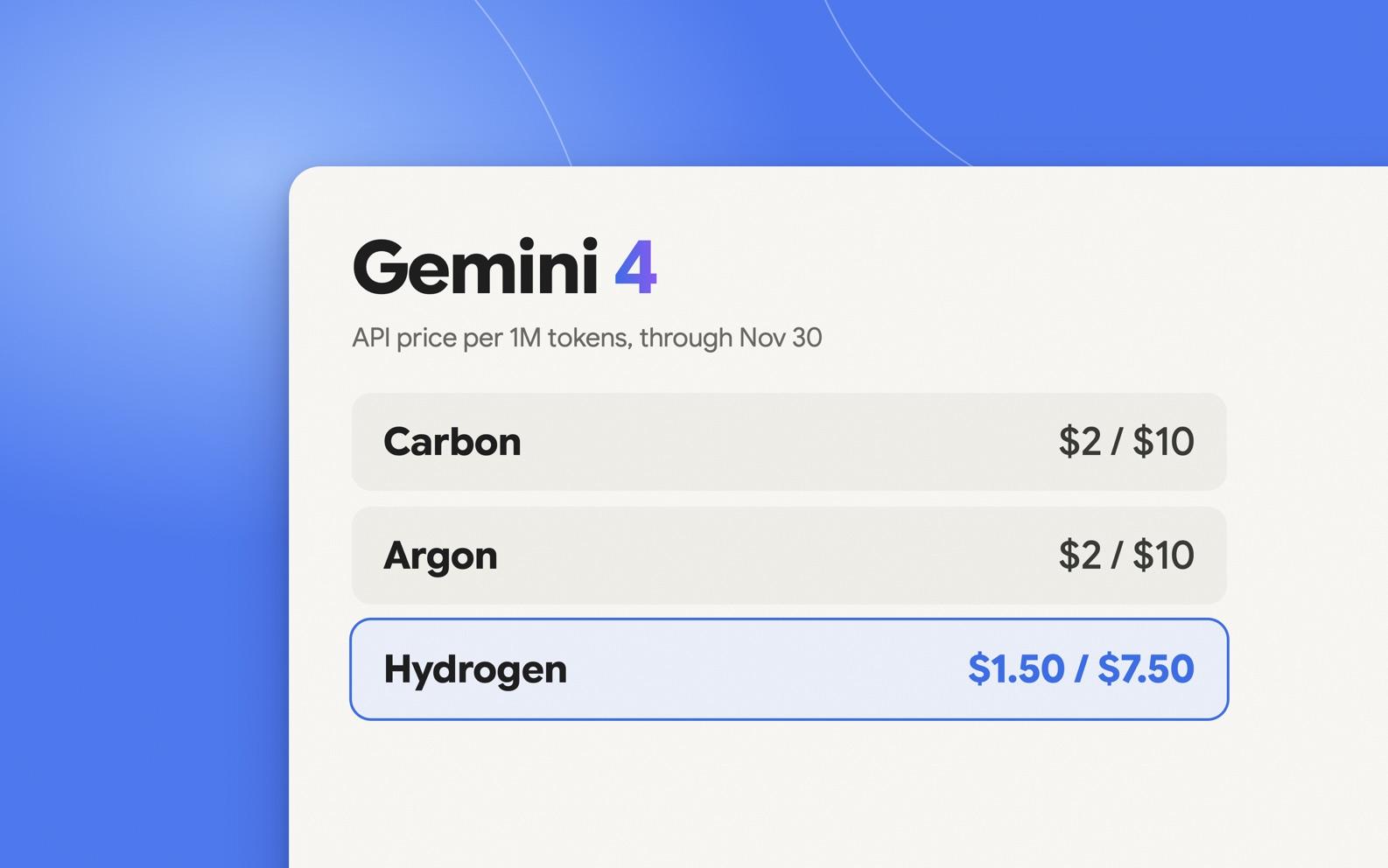
The cut puts Astra at exactly Claude Fable 5.2's list price, though Anthropic charges half as much for cache reads. Sol still costs a quarter of Astra and matches the introductory price of Google's Gemini 4 Carbon. Batch runs cost half the standard rate and Fast mode twice. Ultrafast, OpenAI's quickest tier, costs 3x the standard rate through February 28, 2027, then 6x from March 1.
Sources: API pricing (OpenAI)
What GPT-6.2 changes in Codex
For Codex users on ChatGPT Plus, the new models stretch a little further than the ones they replace. OpenAI estimates 6 to 50 local messages per five hours with GPT-6.2 Astra (GPT-6 Astra: 5 to 45) and 17 to 180 with GPT-6.2 Sol (GPT-6.1 Sol: 15 to 160). Pro plans still have no five-hour limit.
Once you run out, Astra costs 200 credits per million input tokens and 1,000 per million output, down from 250 and 1,250. Sol stays at 50 and 250. In Codex, Astra opens with a 272,000 token context and Sol with 500,000; both can go up to 1 million with the model_context_window setting in config.toml. Fast mode now uses 2x your included limits on the 6.2 models, against 2.5x on older ones, and Pro $200 subscribers get Ultrafast for the first time, starting with Sol.
One oddity: on November 18, the Plus card on OpenAI's pricing page still listed GPT-6.1 Sol and GPT-6 Luna, while the limits table below it already included the 6.2 models. Our Codex pricing breakdown has every plan, limit and credit rate updated for GPT-6.2.
Why power users are calling GPT-6.2 a step back
The first reviews were rough. Investor Matt Shumer wrote on X that the models were "essentially unusable" and skipped his usual long review; in his test, Claude models supervising Astra as a sub-agent kept redoing its work. Developer and YouTuber Theo Browne called Astra the worst model OpenAI has ever released, though he credited it with catching code-review issues others missed.
Wharton professor Ethan Mollick found Astra uneven and harder to steer, and said it was the first OpenAI frontier release since GPT-4.5 he didn't see as a clear step forward. Every CEO Dan Shipper said it often stopped early on end-to-end builds. Others were warmer: Raindrop.ai CTO Ben Hylak praised its animation, motion graphics and video editing work.
These are early impressions from a handful of heavy users, not controlled tests, and some of them build on rival models every day. Still, the independent index results above point the same way: GPT-6.2 is a solid price cut with modest gains, not a leap.
Sources: VentureBeat, November 17, 2026
The safety fine print security teams will notice
Both models hit the Critical cybersecurity threshold in OpenAI's Preparedness Framework, as GPT-6 Astra did. OpenAI added stricter safeguards for risky cyber requests, and it says plainly that they will also block some legitimate vulnerability research and security testing. Vetted security researchers are meant to go through OpenAI's Daybreak program instead, which at launch still pointed them to GPT-6 Astra or GPT-6 Cyber.
OpenAI also says Astra is the first model it has released externally that reaches the High threshold for AI self-improvement, meaning it can meaningfully speed up AI research. Its countermeasures include tighter controls on research environments and a monitoring system that can shut down research tasks. For US teams doing red-team or pentest work, expect more refusals and plan to test before switching.
Sources: The Decoder, November 17, 2026
Which GPT-6.2 model to start with
- Start with GPT-6.2 Sol for most coding, writing and agent work. It nearly matches Astra on real codebase changes, costs a quarter as much and gives you about three times the Codex messages on Plus.
- Switch to GPT-6.2 Astra for long science, legal or finance tasks and big refactors where Sol stalls. Test it on your own work first, given the mixed early reviews.
- If you're on GPT-6 Astra in the API, moving to GPT-6.2 Astra cuts your bill by 20% at the same token count.
- Doing security research? Check whether the new cyber safeguards block your workflow before you switch.
- Compare against Claude Fable 5.2 and Gemini 4 before committing. Fable has the same list price and leads the independent indexes for now.
Sources
- GPT-6.2 Astra and Sol are now available (OpenAI Developer Community, November 17, 2026)
- API pricing (OpenAI)
- Codex pricing (OpenAI)
- Codex models (OpenAI)
- OpenAI launches GPT-6.2 Astra and Sol with lower API prices and some benchmark gains (The Decoder)
- OpenAI launches GPT-6.2 Astra and Sol to negative reception from AI power users (VentureBeat)
- OpenAI releases GPT-6.2 Astra and Sol models (Seeking Alpha via TradingView)