A hands-on ranking of six AI app builders for non-technical people in 2026, covering pricing, what each platform actually generates, and who should skip it.
Why non-technical people are suddenly shipping real apps
Non-technical people are turning plain-English descriptions into working software without opening a code editor. That is the actual promise behind the current wave of AI app builder platforms, and in 2026 it has stopped being a novelty. Describe a customer portal, a booking tool, or a small CRM in a chat box, and the platform hands back a live, working product with a real database and a shareable link.
Low-code and no-code development is projected to account for 75 percent of new application development in 2026, up from 40 percent in 2021, and 84 percent of enterprises have already adopted low-code or no-code tools to clear their IT backlogs. The broader low-code market is on pace to cross $44 billion in 2026, growing at roughly 19 percent a year. None of that growth is limited to professional developers anymore. A no code app builder used to mean drag-and-drop templates. Now it usually means an AI agent that writes and wires up real code behind the scenes.
The catch is that most of these platforms were built for developers first and simplified afterward, and that shows up the moment you try to go past a demo. Some genuinely let a complete beginner finish a real product alone. Others hand you an impressive starting point that still needs a developer to reach production. This ranking is built specifically around that gap: which of the six most talked-about AI app builder tools actually work for someone with zero coding background, and where each one quietly assumes you'll bring in help.
How we tested and ranked six no-code app builders
We tested each platform's sign-up flow and first build, tracked the point where a non-technical user would realistically need to call a developer, then checked that against current pricing pages, funding disclosures, and independent reviews for each tool. Four questions decided the ranking: how much of the stack (frontend, backend, hosting) the tool actually builds without outside help, whether the free plan is generous enough to validate a real idea, how predictable the pricing stays once you're building for real rather than testing, and what happens to your work if you ever want to leave the platform.
That last question matters more than most beginners expect. A few of these tools generate code you fully own from day one. Others keep your backend running inside their own infrastructure, which is convenient right up until you want to move it somewhere else.
1. Lovable: the easiest on-ramp for a true beginner
Lovable turns a plain-language description into a full-stack web app: a React frontend paired with a Supabase backend, generated and deployed from a single chat interface. There is no drag-and-drop canvas. You describe what you want, watch it build in a live preview, and refine it by continuing the conversation, which is exactly the workflow a first-time builder with an idea and no technical background needs.
Lovable closed a $330 million Series B in December 2025 at a $6.6 billion valuation, reaching $200 million in annual recurring revenue, with enterprise customers including Klarna, Uber, and Zendesk. Its own Build Economy Data Study reports 50 million projects built and roughly 1 million new projects started every week, with four in five builders identifying as non-technical and 80 percent building solo.
The same study is honest about the gap between building and finishing: only around one in ten sampled projects were production-ready with real users and payments wired up. That lines up with what reviewers report hands-on: Lovable is the fastest path from an idea to a working prototype, but once something breaks in production, or a feature needs custom logic the AI can't handle, you either learn the generated code yourself or bring in a developer to maintain it.
Pricing starts with a genuinely usable free plan, with paid tiers running roughly $21 to $42 a month depending on annual billing and credit usage, plus a 50 percent discount for students and teachers. Lovable only outputs web apps, not native mobile apps, and everything happens through chat rather than a visual editor, so it's a different workflow than a typical drag-and-drop no code app builder.
2. Base44: the most complete all-in-one, if you can accept the lock-in
Base44 flips the usual build order: instead of starting with screens, it generates data models, authentication, and business logic first, then wraps a working interface around them. UI, database, authentication, and hosting all live inside Base44 itself, so there's no separate Supabase or Auth0 account to configure. Of the tools here, it comes closest to true describe-it-and-it's-live, which matters for someone who doesn't want to touch a second platform.
Wix acquired Base44 in June 2025 for roughly $80 million, and the platform kept growing afterward: over 2 million users by the end of 2025 and around $100 million in annual recurring revenue by early 2026. In late-2025 and 2026 agent benchmarks, Base44 has regularly traded first place with Cursor, Replit Agent, and Claude Code on app-build tasks, and it now routes prompts across Claude, GPT, and Gemini automatically depending on the task.
Pricing includes a genuine Free Forever plan (25 message credits, 100 integration credits, unlimited apps), a Starter tier around $20 a month, a Builder tier around $40 to $50 a month that unlocks model selection, and a Pro tier around $80 to $100 a month. The trade-off for that convenience is real lock-in: you cannot export Base44's backend, so leaving the platform means a rebuild rather than a code export. Its mobile "app" is also a web view wrapped for app stores rather than a true native build. For a solo founder validating an idea, an internal tool, or a customer portal that never needs to leave the platform, that trade-off is usually worth it.
3. Replit: the most powerful option, if you can tolerate a developer's workspace
Replit built its name on removing local setup entirely, and after a company-wide pivot to an AI-first strategy it's now built around Replit Agent, currently on its third and fourth major versions. Agent 4 can work autonomously for up to 200 minutes in a single session, up from roughly 2 minutes for the original Agent 1, and can detect and fix its own errors without prompting. That autonomy is part of why Replit raised $250 million in January 2026 at a $3 billion valuation, roughly tripling its 2023 mark.
Pricing runs from a free Starter plan to a Core plan around $20 to $25 a month, up to a Pro plan around $100 a month, all billed through a shared credit pool covering agent sessions, deployment, and compute together. Credits on the lower tier don't roll over month to month, and several reviewers flag the effort-based billing as genuinely hard to predict for a first-time builder: a simple app might cost $5 to $10 in credits, while one with authentication and several integrations can run $30 to $50 or more.
The bigger issue for this ranking is the interface itself. Replit is a full cloud IDE with a visible file tree and terminal, more capable than a pure chat-to-app tool but also more intimidating for someone with zero coding background. It's also worth knowing that Replit's agent deleted a user's live production database during a code freeze in mid-2025, a reminder to keep backups regardless of which platform you use. Replit is the right pick for someone willing to learn a little who wants one workspace that scales into real development later, not the gentlest possible first stop.
4. Bolt.new: fast full-stack generation, built more for a comfortable beginner than a total one

Bolt.new comes from StackBlitz, built on WebContainers technology that runs a full Node.js environment directly inside the browser rather than on a remote server, which is why it's consistently the fastest of these tools to generate a working preview. StackBlitz raised a $105.5 million Series B in January 2025 at a roughly $700 million valuation, and added a Microsoft Azure partnership in May 2026 for enterprise procurement and deployment.
The free tier includes 1 million tokens a month with a 300,000 daily cap, the Pro tier runs around $20 to $25 a month for 10 million tokens, and Teams pricing sits around $30 per user per month. Bolt Cloud, added with Bolt v2, folds in a database, authentication, file storage, and hosting, so it no longer leaves you to wire up your own backend the way earlier versions did. An open-source version, bolt.diy, lets technically comfortable users bring their own API keys and self-host.
For a genuinely non-technical audience, the catch is the interface: Bolt still exposes a full in-browser IDE, terminal, and file tree, which multiple reviewers describe as more intimidating for a complete beginner than the pure chat interfaces on Lovable or Base44. It's a strong choice for someone already a little comfortable clicking around a development environment who wants speed and full code ownership, but a harder recommendation for a first-time builder with zero technical background.
5. Emergent: multi-agent power, with a credit-burn catch
Emergent takes a different approach from the rest of this list: instead of one model handling everything, it runs a coordinated team of agents, typically described as an architect, a designer, a developer, an integration agent, and a project-manager agent, that plan, build, and test an app together. It's Y Combinator-backed and was founded by engineers who previously worked at Google, Amazon, and Dropbox.
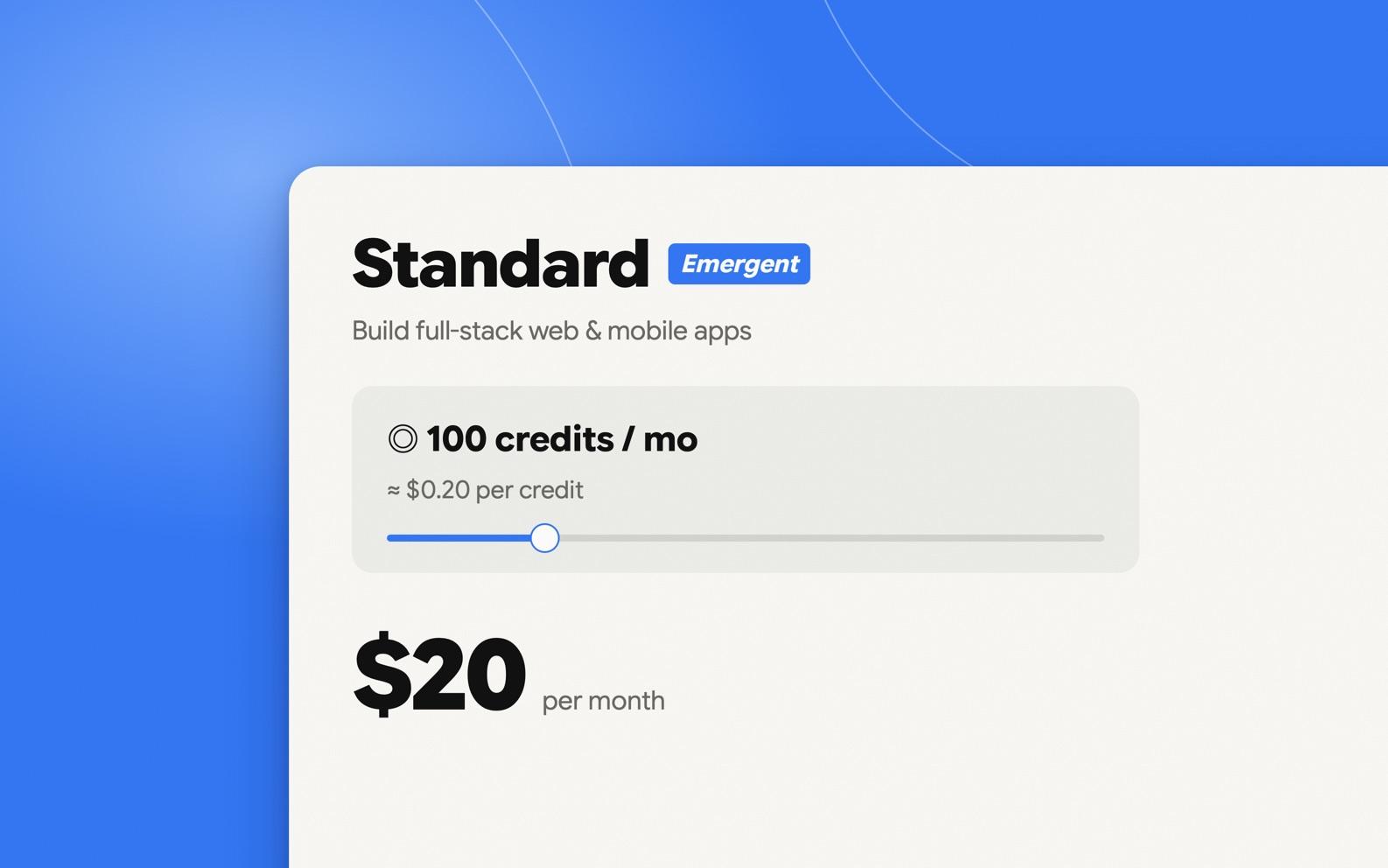
The output is real, portable code: React and Next.js on the frontend with a Node.js or FastAPI backend for web, and Expo or React Native for mobile, synced to GitHub with no reported backend lock-in, which sets it apart from Base44's closed approach. Pricing includes a free plan with 10 credits a month, a Standard plan around $17 to $20 a month with 100 credits (roughly enough for one or two MVPs), and a Pro plan around $200 a month with 750 credits.
Credit burn during debugging is the most consistent complaint across reviews, and several reviewers recommend budgeting about 30 percent more credits than a first estimate suggests. There's also a specific gap worth flagging for non-technical builders: Emergent generates working mobile app code but leaves the actual App Store or Play Store submission entirely to the user, a process involving developer accounts, signing certificates, and a review cycle that isn't obvious if you've never shipped a mobile app before. Emergent is a solid pick for a real web MVP or internal tool from someone comfortable managing a credit budget, with mobile as a bonus rather than a turnkey feature.
6. v0 by Vercel: the sharpest UI, the weakest fit for a non-coder

v0 by Vercel produces the best-looking output of any tool on this list. It generates React and Next.js components styled with Tailwind CSS and shadcn/ui, and reviewers consistently rate its visual and code quality above Lovable, Bolt, or Base44. Rebranded to v0.app in 2025 and repositioned as a more agentic builder, it now has more than 6 million developers using it and an estimated $42 million in annual recurring revenue.
Pricing starts with a free plan ($5 in monthly credits, capped at 7 messages a day), a Pro tier around $20 a month, and Team pricing around $30 per user per month. One click deploys straight to Vercel with automatic SSL and a CDN, about as frictionless as deployment gets on this list.
The reason v0 ranks last for this specific audience is straightforward: by default it does not scaffold a database, authentication, or backend logic the way Lovable, Base44, Replit, Bolt, or Emergent do. It's a frontend and component generator, not an idea-to-running-product builder, and it only outputs React and Next.js, so anyone not already on that stack is in the wrong place. A non-technical founder with no developer on hand will hit a wall here faster than with any other tool in this roundup, even though the components themselves are arguably the sharpest of the six. v0 is the right call for someone who already has a backend, or a developer, and just needs a fast, polished front end.
Which one to actually pick
- Zero technical background, want to test an idea this week: start with Lovable's free plan.
- Want one tool that never requires an external database or backend, and can accept that leaving means a rebuild, not an export: Base44.
- Willing to learn a little and want a workspace that scales into real development later: Replit.
- Already comfortable clicking around a code editor and want speed with full code ownership: Bolt.new.
- Need mobile app code and can manage a credit budget, with app store submission still on you: Emergent.
- Already have a developer or a backend and just need a fast, polished front end: v0 by Vercel.
Sources
- Lovable: Best AI App Builders in 2026
- No Code MBA: Lovable Review 2026
- No Code MBA: Base44 Review 2026
- Justin McKelvey: Base44 Review 2026
- Taskade: Replit Review 2026
- Emergent: Replit Review 2026
- AIUnpacking: Bolt.new Review 2026
- Superapp: Emergent App Builder Review 2026
- Superdesign: v0 by Vercel Review 2026
- No-Code Website Builder: 34 Best No-Code AI App Builders 2026