Image: Flickr / Wikimedia Commons / Unsplash
GLM Coding Plan Pricing: Lite, Pro, and Max Limits With GLM-5.3
What Z.ai's GLM Coding Plan costs, how its credit limits and off-peak pricing work, and what GLM-5.3 and GLM-5.3-Flash change for coding-agent users.
Image: Flickr / Wikimedia Commons / Unsplash
This article contains an affiliate link. AI Eating The World may earn a commission on qualifying purchases, at no extra cost to you.
The GLM Coding Plan starts at $18 per month and now runs on GLM-5.3 and GLM-5.3-Flash. Here are the tiers, credit limits, off-peak rules, and tradeoffs for US developers.
GLM-5.3 replaced GLM-5.2, and Flash arrived behind it
The GLM Coding Plan began as a way to run GLM-5.2 inside tools like Claude Code and Cline. GLM-5.2 arrived in mid-June 2026 with a 1 million-token context window, up from 200K on GLM-5.1, and Z.ai pitched it as a frontier-grade option for developers wary of depending on a single US vendor. That pitch carried extra weight after Anthropic suspended access to Claude Fable 5 and Mythos 5 on June 12 to comply with US export controls, a suspension that ended when access was restored on July 1.
Z.ai has since moved on. GLM-5.3 shipped on August 14, 2026, built on the same base model as GLM-5.2 with every gain coming from heavier post-training. Z.ai reports a 50% improvement over GLM-5.2 on its in-house Z.ai Code Bench, plus open-source state-of-the-art results on Terminal Bench 3.0 and Agents' Last Exam. Reasoning is now always on, with three effort levels (low, high, and max) and no way to switch thinking off, which matters if an existing workflow relied on non-thinking calls.
GLM-5.3-Flash followed on August 26. It is a natively multimodal model with 320 billion total parameters and 18 billion active, built for visual coding and cheaper agent loops. Inside the Coding Plan it carries about three times the usable quota of GLM-5.3.
GLM-5.3 also came with a safety wrinkle. Z.ai says cyber capability emerged faster than expected as it scaled post-training, and it staged the weights release behind a safety review, reportedly a first for the GLM line. The weights are now on Hugging Face under a dedicated GLM-5.3 license rather than the MIT license GLM-5.2 shipped under, so teams planning to self-host should read the terms.
GLM Coding Plan pricing, credits, and off-peak rules
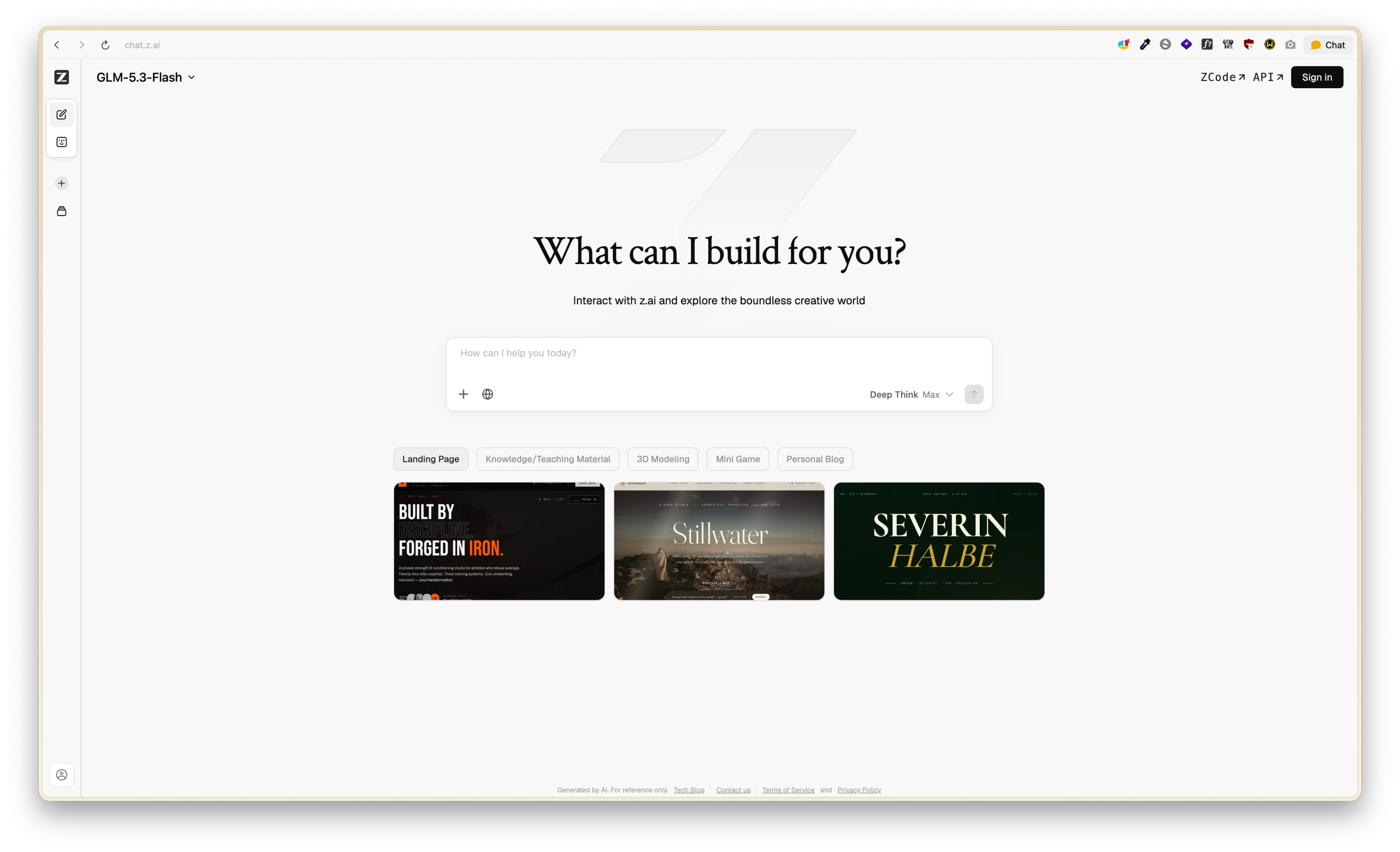
As checked on August 24, 2026, Z.ai lists standard monthly prices of $18 for Lite, $80 for Pro, and $168 for Max, with promotional prices of $12.60, $56, and $117.60 shown at the time. Promotional pricing is temporary, and some third-party trackers still list Pro at $72 and Max at $160, so confirm the checkout total on Z.ai before you subscribe.
The plan now runs on a credit system. Z.ai's documentation lists 2,000 five-hour and 10,000 weekly credits for Lite, 12,000 and 60,000 for Pro, and 28,000 and 140,000 for Max. Five-hour credits refresh five hours after use, and weekly credits reset every seven days from activation.
Credits are spent on tokens, not prompts. GLM-5.3 is charged at multipliers of 6.9 for input, 1.7 for cached input, and 24 for output. GLM-5.3-Flash uses 2.3, 0.56, and 8, and each web search, web reader, or Zread call costs 1.2 credits. Calls made during off-peak hours, including all day on weekends, cost half.
Peak hours run 2 PM to 6 PM Singapore time on weekdays. For US developers that lands roughly between 2 AM and 6 AM Eastern (11 PM to 3 AM Pacific), so most US working hours already count as off-peak.
Every plan supports GLM-5.3 and GLM-5.3-Flash. Requests for GLM-5.2 or GLM-5.1 are routed to GLM-5.3, and requests for GLM-4.7 are routed to GLM-5.3-Flash, so a subscription no longer lets you pin an older model. Through September 20, 2026, paid users also get unlimited GLM-5.3-Flash in ZCode and doubled Flash quota in other supported agents between 23:00 and 09:00 Singapore time (8 AM to 6 PM Pacific).
Sources for this section
Where GLM-5.3 lands next to Claude and GPT-5.6
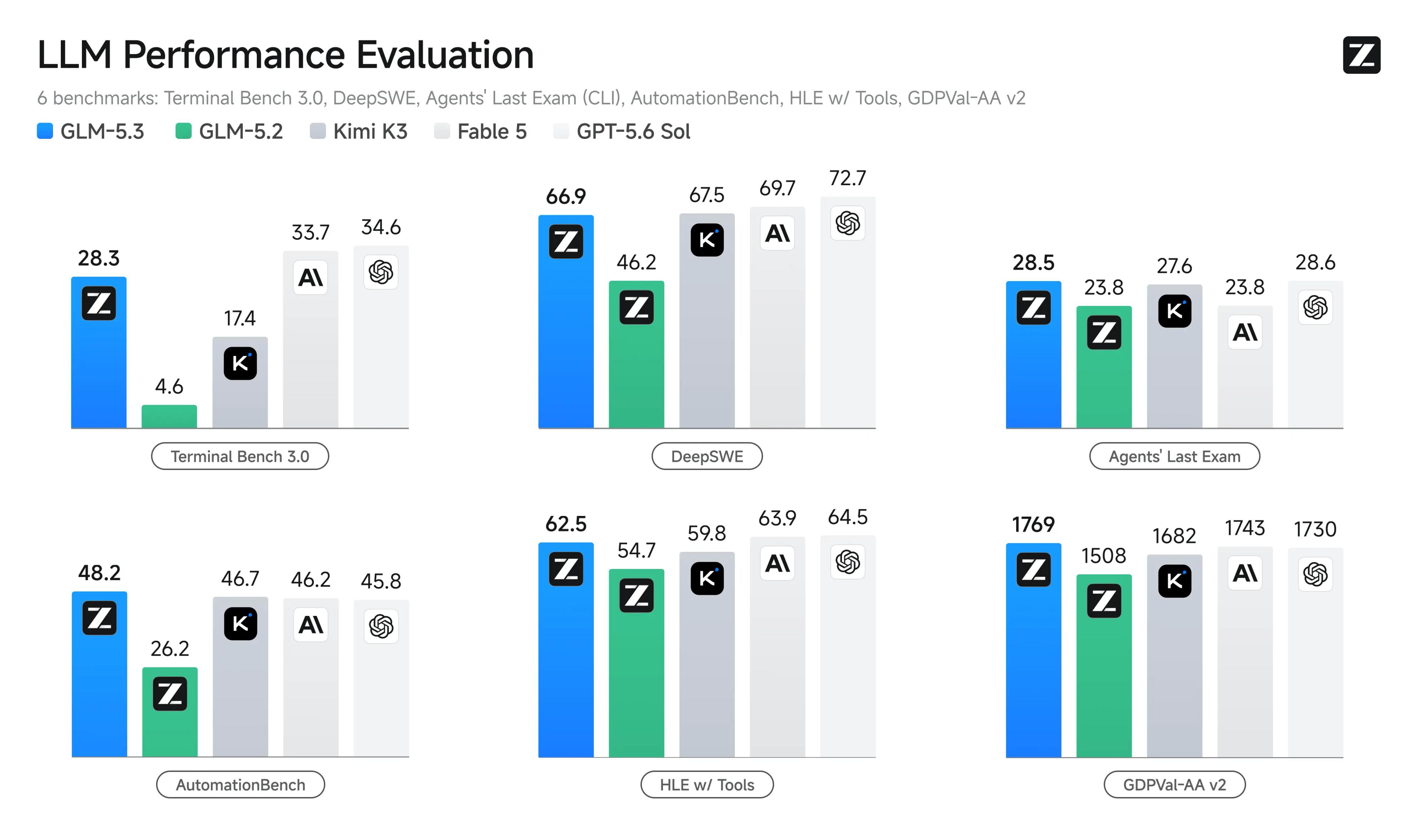
On Z.ai's own comparison table, GLM-5.3 leads the open-weight field but does not top the closed frontier models. On Terminal Bench 3.0 it scores 28.3, up from 4.6 for GLM-5.2, ahead of Claude Opus 4.8 at 21.1 but behind Claude Fable 5 at 33.7 and GPT-5.6 Sol at 34.6. On DeepSWE it posts 66.9 against 58.0 for Opus 4.8, 69.7 for Fable 5, and 72.7 for GPT-5.6 Sol.
The picture shifts by task. GLM-5.3 tops the table on CyberGym (84.5) and AutomationBench (48.2), but trails Fable 5 and GPT-5.6 Sol on ExploitBench (54.4 versus 78.0 and 76.5), and Opus 4.8 still posts the best scores on NL2Repo and SWE-Marathon.
Every figure here is vendor-reported. Z.ai ran most evaluations in the Claude Code harness with its own settings, and independent replication is thin, so read the table as Z.ai's best case. Its comparison set also uses Opus 4.8 and Fable 5, so check newer Claude releases such as Opus 5 and Fable 5.1 before treating any gap as current.
The cost gap is the stronger argument. GLM-5.3 lists at $1.40 per million input tokens and $4.40 per million output tokens on Z.ai's API, and Flash at $0.15 and $0.50. Compare those rates with what your team pays today, then decide whether GLM-5.3 becomes the default model or the fallback.
Who this actually makes sense for
The open weights are the part worth pausing on. GLM-5.3 and GLM-5.3-Flash can both be downloaded and served on your own infrastructure through frameworks like vLLM and SGLang, which means strong coding help without sending proprietary code to an outside API. Check the license first: GLM-5.3 ships under its own GLM-5.3 license, and Flash is reported to be MIT-licensed.
Be realistic about hardware. GLM-5.3 has about 753 billion parameters, so self-hosting is a datacenter job, not a workstation one. Flash, at 320 billion total and 18 billion active, is lighter but still a datacenter-class deployment.
For hosted use, the plan fits developers who run long agentic sessions: refactors across large repositories, CI triage, and multi-hour agent loops, where Z.ai says GLM-5.3's gains concentrate. Flash adds native visual coding, so an agent can open a page, inspect the result, and check its own changes, which suits front-end and mobile work.
It is a weaker fit for occasional users. Credits reward steady sessions, and the plan only works inside Z.ai's supported coding tools, so scripts and production API workloads need pay-as-you-go API billing instead.
Sources for this section
The tradeoffs worth knowing before you switch
GLM-5.3 is expensive in credits. With a 24x output multiplier it drains an allowance far faster than Flash does. Z.ai's own estimate for Lite runs from roughly 48 million to 97 million GLM-5.3 tokens a week at a 95% cache hit rate, depending on whether usage lands in peak or off-peak windows. Routing routine edits to Flash is the practical way to stretch quota.
Reasoning is always on. GLM-5.3 defaults to max effort and no longer lets you disable thinking, so latency and token use can climb on simple tasks unless you explicitly pass low or high.
The cyber gains cut both ways. Z.ai says GLM-5.3 more than doubles GLM-5.2 on exploitation benchmarks, which helps defenders but is also why the weights were held for safety review. Teams with security policies on model use should account for that.
Prices and promotions move quickly. Z.ai has run several promotional windows, including the Flash campaign that ends September 20, and third-party trackers disagree on Pro and Max prices. Confirm current pricing and limits directly on Z.ai before committing to annual billing.
Getting started with the GLM Coding Plan
For US developers deciding whether to add a second model to their coding stack, start by matching credits to workload. Lite is positioned for one lightweight project, Pro for regular work across one or two projects, and Max for heavier concurrent use. Because most US working hours fall in the off-peak window, the half-price credit rate covers a lot of daytime usage.
Run GLM-5.3 on work you can evaluate, use GLM-5.3-Flash for routine edits and visual checks, and compare output quality and credits consumed against your current stack before committing to a longer billing cycle. If you are weighing tools rather than models, our coding tool comparisons are a good next read.
Sources
Brian Weerasinghe is the founder and editor of AI Eating The World, where he covers artificial intelligence, tech companies, layoffs, startups, and the future of work. His reporting focuses on how AI is transforming businesses, products, and the global workforce. He writes about major developments across the AI industry, from enterprise adoption and funding trends to the real-world impact of automation and emerging technologies.