In three randomized experiments, people who used an AI assistant for a short session solved fewer problems and skipped more once the AI was taken away. The damage was concentrated in people who asked the AI for answers, not hints.
What the Berkeley study found about cognitive offloading
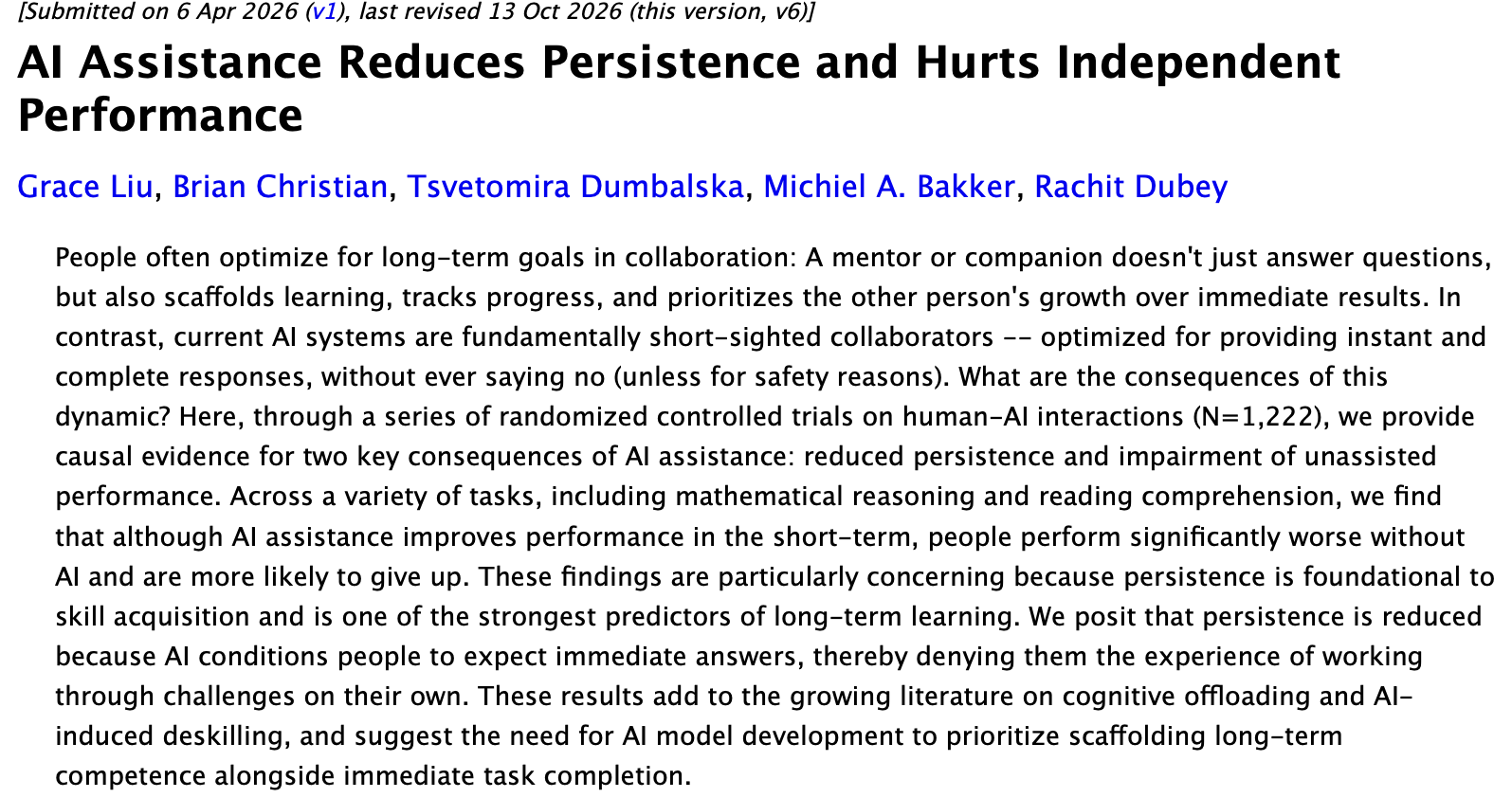
Cognitive offloading means handing mental work to a tool, the way a calculator holds arithmetic or a phone holds phone numbers. A new paper puts a number on what that costs when the tool is an AI chatbot. Researchers from UC Berkeley, Carnegie Mellon, MIT, Oxford and UCLA ran three randomized experiments with 1,222 US adults. People who had an AI assistant for a short session did worse, and gave up more often, as soon as the assistant was removed.
The paper, "AI Assistance Reduces Persistence and Hurts Independent Performance," is led by Grace Liu of Carnegie Mellon with Brian Christian of Berkeley's Center for Human-Compatible AI. Berkeley News reported on October 9 that the updated, peer-reviewed version was presented at the Conference on Language Modeling (COLM).
How the experiment worked
Participants worked through fraction problems (two experiments) or SAT-style reading questions (one experiment). Half had a GPT-5 assistant in a sidebar that already knew each problem and its solution. The other half worked alone. After about 10 to 15 minutes, the AI disappeared without warning and everyone faced three final test problems on their own. A skip button was always available, and wrong answers cost nothing, so skipping measures motivation rather than fear of failure.
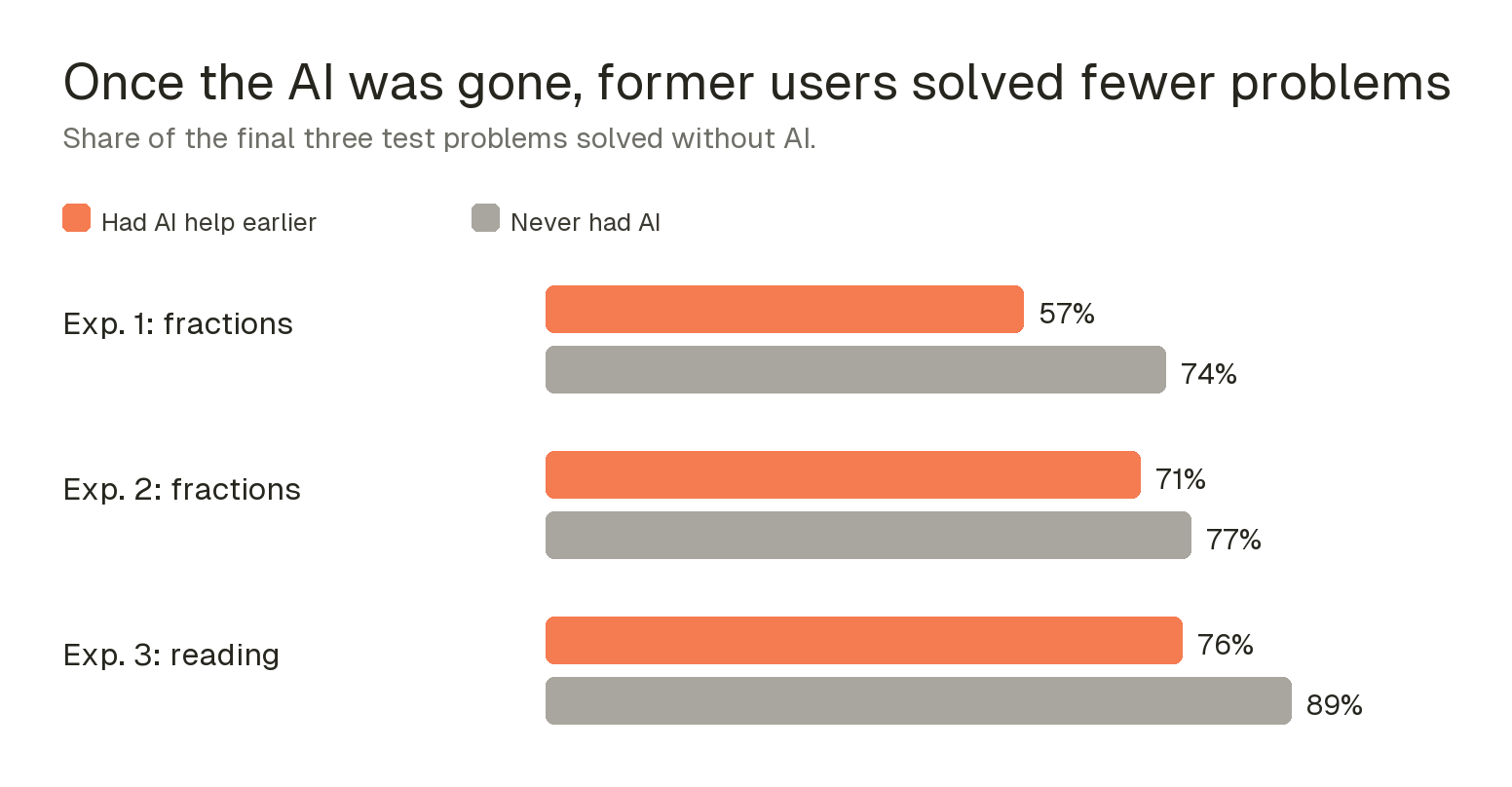
In the first fractions experiment, former AI users solved 57% of the test problems against 74% for people who never had AI. The replication with 585 people showed a smaller but still significant gap, 71% vs 77%. In reading comprehension the gap was 76% vs 89%.
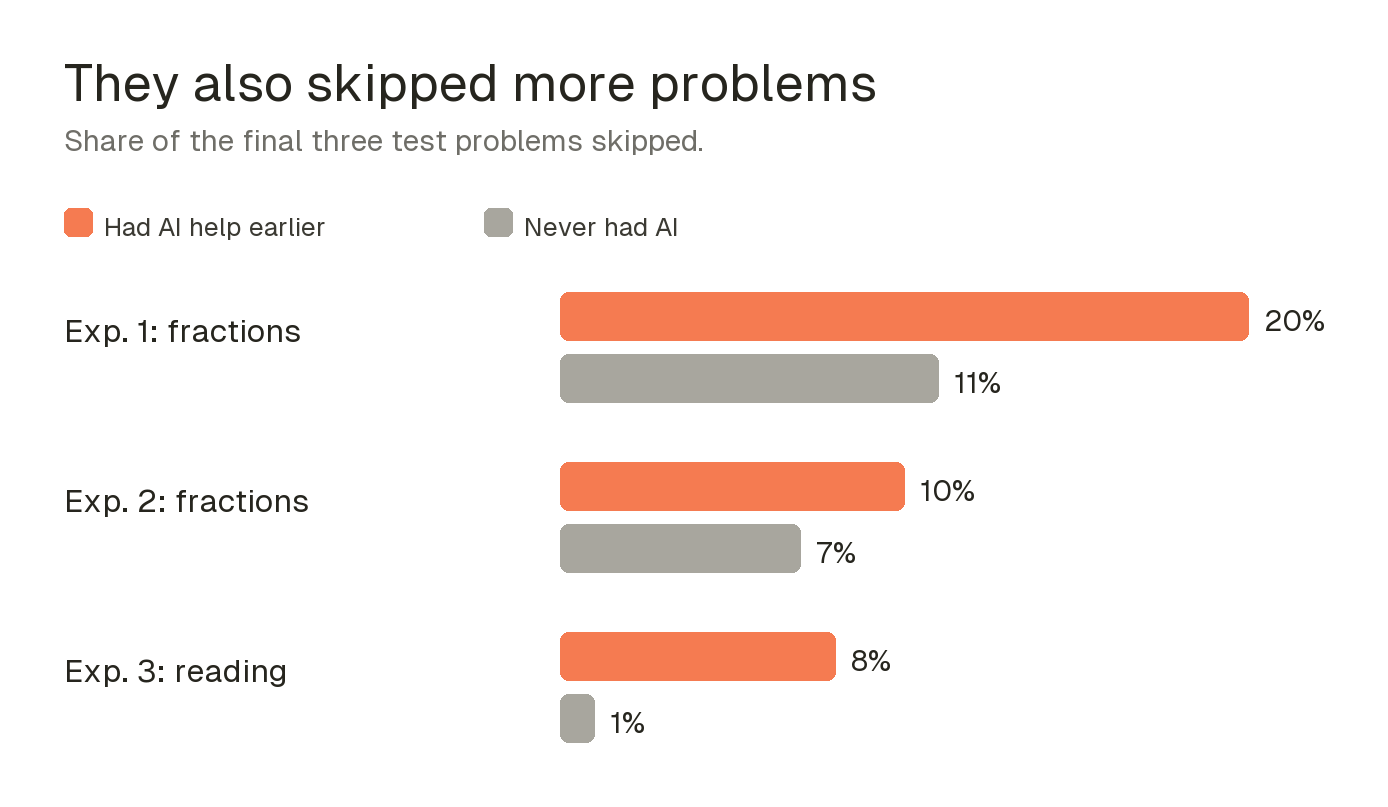
Skipping tells the persistence story. Former AI users skipped 20% of problems in experiment 1, nearly double the control group's 11%, and 8% vs 1% in the reading test. In the replication the overall skip gap was small and not statistically significant, a detail Berkeley's own press release glossed over.
Is AI making us dumber? Only if you ask it for answers
The most useful finding is buried in experiment 2, where the researchers asked people how they had used the assistant. Sixty-one percent asked it for direct answers. Twenty-seven percent asked for hints or clarification. Twelve percent barely used it.
The answer-seekers drove the damage. They solved 65% of test problems against 77% for the control group, and they were the ones skipping more. People who asked for hints solved 76% and skipped less than the answer-seekers. People who had the AI but ignored it solved 89%, though that group likely included stronger students who felt no need for help. The authors call this analysis correlational, not causal.
So does AI make you dumber? This study does not show that. It shows something narrower: when an assistant does the thinking for you, you get used to not struggling, and the struggle feels worse when it comes back. The authors argue AI conditions people to expect immediate answers. That is a habit problem, and habits depend on how you use the tool.
Christian made the stakes plain to Berkeley News: "This is not a story about fractions and SAT problems." Persistence is one of the strongest predictors of long-term learning, which is why the paper treats a small drop in a short session as a warning.
AI and critical thinking: what other studies show
The Berkeley result fits a growing body of research on the negative effects of AI on thinking, though each study measures something different. A 2025 MIT Media Lab study, often called the MIT ChatGPT study, used EEG headsets on 54 people writing essays. The ChatGPT group showed the weakest brain connectivity and struggled to recall what they had written. That paper was small and not peer reviewed when it came out.
A 2025 Microsoft Research and Carnegie Mellon survey of 319 knowledge workers, presented at CHI 2025, found that confidence in AI went with less critical thinking effort, while confidence in one's own skills went with more. That study relied on self-reports.
What the Berkeley paper adds is causation. Random assignment means the gap comes from the AI, not from who chose to use it. What none of these studies show yet is lasting AI cognitive decline. The Berkeley team tested people minutes after the AI was removed. Whether the effect fades in an hour or builds over a semester is unknown.
The limits, and what the authors want from AI labs
Keep the caveats in view. The tasks were fractions and reading questions, not software engineering or legal analysis. The assistant was built to be as helpful as possible, so the study says nothing yet about a tutor-style AI that withholds answers. The authors themselves urge caution about reading the results as broad evidence.
They are also skeptical of easy fixes. In their conclusion they write that user-side changes such as Socratic AI or limited use time may help at the margins but will only serve as "band-aids," because AI offers a temptation to offload at scale. Their ask is for model developers to design for long-term competence alongside instant task completion.
Our view: this matters most for US companies rolling out AI to junior staff. A new hire who never learns to push through a hard problem becomes a senior employee who cannot check the AI's work. We wrote about that gap in how AI rollouts create an internal skills divide.
How to use AI without losing your edge
- Ask for hints before answers. In the study, hint-seekers held up far better than answer-seekers.
- Try the problem first. Give yourself a few minutes before opening the chat, so the AI checks your thinking instead of replacing it.
- Use tutor or study modes for learning, and save full answers for work you already understand.
- For teams: watch AI dependency in junior staff. Review their reasoning, not just their output.
- Every so often, do the task without AI to see where your own skills stand.
Sources
- Liu, Christian, Dumbalska, Bakker, Dubey: AI Assistance Reduces Persistence and Hurts Independent Performance (arXiv 2604.04721v6, October 13, 2026)
- Berkeley News: Study explores how AI use affects performance on math and reasoning tasks (October 9, 2026)
- Kosmyna et al.: Your Brain on ChatGPT (MIT Media Lab, arXiv 2506.08872, 2025)
- The Register: Some workers already let AI do the thinking for them, Microsoft researchers find (February 11, 2025)