Image: Flickr / Wikimedia Commons / Unsplash
Claude Science: Anthropic Builds an AI for Science Workbench, Not Just Another Model
The new desktop app bundles 60+ scientific databases, compute management, and reproducible outputs into one environment, entering a race that already includes Google's Gemini for Science and OpenAI's GPT-Rosalind.
This article was produced by the AETW editorial team.
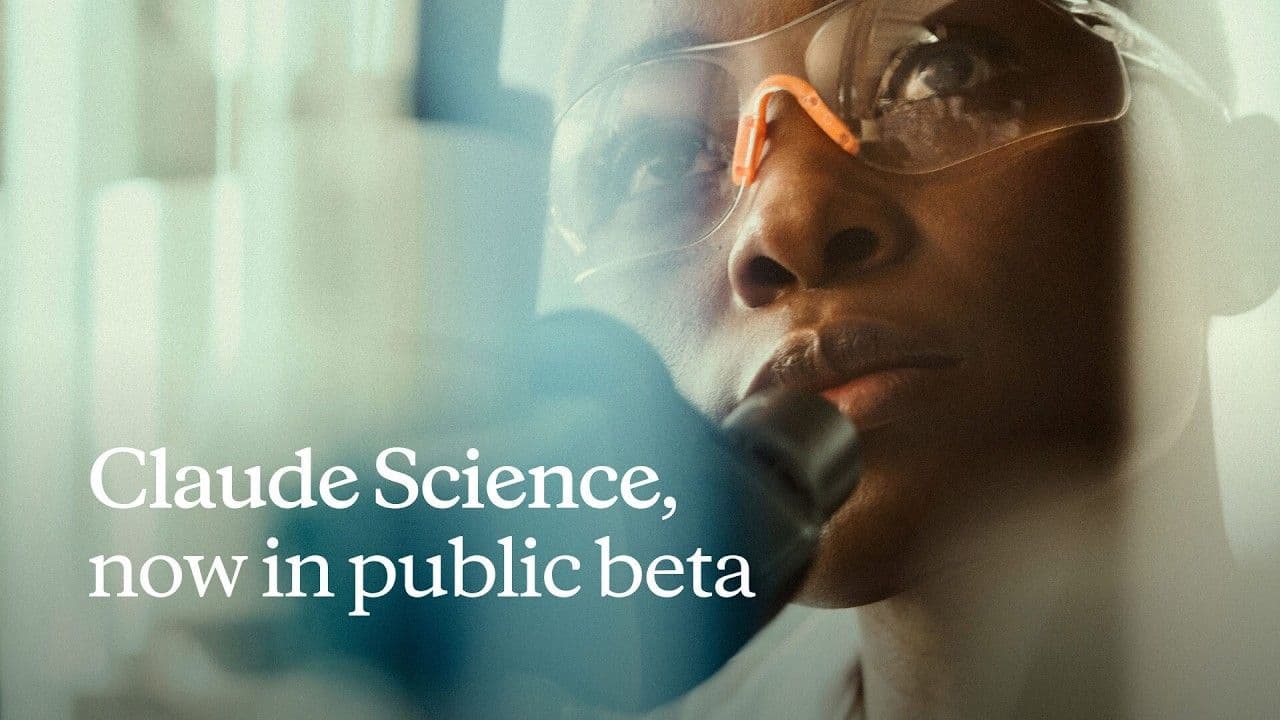
Anthropic launched Claude Science on June 30, a standalone desktop app that turns Claude into a full research workbench with 60-plus scientific databases and reproducible outputs, entering a three-way race for AI for science with Google's Gemini for Science and OpenAI's GPT-Rosalind.
A workbench, not another model

Source: Anthropic
Anthropic released Claude Science on June 30, 2026, a standalone desktop app built specifically for scientific research rather than general chat or coding. It joins the existing Claude app lineup on Mac, which already includes Claude AI, Claude Cowork, and Claude Code, as a purpose-built environment for lab work. The app is currently in public beta on macOS and Linux for Pro, Max, Team, and Enterprise plans.
Claude Science is not a new model. It runs on Claude models already available on those plans, including Opus 4.8, and instead bundles the surrounding infrastructure researchers actually need day to day: more than 60 curated scientific skills and connectors pre-configured for genomics, single-cell analysis, proteomics, structural biology, and cheminformatics. That distinction matters for how Anthropic is positioning the product inside its broader AI for science strategy, as a workflow layer rather than a benchmark play.
A generalist coordinating agent handles the overall conversation and can spin up specialist sub-agents for individual tasks, or hand off to specialist agents researchers have built themselves. A separate reviewer agent checks citations and calculations, flagging results that cannot be traced back to supporting evidence.
Sources for this section
The reproducibility argument
Anthropic's pitch centers on a problem familiar to anyone who has tried to rerun a colleague's analysis months later: most scientific workflows are not actually reproducible. Every artifact Claude Science produces, whether a figure, a table, or a notebook, ships with the exact code that generated it, the computing environment it ran in, a plain-language description of the process, and the full conversation history behind it.
The app is also built to run on infrastructure researchers already control: a laptop, a lab Linux box, a Slurm cluster over SSH, or an HPC login node, with jobs scaling from a single GPU to hundreds through a Modal integration for on-demand compute. Anthropic says large or sensitive datasets never have to leave the systems they are already on, since only the context needed for each analysis step gets sent to Claude itself, a detail aimed squarely at labs handling genomic or patient data that would never touch a consumer chatbot.
Researchers can also fork a session mid-analysis to compare two approaches side by side without losing the original thread, and can ask the agent to edit its own code in plain language, removing gridlines from a chart or switching an axis to log scale, for example.
Sources for this section
Where it has already been useful

Source: Anthropic
Anthropic has been testing Claude Science with beta users since last fall as part of a broader life sciences push, alongside Claude for Life Sciences and this month's Claude Fable 5 release, which the company said could accelerate parts of drug design tenfold.
Manifold Bio, which designs tissue-targeting medicines, used the app to rank candidate binders across hundreds of targets by surface expression, trafficking, and safety criteria drawn from the company's own proprietary data. Manifold said what set Claude Science apart from a general coding assistant was that it could run the process end to end, gathering the right data and applying judgment informed by the context of past programs.
At the Allen Institute, neuroscientist Jerome Lecoq built a roughly 20-skill multi-agent pipeline that reads through thousands of papers, extracts central claims and quantitative findings into an evidence database, then drafts long-form scientific reviews section by section using actor-critic agent pairs. Work that previously took his team up to two years now produces reviews often exceeding 100 pages, with citations checked by a dedicated reviewer agent.
At UCSF, epidemiologist Stephen Francis said the app cut the time for comprehensive germline variant workups in his glioma research to roughly a tenth of what it previously took, with the faster results independently validated by his own lab.
Sources for this section
Three companies, three different bets on AI for science
Claude Science lands in the middle of a fight that has been building since April. OpenAI released GPT-Rosalind, a model fine-tuned specifically for biological reasoning that leads on the BixBench bioinformatics benchmark and beat GPT-5.4 on 6 of 11 LABBench2 tasks. Access runs through a Trusted Access program gated behind a governance and pathogen-misuse review, currently limited to named partners including Amgen, Moderna, Novo Nordisk, Thermo Fisher Scientific, and the Allen Institute.
Google took a different route with Gemini for Science, launched at I/O in May, bundling frontier models with more than 30 life-science databases and an AI co-scientist hypothesis engine built on top of Google Antigravity, alongside foundational science models like AlphaFold and AlphaGenome.
Anthropic's differentiator is access rather than benchmark supremacy. Claude Science is available in beta to any paid Pro, Max, Team, or Enterprise subscriber with no qualification process, running on the same Claude models already included in each plan rather than a separately gated, science-tuned model. That openness is also a bet: GPT-Rosalind's benchmark numbers currently do not include Claude models for direct comparison, so Anthropic is competing on workflow and access rather than head-to-head scores.
Sources for this section
What this means for builders watching from the outside
For teams outside biotech and pharma, the more interesting signal may be strategic rather than technical. Anthropic has filed confidentially for an IPO, and Claude Science fits a pattern of building vertical, revenue-generating products, Cowork, Claude for Chrome, Claude for Excel, and now Science, ahead of that listing rather than betting everything on one general-purpose chatbot.
Anthropic is backing up to 50 AI for Science projects with as much as $30,000 in credits each, plus up to $2,000 in Modal compute for select projects, with an early focus on biology and biomedical research. Applications close July 15, 2026, with award notifications by July 31 and funded projects running from September 1 to December 1.
Team and Enterprise users need an admin to switch access on, and Anthropic is offering discounted Team seats to active scientific labs at academic institutions and nonprofit research organizations, a detail worth flagging for any university lab or research nonprofit already paying for Claude.
- Claude Science is in public beta now for Pro, Max, Team, and Enterprise plans on macOS and Linux.
- It runs on existing Claude models (including Opus 4.8), not a new science-specific model.
- AI for Science project applications are open through July 15, 2026, with up to $30,000 in credits per award.
Sources
Brian Weerasinghe is the founder and editor of AI Eating The World, where he covers artificial intelligence, tech companies, layoffs, startups, and the future of work. His reporting focuses on how AI is transforming businesses, products, and the global workforce. He writes about major developments across the AI industry, from enterprise adoption and funding trends to the real-world impact of automation and emerging technologies.