Anthropic released Claude Opus 5 on July 24, matching Opus 4.8's pricing while approaching Fable 5's performance on coding and knowledge-work benchmarks, as competition from GPT-5.6 and Chinese open-weight models intensifies.
What Anthropic actually shipped
Anthropic released Claude Opus 5 on July 24, 2026, and it is available immediately across the Claude API, Claude.ai, Claude Code, and Claude Cowork. The headline is pricing: Opus 5 costs $5 per million input tokens and $25 per million output tokens, exactly what its predecessor Opus 4.8 charged. Fable 5, Anthropic's more expensive frontier model, costs twice as much at $10 and $50 per million tokens respectively.
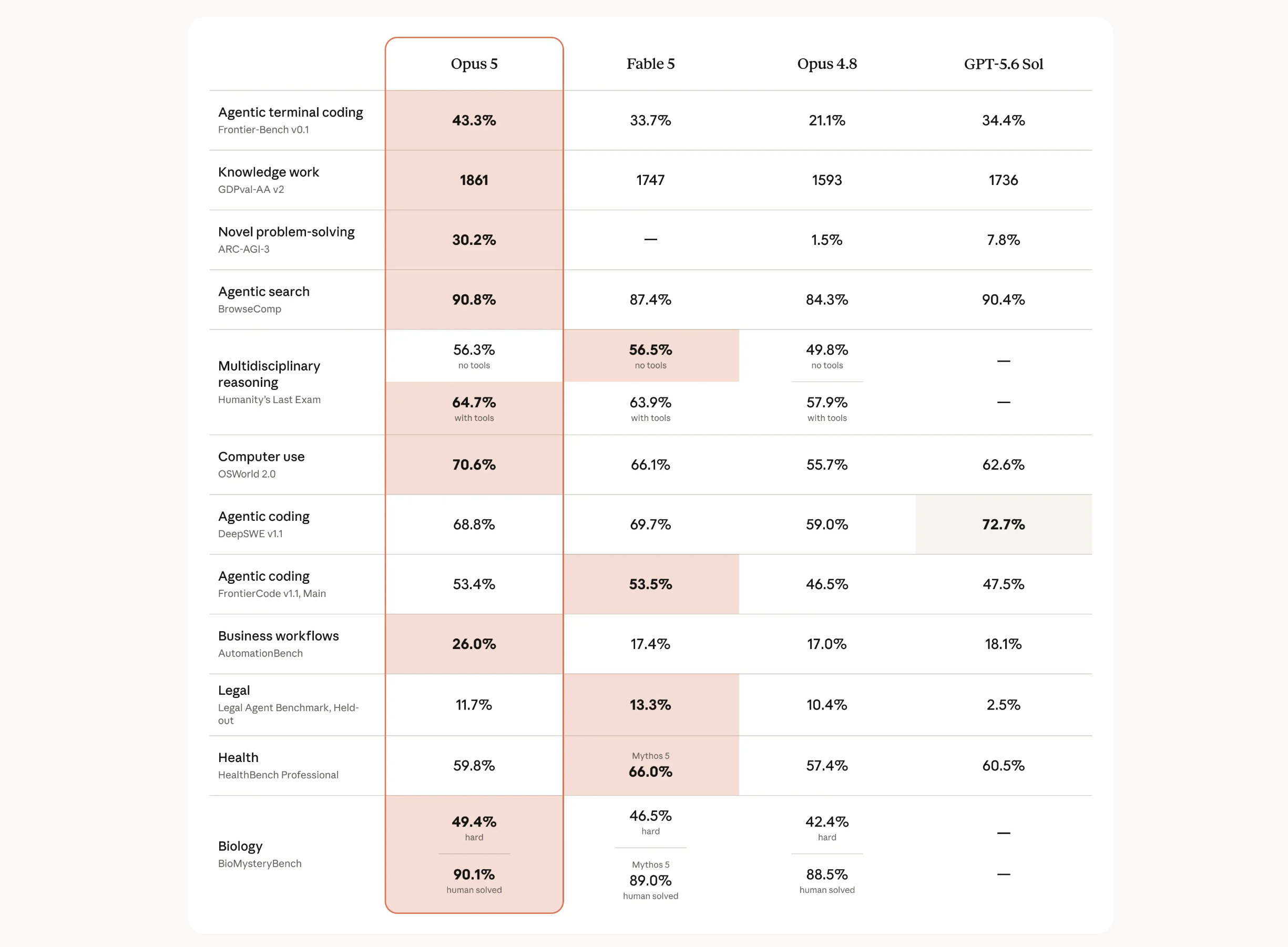
Anthropic says Opus 5 is now state of the art on coding and knowledge-work evaluations like Frontier-Bench and GDPval-AA, and that on CursorBench it lands within half a percent of Fable 5's peak score at half the cost per task. The company also shipped a five-level effort setting (low, medium, high, xhigh, max) that lets developers trade intelligence for speed and cost, plus a Fast mode that runs about 2.5x faster for double the base price.
Opus 5 is now the default model on Claude Max and the strongest model available on Claude Pro, Anthropic's consumer subscription tiers.
Sources: Anthropic: Introducing Claude Opus 5
The pitch is the daily driver, not the smartest model in the room
Anthropic isn't claiming Opus 5 is its smartest model. That title still belongs to Fable 5. Instead, the company is arguing that most economically valuable AI work sits in a middle band of difficulty, where near-frontier intelligence delivered cheaply beats frontier intelligence delivered expensively. An Anthropic spokesperson described Opus 5 to VentureBeat as the model teams hand complex work to and review once it's done, positioning it as the daily driver of the lineup rather than the ceiling.
Early-access partners back up that framing with concrete numbers rather than just enthusiasm. Zapier said Opus 5 topped its AutomationBench leaderboard without burning more tokens than prior Claude models, completing a full churn-prevention workflow end to end where earlier models failed outright. Cognition, the company behind the Devin coding agent, said Opus 5 approaches Fable-level performance on FrontierCode 1.1 at half the cost. Box reported an 8% overall improvement over Opus 4.8, with due-diligence workflows improving 17%.
For teams already running Claude Code or Cowork, the practical shift is that the model many of them were avoiding on cost grounds now performs closer to the one they were saving for hard problems only.
Where Opus 5 still stops short
Anthropic is explicit that Opus 5 does not push the frontier on risky, dual-use capabilities. It remains behind Mythos 5, Anthropic's top safety-tier model, on both biology research and offensive cybersecurity. The two models are close on identifying vulnerabilities, but Opus 5 falls well behind on turning a vulnerability into a working exploit, a gap Anthropic says is intentional since the model wasn't trained on offensive cyber tasks.
Because of that, Opus 5 ships with lighter cybersecurity classifiers than Fable 5. It can find vulnerabilities in source code but blocks binary-based scanning, penetration testing, and exploit generation. Anthropic expects these classifiers to intervene roughly 85% less often than Fable 5's, with flagged requests falling back to Opus 4.8 by default in Claude.ai, Claude Code, and Claude Cowork.
On alignment, Anthropic's own automated behavioral audit scored Opus 5 as its most aligned model yet, ahead of Opus 4.8, Sonnet 5, and Fable 5, with the lowest recorded rates of deceptive behavior. That claim comes from Anthropic's internal testing, not an independent third party, and is worth reading with that caveat in mind.
Sources: Anthropic
The launch lands in the middle of a price war
Opus 5 didn't ship in a vacuum. OpenAI's GPT-5.6 Sol has been public since July 9 and, by OpenAI's own internal evaluations, outperformed Fable 5 by 11.4 points at medium reasoning while costing roughly a quarter as much. Moonshot AI's Kimi K3, a 2.8-trillion-parameter open-weight model with a 1-million-token context window, launched July 16 and undercuts frontier pricing even further. Z.AI's GLM 5.2 has added to the pressure from the open-weight side.
Anthropic's own reporting acknowledges the same dynamic: Opus 4.7 ended up costing 30 to 40% more per task than Opus 4.6 despite identical headline rates, since token efficiency, not the sticker price, decides the real bill. Opus 5's pitch only works if its lower per-task cost holds up once teams run it at the effort levels they actually need for production work, not just the benchmark-optimized settings in Anthropic's own charts.
For US builders, this is the second Anthropic model launch in a month following Sonnet 5 on June 30, and it comes against a backdrop where Google's flagship Gemini update has reportedly slipped. The competitive axis analysts are watching has shifted from raw benchmark wins toward total cost of ownership and which ecosystem enterprises are willing to standardize on.
What to actually try first
- Start new agentic and coding work on Opus 5's low or medium effort setting; Anthropic's own prompting guidance says these settings now beat the equivalent tiers on Opus 4.8 at a fraction of the tokens.
- Reserve xhigh or max effort for genuinely hard software engineering and long-running agent tasks, where Opus 5 has shown the largest gains over its predecessor.
- Track your actual per-task token spend for two weeks rather than trusting the headline per-million-token rate. Prior Opus releases have shown that efficiency, not price, determines the real cost.
- If your workload touches cybersecurity research or biology, expect some requests to fall back to Opus 4.8 automatically and plan around that rather than being surprised by it mid-project.