Image: Flickr / Wikimedia Commons / Unsplash
She Built a Women's Safety App With Zero Coding Experience. It Hit $456K ARR in 3 Months.
Sabrine Matos had never written a line of code. After a femicide case hit close to home, she used the AI app builder Lovable to launch Plinq, a women's safety app, in 45 days.
This article includes an affiliate link to Lovable. AETW may earn a commission if you sign up through it, at no extra cost to you. This does not affect our editorial coverage.
A Brazilian growth marketer with no engineering background built Plinq, a women's safety app, entirely inside the AI app builder Lovable. In three months it reached $456K in annual recurring revenue and 10,000 users, and helped flag over 200 potentially dangerous situations.
A phone call that became a product
Sabrine Matos spent her career in growth marketing, sitting next to product teams without ever building anything herself. That changed in February 2025, when a femicide case in Brazil made national news: a woman murdered by a partner who had a violent criminal record she never knew about.
Matos's mother called her after seeing the story. Her message was direct: women in Brazil have no way to check this kind of information until it is too late. Brazil has one of the highest rates of gender-based violence in the world, with 37.5% of women aged 16 and older reporting some form of violence in the past year, the highest rate recorded since national monitoring began in 2017.
Matos had no engineering degree and could not write a line of code. She turned to Lovable, an AI app builder that converts plain-English prompts into working software, and started building anyway.
What she built in 45 days
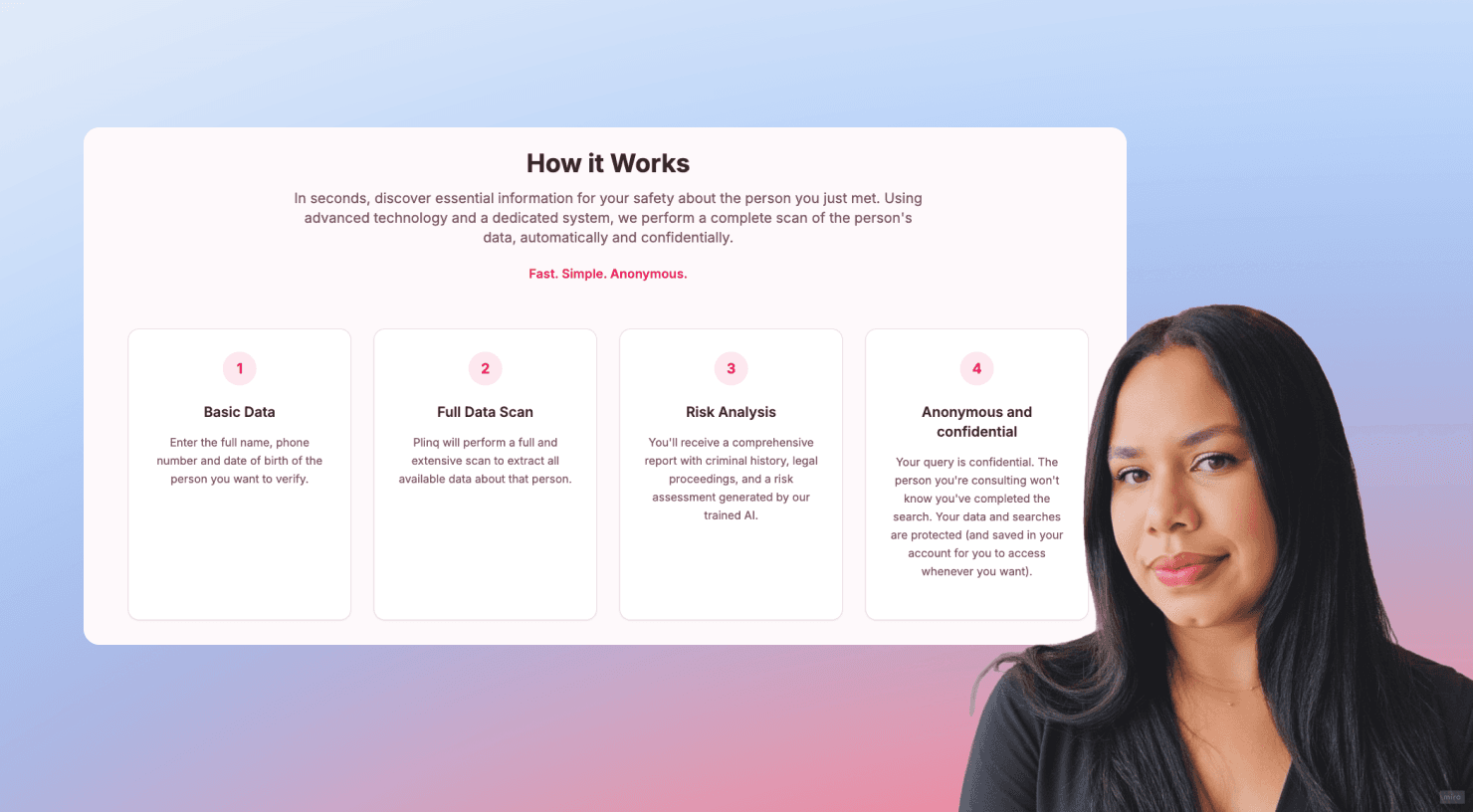
The result is Plinq, a women's safety app that gives users instant, consumer-level background checks. It connects to public criminal and legal records databases and returns a green, yellow, or red risk score based on a person's history. The app also includes a panic button that sends a user's location to emergency contacts, and a content feed covering prevention and safety information.
Matos built the entire product inside Lovable, from the front-end interface and scoring logic to the backend integrations pulling from public records. The MVP went live 45 days after she started.
Existing background check services exist in Brazil, but they are slow, built for businesses, and inaccessible to individual consumers. Plinq was built specifically for the person who wants an answer in minutes, not a corporate procurement process.
The numbers behind the story
Three months after launch, Plinq had crossed 10,000 users and reached R$2.2 million in annual recurring revenue, around $456K. The company reported 300% month-over-month growth and was raising a R$1.5-2 million pre-seed round (roughly $500K) backed by angel investors.
Lovable says Plinq has helped women avoid more than 200 potentially dangerous situations since launch. A B2B version aimed at HR and employer screening use cases is reportedly in development.
Matos has been direct about what made this possible: "If Lovable didn't exist, Plinq would never have seen the light of day. I built everything on Lovable, the website, the desktop app, the backend workflows, all without an engineering degree."
Why this story matters more than the bigger ones
Lovable has no shortage of headline numbers of its own. The Stockholm-based company crossed $100M in annual recurring revenue eight months after launch, reportedly faster than OpenAI, Cursor, or any other software company in history. It has since passed $500M in annualized revenue, with more than 50 million projects built on the platform and a million new projects created every week.
Those numbers say something about the category. Plinq says something about who actually benefits. Most coverage of AI app builders centers on engineers moving faster or founders skipping a dev hire. Plinq is a reminder that the bottleneck these tools remove was never purely technical for a lot of people. It was access. A marketer with a real problem and no funding had no path to a working product before tools like this existed. Now she does.
That distinction matters for how US operators and founders should think about this category. The pitch is not just speed for people who already know how to brief an engineering team. It is a genuine new entry point for people whose only qualification is that they understand the problem better than anyone with a CS degree.
The honest caveat
Plinq is a standout, not an average outcome. Most projects built on AI app builders do not raise a pre-seed round or cross six figures in revenue within a quarter. Industry surveys on vibe-coded products consistently point to the same gap: building the product is a small fraction of building a business. Customer acquisition, pricing, retention, and operations are where most of these projects stall, regardless of how fast the build was.
Matos's own advice reflects that gap. Her three lessons from building Plinq: launch fast and iterate based on real user feedback rather than guesses, anchor every feature in an actual user problem rather than a feature checklist, and treat marketing as the next constraint once building stops being the bottleneck.
Sources
Brian Weerasinghe is the founder and editor of AI Eating The World, where he covers artificial intelligence, tech companies, layoffs, startups, and the future of work. His reporting focuses on how AI is transforming businesses, products, and the global workforce. He writes about major developments across the AI industry, from enterprise adoption and funding trends to the real-world impact of automation and emerging technologies.