Claude Fable 5 is Anthropic's first Mythos-class model made available to the general public, bringing frontier-level coding, vision, and scientific research capabilities alongside a new tier of safety classifiers that fall back to Opus 4.8 for high-risk queries.
The model Anthropic wasn't going to release - until now
Claude Fable 5 launched on June 9, 2026, and it is not a typical model release. It sits in a new tier Anthropic calls Mythos-class, a category that until today existed entirely behind closed doors. The first Mythos model, Claude Mythos Preview, was released in April through Project Glasswing - a restricted program involving vetted partners including AWS, Microsoft, Apple, and CrowdStrike. General developers couldn't touch it.
Today that changed. Fable 5 is the public-safe version of that same Mythos-class intelligence. Anthropic's position is straightforward: the model is capable enough that releasing it without safeguards poses real risk, particularly in cybersecurity. So rather than hold it back indefinitely, they built a classifier layer that routes sensitive requests elsewhere. The result is a model that Anthropic describes as state-of-the-art on nearly all tested benchmarks - and that any US developer can now access through the Claude API using the string claude-fable-5.
Alongside Fable 5, Anthropic also shipped Claude Mythos 5 - the same underlying model with the cybersecurity safeguards lifted, exclusively for existing Project Glasswing partners and a small group of biomedical researchers. The two models share identical weights. The only difference is which classifier gates are active.
What Claude Fable 5 can actually do
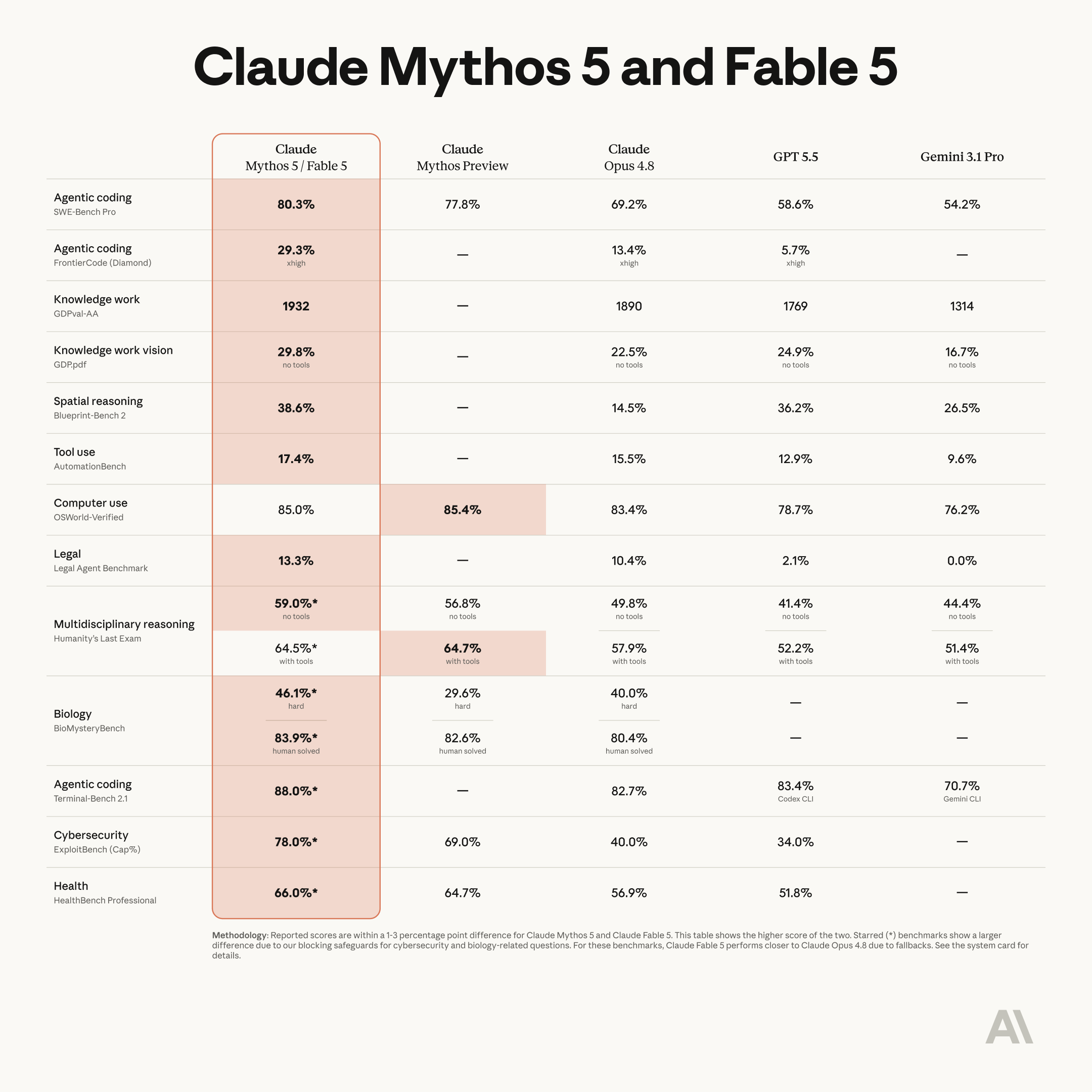
The headline capability numbers are real. Claude Fable 5 scores 95.5% on SWE-bench Verified and 80.3% on SWE-bench Pro, with the next-best model sitting 11 points behind on the Pro benchmark. On Cognition's FrontierCode Diamond evaluation - which tests whether models can pass difficult coding tasks while meeting production codebase standards - Fable 5 scores 29.3%, compared to GPT-5.5 at 5.7%. That is not a rounding error.
The most concrete real-world example comes from Stripe. During early access testing, Stripe reported that Fable 5 compressed months of engineering into days on a 50-million-line Ruby codebase, completing a full codebase migration in a single day that would have required a whole team over two months by hand. Cursor called it 'state of the art on CursorBench' and said it opens up 'a class of long-horizon problems that were out of reach for earlier models.' GitHub's Chief Product Officer noted that it took on complex, long-horizon coding tasks with autonomy and reliability that exceeded previous benchmarks.
Vision is another major step. Fable 5 can rebuild a web app's source code from screenshots alone, and it beat Pokemon FireRed using only raw game screenshots with no maps, navigation aids, or helper harnesses - something earlier Claude models couldn't do without significant scaffolding. For knowledge work, Hebbia's Finance Benchmark for senior-level reasoning put Fable 5 at the top of all tested models, with gains in document-based reasoning, chart interpretation, and problem solving. IMC noted it aced their trading-analysis evaluations nearly across the board.
Memory and long-context handling is significantly improved. The model works across a 1-million-token context window and improves its outputs using its own persistent notes on long-running tasks. Anthropic tested this with the deck-building game Slay the Spire: giving Fable access to persistent file-based memory improved performance three times more than it did for Opus 4.8, and Fable reached the final act three times more often.
The safety layer that makes public access possible
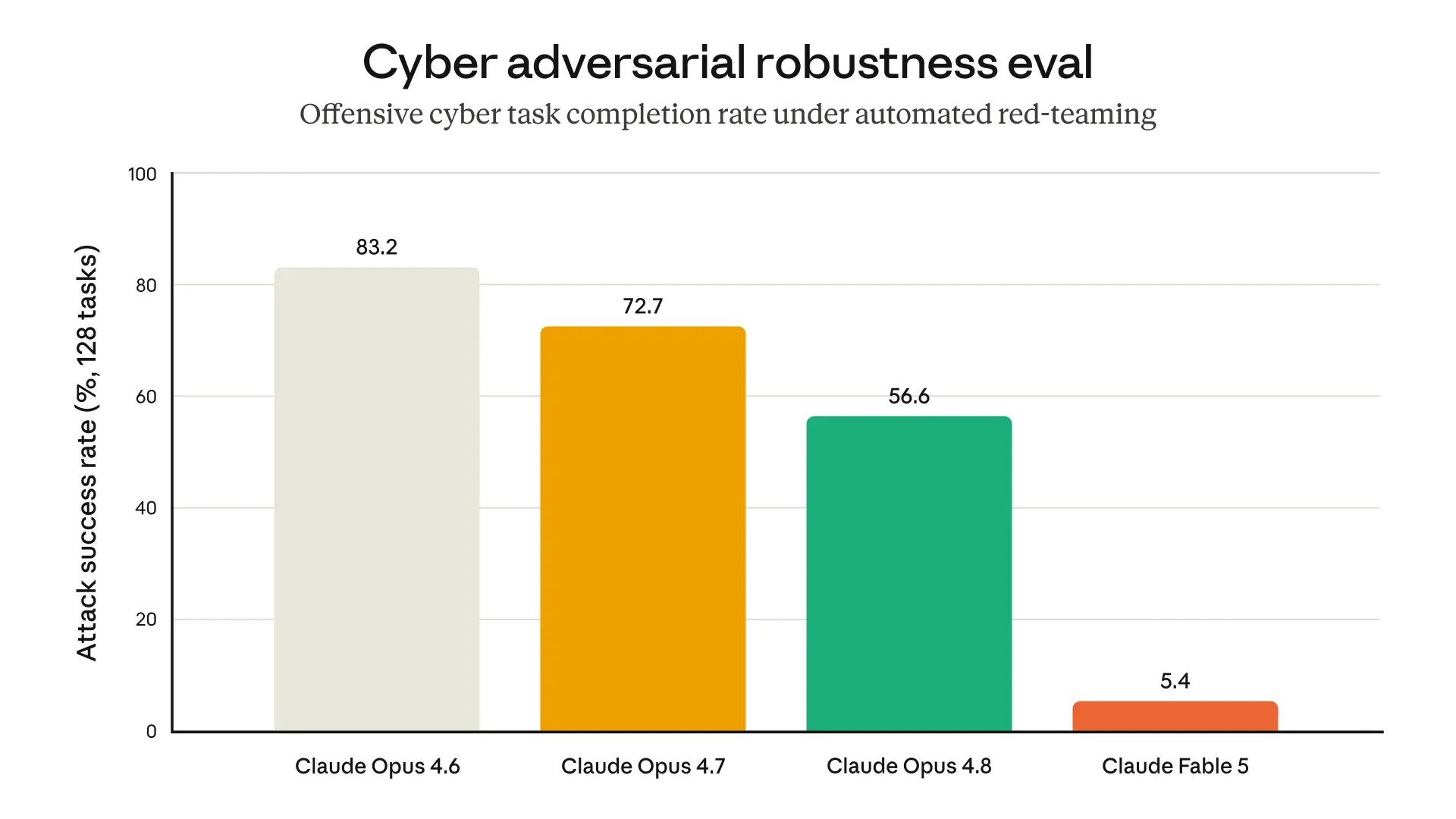
Fable 5 comes with a new tier of safety classifiers - separate AI systems that run alongside the main model, detect potentially dangerous requests, and silently route them to Claude Opus 4.8 instead. Users are told when a fallback occurs. Anthropic says this happens in fewer than 5% of sessions, meaning the experience for over 95% of conversations is identical to Mythos 5's full capability.
Three domains trigger the classifiers: cybersecurity (exploitation, offensive cyber, agentic hacking), biology and chemistry (dual-use research, biological uplift), and distillation (large-scale attempts to extract Claude's capabilities to train competing models in authoritarian countries). The cybersecurity classifiers are the most consequential. In internal evaluations, Mythos Preview independently identified 271 zero-day vulnerabilities in Firefox, developing working proof-of-concept exploits with minimal human steering. The classifier layer effectively blocks Fable 5 from making any progress on offensive cyber tasks.
Anthropic ran extensive red-teaming before launch, including an external bug bounty that produced no universal jailbreaks in over 1,000 hours of testing. The UK AI Safety Institute made some progress toward a universal jailbreak in a brief initial testing window, which Anthropic disclosed. One external partner found Fable 5's cyber safeguards to be the most robust of any model tested - it complied with zero harmful single-turn requests relating to cyberattack planning, exploit development, or defense evasion across 30 different public jailbreak techniques.
A new data retention policy also applies to all Mythos-class model traffic starting today. Anthropic will require 30-day retention for all traffic on Fable 5, Mythos 5, and future models at this capability tier - on both first- and third-party surfaces. This overrides previously negotiated zero-retention agreements for enterprise customers. The data won't be used for training, and Anthropic says it will be deleted after 30 days in almost all cases.
Drug design, novel hypotheses, and what Mythos 5 is doing for science
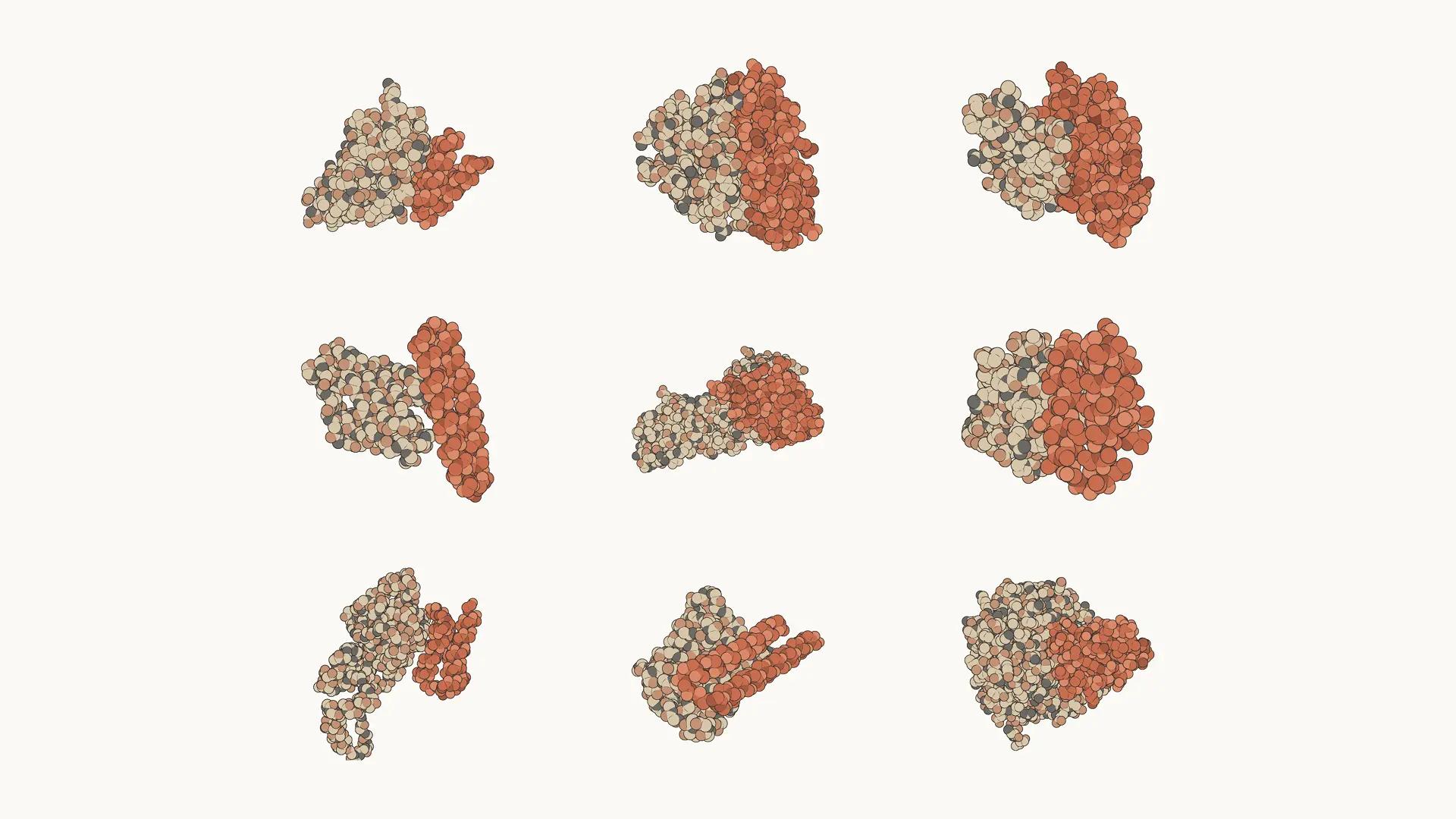
Some of the most striking numbers in the launch materials involve life sciences. Using Claude Mythos 5, Anthropic's internal protein design experts accelerated aspects of the drug design process by around ten times. In one evaluation, Mythos 5 - given protein design and bioinformatics tools but no human assistance - matched or beat skilled human operators across all tasks a scientist would normally complete: choosing binding sites, selecting and running protein design tools, and recovering from failures. Nine of 14 protein targets from this study yielded strong drug design candidates currently under investigation.
Mythos 5 is also Anthropic's first model to consistently generate novel scientific hypotheses that researchers find compelling. In blinded head-to-head comparisons against Opus-class models, Anthropic's scientists preferred Mythos 5's molecular biology hypotheses around 80% of the time. One hypothesis about a novel mechanism in an E. coli protein was independently corroborated by a study from a separate lab working on the same problem. Separately, Mythos 5 conducted over a week of largely autonomous genomics research, assembling single-cell data for millions of cells across 138 animal species and training a custom machine learning model that outperformed a recent result published in Science - while being 100 times smaller. Anthropic says it intends to publish these results.
This is the dual-use tension at the center of the Fable 5 launch. The same capability that makes Mythos 5 extraordinary for drug discovery also makes it potentially dangerous in biology in other hands. Fable 5's biology classifier is deliberately broad right now - some biomedical researchers will find it catches legitimate queries. Anthropic says it plans to open a biology trusted access program for Fable 5 (with bio/chem safeguards removed, cyber safeguards intact) in the coming weeks, enrolling a small number of life science researchers initially.
Pricing, access, and the free window that closes June 22
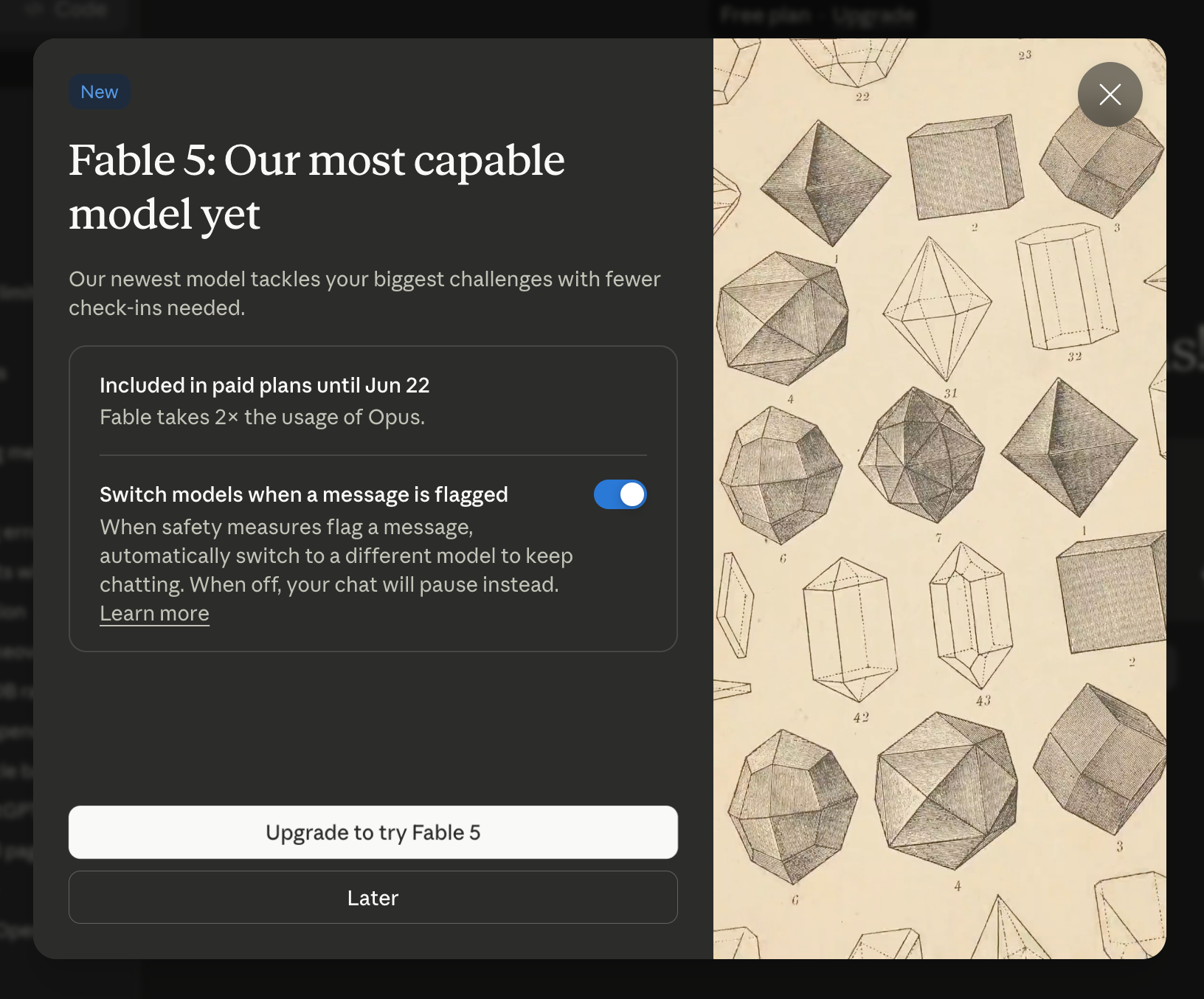
Claude Fable 5 is priced at $10 per million input tokens and $50 per million output tokens - less than half the price of Claude Mythos Preview. The API model string is claude-fable-5. Context window is 1 million tokens, max output is 128,000 tokens, and the knowledge cutoff is January 2026.
For developers on the Claude API and consumption-based Enterprise plans, Fable 5 is fully available starting today. For subscription plans, Anthropic is rolling out access in stages given high expected demand. Fable 5 is included on Pro, Max, Team, and seat-based Enterprise plans at no extra cost through June 22. On June 23, it will be removed from those plans and will require usage credits. Anthropic says it aims to restore Fable 5 as a standard subscription feature as quickly as capacity allows.
Claude Mythos 5 - the version with cyber safeguards lifted - is available now only to existing Project Glasswing partners. Anthropic plans to expand access to Mythos 5 through a broader trusted access program in consultation with the US government, allowing cybersecurity organizations to apply more systematically.
The bigger picture: a new frontier ai model tier goes mainstream
The Fable 5 launch is structurally different from any previous model release in the AI industry. This is the first time a company has acknowledged that a model is genuinely too dangerous to release without constraints - and then released it anyway, with a technical layer designed to contain the risk. The classifier-based approach is Anthropic's answer to a problem that has been theoretical until now: how do you give the public access to a frontier ai model that could enable serious harm if misused?
The timing is also notable. Fable 5 arrives as Anthropic prepares to enter the public markets, alongside OpenAI and Elon Musk's SpaceX. The launch comes days after Anthropic published a public statement urging major global AI labs to coordinate on slowing frontier AI development. Releasing the most capable publicly available AI model hours later is a tension Anthropic did not shy away from acknowledging.
For US enterprise teams evaluating AI infrastructure, Fable 5 changes the calculus for agentic coding workloads, long-horizon analytical tasks, and multi-step scientific workflows. The combination of a 1M-token context window, persistent memory, vision capabilities, and the strongest available coding benchmarks positions it as the model to reach for when task complexity exceeds what current tooling can handle. The catch, for now, is cost - $50 per million output tokens is not a number that pencils out on commodity use cases. For the engineering problems where months compress to days, it very likely does.
Sources
Related: Anthropic: Claude Fable 5 and Claude Mythos 5 (official announcement)Anthropic: Project GlasswingAnthropic: Fable 5 and Mythos 5 System CardTechCrunch: Anthropic releases Claude Fable 5VentureBeat: Anthropic brings Mythos to the masses with Claude Fable 5Simon Willison: Initial impressions of Claude Fable 5Claude API model documentation