Image: Flickr / Wikimedia Commons / Unsplash
AI Labs Are Paying Engineers $570K to Help Build Their Replacements
The same companies predicting AI will automate software engineering are offering the highest salaries in tech history to attract the engineers who can make that happen.
This article was produced by the AETW editorial team.
Anthropic pays software engineers a median $570K per year. Its CEO says AI could handle most of what those engineers do within 6-12 months. Both things are true at the same time.
The meme is real

Source: Linkedin - AI Eating The World
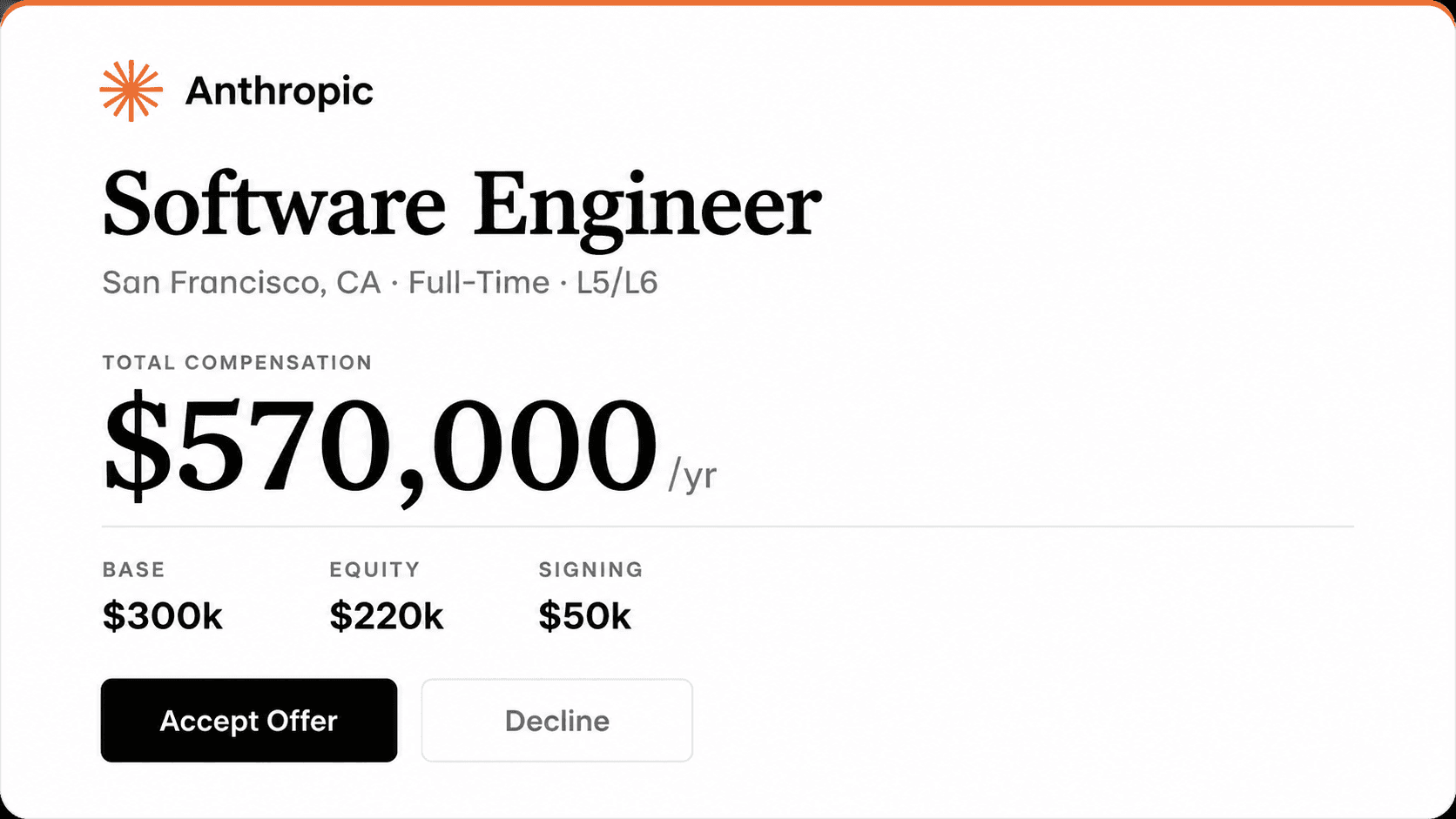
A job offer graphic has been making the rounds on LinkedIn. It shows an Anthropic offer letter for a Software Engineer: $570,000 in total comp, split across a $300K base, $220K in equity, and a $50K signing bonus. At the bottom, in small red text: 'Note: This role may not exist in 12 months.' The joke works because the number isn't made up. According to verified salary data from Levels.fyi, the median total compensation for a software engineer at Anthropic in the US is exactly $570,000 — a figure that has gone up 433% in search interest over the past year, which tells you how many people are paying attention.
The question of whether AI will replace software engineers has moved from Reddit speculation to board-level strategy in the span of about 18 months. It's no longer abstract. The people building the tools that could automate software engineering are also the ones writing the job offers.
What the compensation actually looks like
Anthropic's $570K median is not the ceiling. The highest reported package on Levels.fyi for an Anthropic software engineer in the US sits at $920,000. Senior engineers land between $563K and $785K. At OpenAI, the median software engineer total comp is $555K, with packages ranging from $251K for early-level engineers up to $1.28M at the senior end. The highest reported figure there: $1.38M.
These numbers exist because AI labs are competing for a small pool of engineers who understand both systems-level software and modern ML infrastructure. AI engineer base salaries averaged $206,000 in 2025, a figure that jumped another 7% in Q1 2026. OpenAI ran $300K retention bonuses for new graduate technical hires in August 2025. Meta reportedly offered sign-on packages exceeding $100M for elite AI researchers. The market for this particular kind of talent is, by any historical measure, broken.
For context, Google's median ML engineer comp sits at $290K. Microsoft lands around a similar range for most senior roles. Anthropic and OpenAI are not playing in the same compensation league as traditional big tech — they are running a different game entirely, and they are winning it by writing larger checks.
Dario Amodei said what, exactly

Source: flickr
In January 2026, Anthropic's CEO sat across from The Economist's editor-in-chief at the World Economic Forum in Davos and said something that got clipped and screenshotted several thousand times: 'I have engineers within Anthropic who say, I don't write any code anymore. I just let the model write the code. I edit it. I do the things around it. I think we might be six to 12 months away from when the model is doing most, maybe all of what we do end to end.'
He followed that up at India's AI Impact Summit by going further: even Anthropic itself would need fewer software engineers as models improve. The accelerating loop he described involves AI systems that are good at coding and AI research being used to build the next generation of those same systems — a feedback mechanism that compounds.
Amodei's comments drew more attention than most CEO predictions do, partly because he runs one of the few companies with the credibility to make that call. He is not an outsider speculating about what AI might do to tech jobs. He is the person allocating the compute.
What is actually happening inside Anthropic
In December 2025, Anthropic published internal research based on a survey of 132 of its own engineers and 53 in-depth interviews. The headline finding: engineers are getting substantially more done, handling tasks outside their normal expertise, and delegating increasingly complex work to Claude with less and less oversight over time.
The usage data is specific. Between February and August 2025, the share of Claude Code transcripts used for implementing new features jumped from 14.3% to 36.9%. Tasks involving code design and planning went from 1% to nearly 10%. The average task complexity went up. The number of human turns in each session went down. The research team described it bluntly: 'people are increasingly delegating more autonomy to Claude over time.'
What Anthropic's engineers are doing with their reclaimed time is telling. More 'full-stack' work, more quality-of-life improvements, more experimentation across domains they would not have touched before. That sounds like productivity gain, and by most measures it is. But it also means one engineer is doing what two or three engineers did before, which is a different kind of news depending on where you sit.
The split that nobody wants to talk about

Source: linkedin
The AI job market has fractured in two directions at once, and the gap is widening fast. Senior ML engineers at top labs command $470K-$630K median compensation. AI software engineer jobs are up 306% in search volume over the past year. The demand for engineers who can build with and on top of AI systems is real.
But entry-level is in freefall. US programmer employment fell 27.5% between 2023 and 2025, according to Bureau of Labor Statistics data. New graduate hiring at the 15 largest US tech companies dropped more than 55% since 2019. Junior developer employment for people aged 22-25 is down roughly 20% from its peak. Only 18% of tech job postings in Q2 2025 were open to candidates with one year or less of experience. Computer engineering graduates now face a 7.5% unemployment rate — higher than fine arts majors.
What is happening is not a wholesale replacement of software engineers. It is something more surgical. Companies are using AI to get the output of three engineers from one senior engineer. They are hiring fewer juniors and using tools to stretch the people who remain. Salesforce stopped hiring engineers entirely for a period. Pinterest, Autodesk, Amazon, and Salesforce all announced AI-driven layoffs in 2026. Block cut more than 4,000 jobs in February — not because revenue was weak (Q4 gross profit was up 24% year-over-year) but because, as Jack Dorsey put it, AI meant the company could do more with fewer people.
The read on the $570K offer
Here is the honest interpretation of the compensation arms race: AI labs are paying record salaries because the engineers who can build frontier AI systems are genuinely rare, genuinely valuable, and genuinely in demand from multiple well-funded competitors. The $570K is not charity. It is market pricing for a skill set that takes years to develop and that most candidates do not have.
The meme's 'this role may not exist in 12 months' footnote is doing something more interesting than just pointing out irony. It is identifying a real tension inside the industry. The labs are paying these salaries while simultaneously accelerating the development of tools that will compress the engineering headcount needed to do the same work. Those two things are not contradictory from a business standpoint. They make perfect sense. You pay for the talent you need now to build the thing that reduces your dependency on that talent later.
Whether AI will replace software engineers entirely is probably the wrong question. What is happening now is more specific: AI is already replacing the bottom of the market, augmenting the middle, and concentrating enormous rewards at the top. The $570K job exists. So does the 27.5% employment drop for junior programmers. Both are data points in the same story.
Sources
Brian Weerasinghe is the founder and editor of AI Eating The World, where he covers artificial intelligence, tech companies, layoffs, startups, and the future of work. His reporting focuses on how AI is transforming businesses, products, and the global workforce. He writes about major developments across the AI industry, from enterprise adoption and funding trends to the real-world impact of automation and emerging technologies.