Image: Flickr / Wikimedia Commons / Unsplash
Weyerhaeuser Is Deploying AI Across 10 Million Acres of American Forest
The 125-year-old timber giant is building a digital twin of every tree on its land and testing autonomous logging machines - targeting $1 billion in added annual profit by 2030.
Image: Flickr / Wikimedia Commons / Unsplash
This article was produced by the AETW editorial team.
Weyerhaeuser, America's largest private timberland owner, is rolling out AI across logging, replanting, trucking, and mill operations - with a goal of adding $1 billion in annual profit by 2030, independent of lumber prices.
A $1 billion bet that doesn't depend on lumber prices

Weyerhaeuser, the Seattle-based company that owns 10.4 million acres of US timberland, has spent 125 years growing forests. Now it's deploying AI across the full operation - logging, replanting, truck routing, and mill management - with a target of adding roughly $1 billion in annual profit by 2030. The company says that gain would be independent of any rise in lumber prices, which matters because Weyerhaeuser's stock has dropped about 40% from its 2022 pandemic-era peak as the housing market cooled.
CEO Devin Stockfish put it plainly to the Wall Street Journal: the company has more data on how forests grow than virtually any organization on earth, and the opportunity is to run that data through AI to make every decision sharper. The targeted $1 billion gain would roughly double 2025 profits. That's an industrial AI case study playing out across terrain roughly the size of Indiana.
The digital twin: mapping every tree
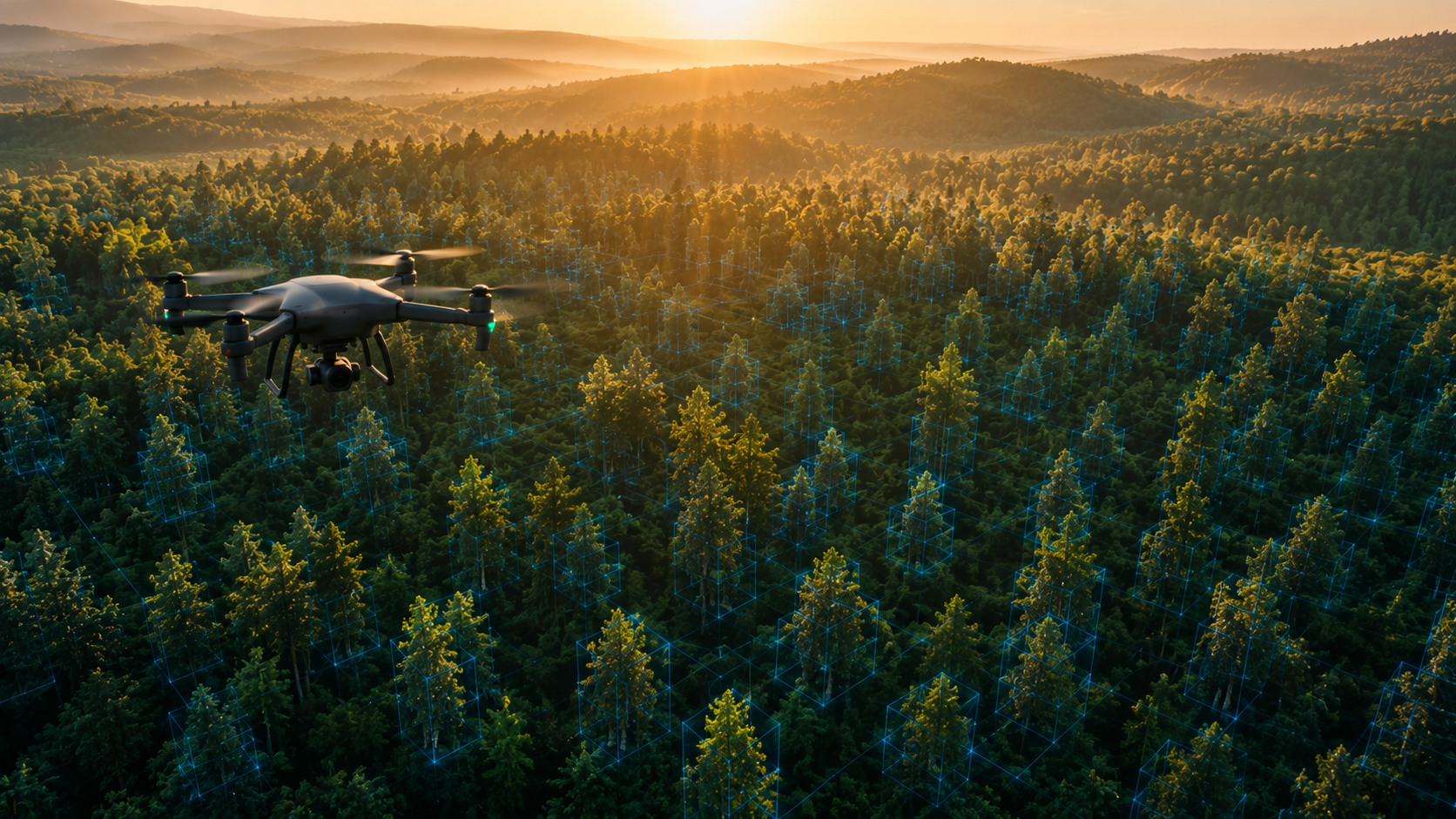
To lead its AI rollout, Weyerhaeuser hired John Scumniotales - a longtime tech executive from Amazon's Alexa unit - to oversee what amounts to a full-scale digital transformation of its timberlands. The centerpiece is a digital twin of every acre Weyerhaeuser manages, built from satellite imagery, drone photography, and lidar sensors (the same laser-based technology self-driving cars use to map their surroundings). The system is designed to identify the size, species, and spacing of each tree across the entire 10.4 million acres.
That level of granularity has direct operational value. Weyerhaeuser plants over 100 million seedlings a year - roughly 190 every minute - and historically, tracking their survival meant sending foresters into steep or sweltering terrain to count young trees by hand. The company has now trained an AI model on drone footage to calculate seedling survival rates automatically, delivering faster and cheaper data without putting people on difficult ground. Stockfish described it simply: better data, quicker data, cheaper data.
Remote skidders and the path to full autonomy
The more striking piece of Weyerhaeuser's AI deployment involves the machines that drag felled trees across logging sites - skidders. At an investor presentation in New York last year, Weyerhaeuser showed video of a driverless skidder operating at a Southern logging site, controlled by an operator working from a home office 400 miles away. The machine ran on AI-assisted navigation and terrain mapping built by Kodama Systems, a California-based startup that raised $6.6 million in seed funding and has been developing its Autopilot platform for forestry equipment since 2024.
Travis Keatley, Weyerhaeuser's senior vice president of timberlands, said the pilot demonstrates a clear efficiency path: one operator running multiple machines remotely, and eventually full autonomy. The vision extends beyond skidders. Weyerhaeuser sees the entire logging workflow - from feller-bunchers that cut and stack trunks to delimbers that shear branches - as candidates for remote or autonomous operation, supervised by a smaller on-site crew.
AI in the cab: which trees to cut and which to leave
For thinning operations, Weyerhaeuser is also testing an in-cabin AI assistant built in partnership with Nordic Forestry Automation, a Swedish company whose technology has been deployed in harvesters across the Nordics, North America, and Australia. The system shows machine operators a digital representation of the surrounding forest and highlights which trees to cut and which to leave standing, guided by an algorithm Weyerhaeuser developed to maximize long-term value. The goal is to leave the strongest specimens with enough room to grow into the highest-value products - lumber, utility poles, and structural timber.
These are not easy calls to automate. Thinning decisions depend on dozens of variables: species, spacing, canopy competition, soil quality, growth projections, and target product mix. Moving that judgment into an algorithm, trained on 125 years of Weyerhaeuser's own forest data, is a significant application of industrial AI in a sector that has changed little operationally in decades.
AI across the supply chain - mills, trucks, and real-time pricing
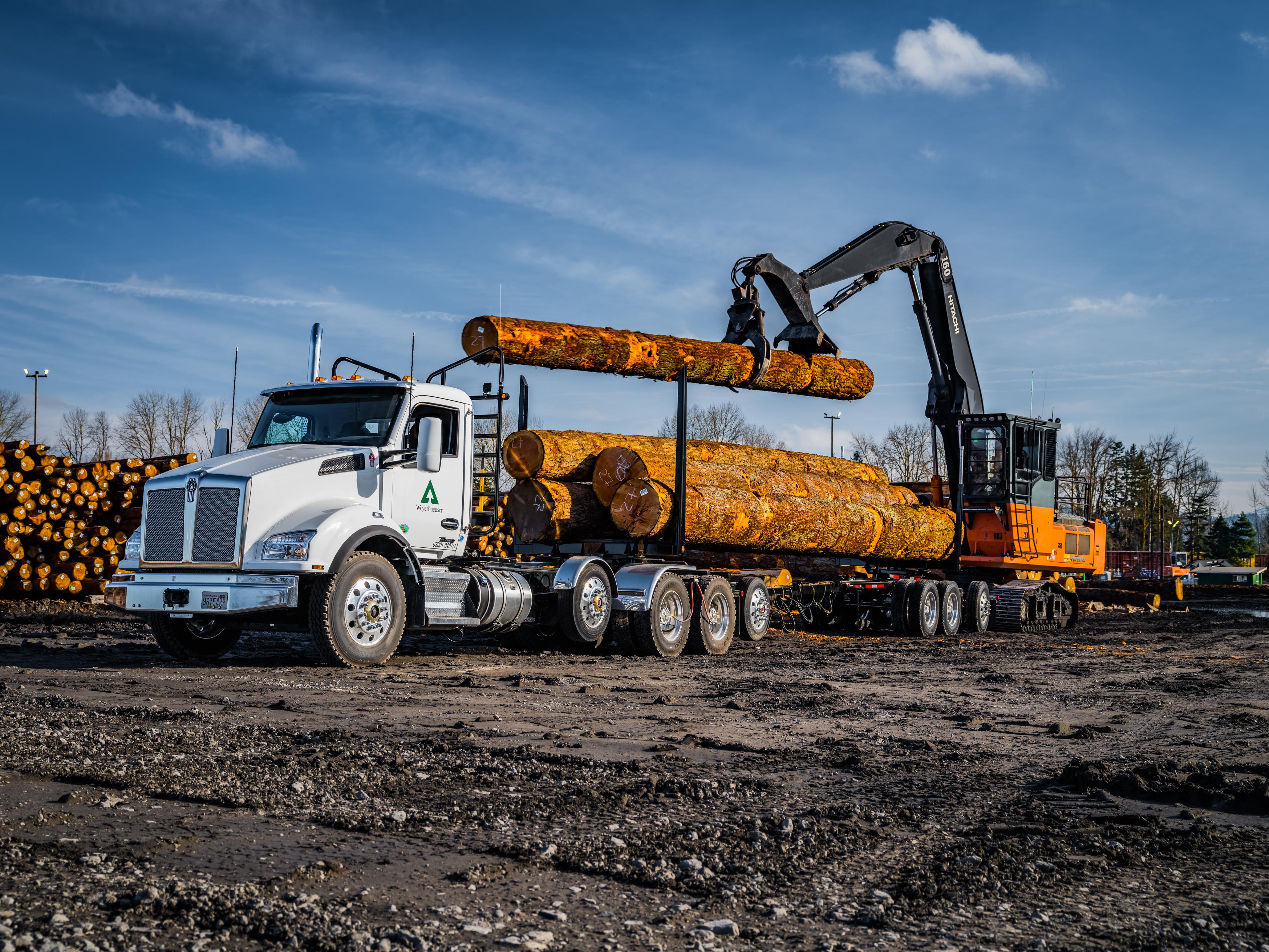
The forestry innovations get more attention, but Weyerhaeuser's AI deployment also covers its manufacturing and logistics operations. The company is using AI to monitor mill equipment for anomalous vibrations and other maintenance signals before failures occur. It is matching production output to customer demand and live market pricing in real time. And it is optimizing routes for the roughly 5,000 trucks that move daily across Weyerhaeuser's internal logging road network - a system whose total mileage rivals the US Interstate Highway System.
Taken together, this is an enterprise AI adoption story that cuts across every layer of a major industrial business. The AI in manufacturing angle here is less glamorous than autonomous skidders, but it is likely where the bulk of the $1 billion profit target actually comes from. Operational efficiency gains in trucking, scheduling, and predictive maintenance compound quietly across a business this size.
What the broader AI industry should notice
Weyerhaeuser is not a tech company, and it's not pretending to be. It is a 125-year-old industrial business applying AI to problems it has been solving manually for over a century - and it has something most AI deployments don't: a proprietary training data advantage that took generations to build. The company's forest growth records give its models a depth of ground truth that can't be replicated by a competitor that starts today.
This is a pattern worth watching across old-economy industries. The companies that will capture the most AI value are not necessarily those with the largest AI budgets - they are the ones sitting on the most relevant proprietary data. Weyerhaeuser's forests, mapped tree by tree and logged season by season for 125 years, are themselves the moat. The digital twin is just the interface.
Sources
Brian Weerasinghe is the founder and editor of AI Eating The World, where he covers artificial intelligence, tech companies, layoffs, startups, and the future of work. His reporting focuses on how AI is transforming businesses, products, and the global workforce. He writes about major developments across the AI industry, from enterprise adoption and funding trends to the real-world impact of automation and emerging technologies.