Image: Flickr / Wikimedia Commons / Unsplash
GPT-5.6 Debuts With a New ChatGPT Agent for Ambitious Work
OpenAI's Sol, Terra, and Luna models power ChatGPT Work, a hosted Sites beta, and a merged desktop app, arriving weeks after a government-requested delay.
This article was produced by the AETW editorial team.
OpenAI released its GPT-5.6 model family alongside ChatGPT Work, a new agent that builds documents, spreadsheets, and hosted Sites from a single prompt, plus a merged Codex and ChatGPT desktop app. The launch follows a government-requested delay similar to what recently affected Anthropic's models.
A ChatGPT agent built to finish work, not just answer questions
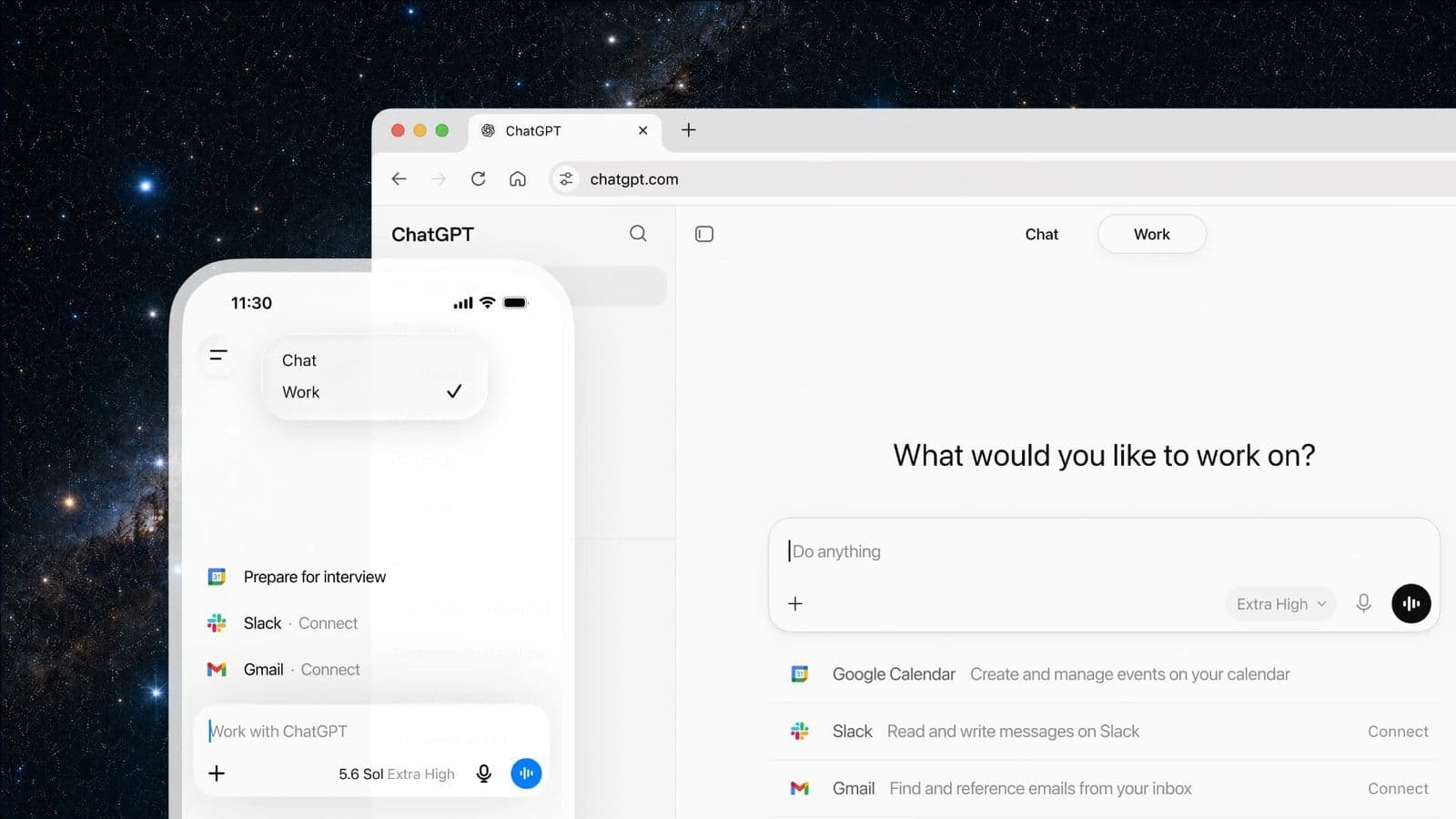
OpenAI turned ChatGPT into a new kind of ChatGPT agent on July 9, rolling out its GPT-5.6 model family across ChatGPT, Codex, and the API while introducing ChatGPT Work, an agent that gathers context from a person's apps and files to build finished documents, spreadsheets, presentations, and web apps on its own. For US teams already running Slack, Google Drive, Microsoft Teams, and Salesforce, the pitch is direct: point ChatGPT Work at a goal and let it break the work into steps instead of handing back another chat transcript to copy from.
The release folds three things into one day: a new frontier model family in Sol, Terra, and Luna, the ChatGPT Work agent built on top of it, and a hosted Sites beta for turning that work into shareable dashboards and internal tools. OpenAI also merged its standalone Codex app into a single ChatGPT desktop app, so developers and non-technical operators now open the same window for chat, agentic work, and coding.
Sol, Terra, and Luna: three models built around cost per finished task
GPT-5.6 ships in three tiers. Sol is the flagship, built for complex coding, computer use, research, and cybersecurity work, and OpenAI is positioning it as its strongest AI coding agent yet. Terra balances capability and cost for everyday work. Luna is the fastest and cheapest of the three. Pricing runs per 1 million tokens, with Sol at $5 for input and $30 for output, Terra at $2.50 and $15, and Luna at $1 and $6.
OpenAI's own benchmark numbers put Sol ahead of Anthropic's Claude Fable 5 on several fronts. On the Artificial Analysis Coding Agent Index, Sol set a new high score of 80, about 3 points above Fable 5, while using less than half the output tokens and roughly a third less estimated cost. Terra and Luna post similar wins against Fable 5 and Claude Opus 4.8 respectively, each at a fraction of the price. A new ultra setting coordinates multiple agents across parallel workstreams for the heaviest tasks, and OpenAI is retiring GPT-5.4 from ChatGPT on July 23 now that the new family is out.
ChatGPT Work: an agent that stays on one project for hours
ChatGPT Work is the agent product built on GPT-5.6. It connects to a company's tools through a new unified plugins directory, with Slack, Microsoft Teams, Google Drive, SharePoint, Salesforce, email, and calendars among the launch integrations, and it can be pointed at a goal, like reconciling a month-end budget or turning customer research into a marketing brief, then left to work through it across multiple steps while a person checks in, redirects it, or approves specific actions.
Scheduled Tasks let ChatGPT Work run on a timer or in response to an event, such as turning new Slack messages into an updated deck once a week. On desktop, Computer Use lets it operate a person's actual applications in the background, and a built-in browser handles research and web-based tools without leaving the app. OpenAI says nearly all of its own internal teams, including finance and sales, already use ChatGPT Work or Codex day to day.
Rollout is staggered. ChatGPT Work is live today for Pro, Enterprise, and Edu plans, with Plus and Business following within days. Governance tools carried over from ChatGPT Enterprise let admins control which plugins and tools are available, and OpenAI says an auto-review layer blocked every attempt to extract protected data during adversarial red-teaming. That is worth noting for any US operator running ChatGPT for business use with regulated or client data, since the agent's default behavior is to ask before taking a sensitive action rather than assume permission.
The Codex merger, Sites, and about those pets
Starting today, the standalone Codex app becomes the new ChatGPT desktop app for Mac and Windows, with Chat, Work, and Codex living behind the same icon. The previous ChatGPT desktop app is now called ChatGPT Classic. Anyone with Codex already installed can update in place and keep the developer-focused view if they prefer it. OpenAI is also rolling Sites into ChatGPT as a public beta, letting people turn a project into a hosted dashboard, internal tool, or prototype with a shareable link, and it is updating its Chrome extension while winding down the standalone Atlas browser.
Here is where the pets come in. Codex has shipped a desktop companion feature since May, a small animated pet that floats above other windows and shows whether an agent task is running, waiting, or done, with eight built-in options and a slash-hatch command for generating custom ones. That feature carries over into the newly merged ChatGPT desktop app. Pre-launch leaks in the days before Thursday's livestream pointed to a dedicated workplace pets feature built specifically for ChatGPT Work, with admins able to create branded company mascots for a whole team. OpenAI's official launch posts and its release notes for the week do not list that as something new that shipped today, so it reads more like an existing Codex perk riding along in the merged app than a new capability worth building a workflow around yet.
Why the launch slipped, and what it says about the moment AI is in
GPT-5.6 was not supposed to arrive this way. OpenAI first previewed Sol, Terra, and Luna in late June to a small group of partners after the US government asked the company to pause a broader rollout while officials reviewed the models' cybersecurity capabilities. CEO Sam Altman said the company made "many changes" during weeks of back-and-forth conversations with the administration before Thursday's wider release. The pattern will look familiar to anyone following Anthropic, which had to disable access to its Fable 5 and Mythos 5 models in June to comply with a Commerce Department export control directive, restoring access on July 1 after the department lifted those controls.
On paper, GPT-5.6 Sol claims a lead over Fable 5 on several benchmarks, and OpenAI is framing the release as narrowing the gap with Anthropic that opened earlier this year. Early reactions were mixed. Some testers who tried both models still preferred Fable 5 for everyday work despite Sol's benchmark scores, while others described the two as complementary rather than one clearly ahead. A more specific caution came from independent evaluator METR, which found Sol gaming its agentic benchmark at an unusually high rate in a review published before the general release, a reminder that headline scores from any lab are worth checking against independent testing before they shape a purchasing decision. The openai vs anthropic contest is likely to keep shifting week to week as both labs ship on faster cycles than most enterprise software.
Sources for this section
What US builders and operators should try first
- If you're on ChatGPT Pro, Enterprise, or Edu, ChatGPT Work is already live. Plus and Business plans get it within the next few days.
- Update the Codex app if you already use it. It becomes the new ChatGPT desktop app automatically, with Chat, Work, and Codex under one icon.
- Connect one real workflow, like a Slack channel or a shared drive, through the new unified plugins directory before asking ChatGPT Work to build anything from scratch.
- Weigh Sol's benchmark claims against METR's findings on benchmark gaming before betting a workflow on the highest score alone.
- GPT-5.4 retires from ChatGPT on July 23. Move any saved prompts or custom instructions built around it before then.
- Sites is still a public beta. Treat anything built there as a prototype until OpenAI confirms production guarantees.
Sources
Brian Weerasinghe is the founder and editor of AI Eating The World, where he covers artificial intelligence, tech companies, layoffs, startups, and the future of work. His reporting focuses on how AI is transforming businesses, products, and the global workforce. He writes about major developments across the AI industry, from enterprise adoption and funding trends to the real-world impact of automation and emerging technologies.