Image: Flickr / Wikimedia Commons / Unsplash
The Data Is In: AI Is Not Replacing Jobs - It's Creating More of Them
Apollo's chief economist points to zero evidence of AI-driven job losses in weekly ADP data - and explains why cheaper AI is fueling a hiring boom, not a collapse.
Image: Flickr / Wikimedia Commons / Unsplash
This article was produced by the AETW editorial team.
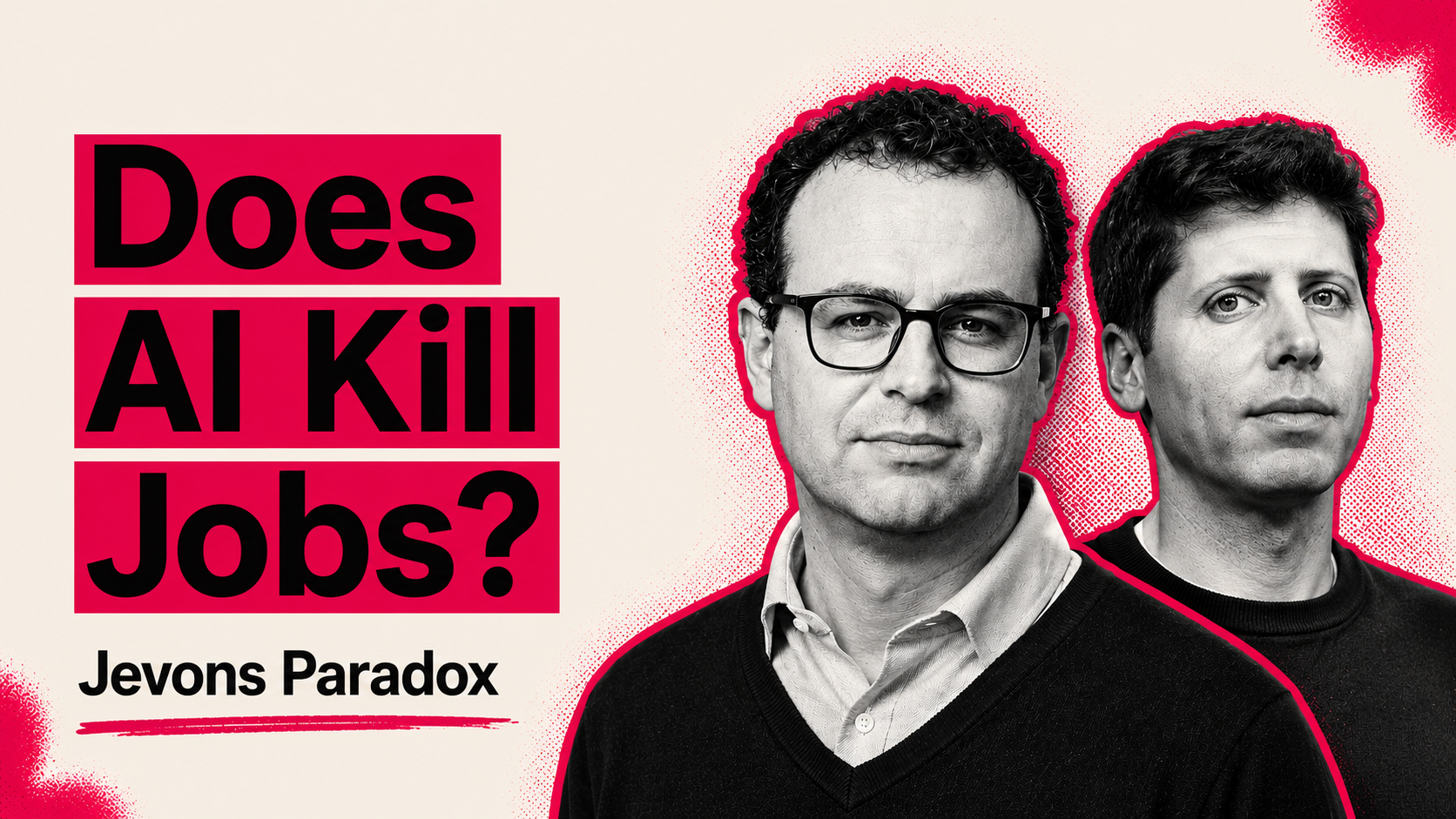
Despite widespread fear about AI replacing jobs, Apollo Global Management's chief economist Torsten Slok says weekly ADP employment data shows zero evidence of AI-driven job losses - and that the Jevons paradox explains exactly why.
What the employment data actually shows
Source: apollo.com
The loudest voices in the AI debate have spent the last two years predicting mass unemployment. Anthropic CEO Dario Amodei warned that AI could push unemployment to 20%. Amazon's CEO said the company expects AI to reduce its total corporate workforce over the next few years. The narrative of AI replacing jobs has become so dominant it almost feels like settled fact.
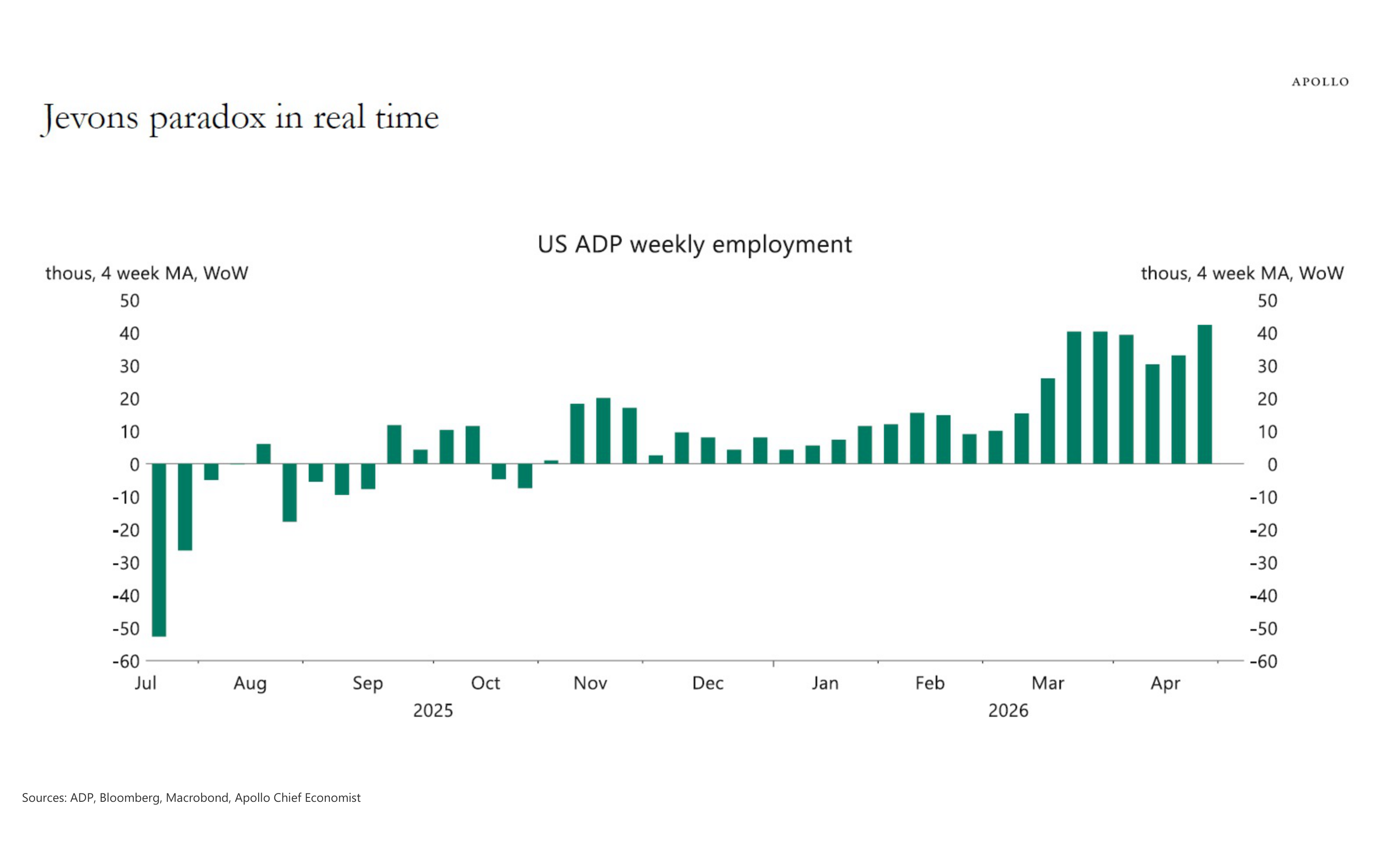
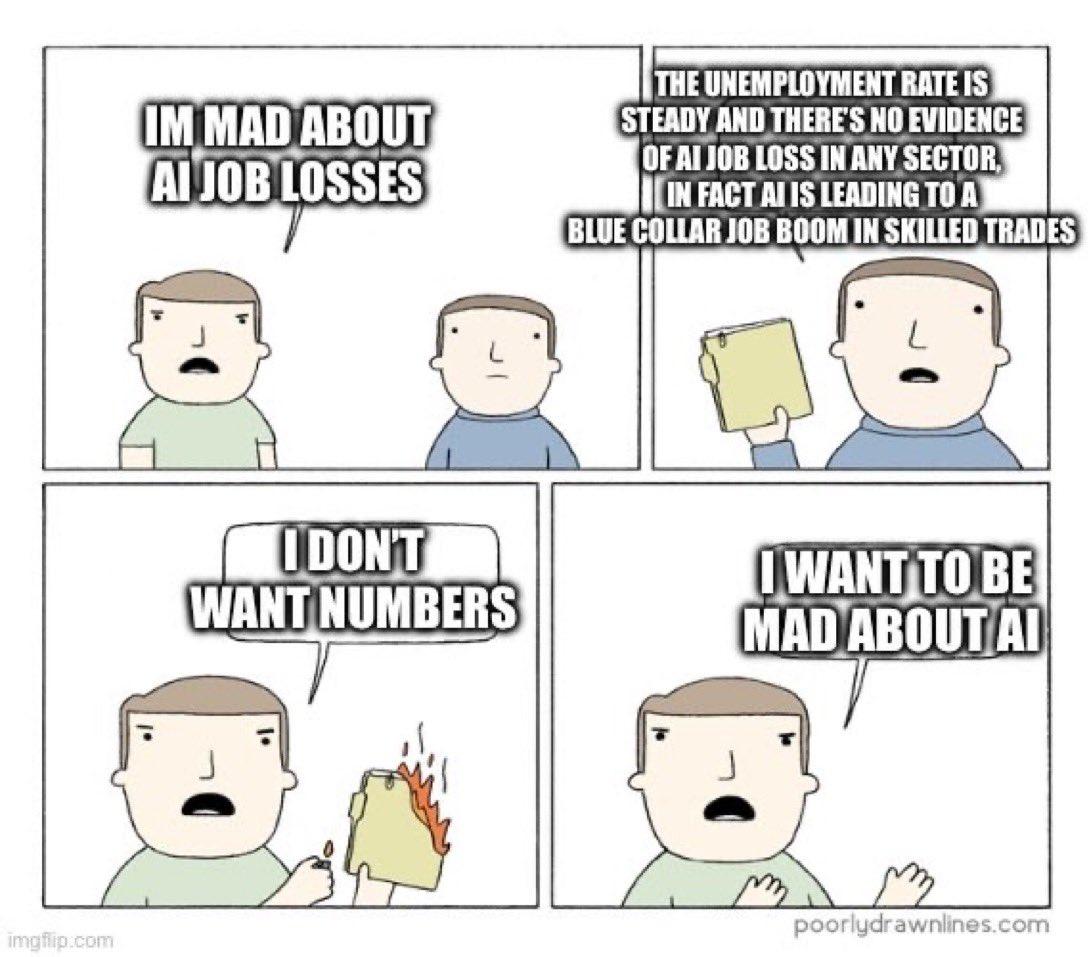
It is not settled. Torsten Slok, chief economist at Apollo Global Management, published a note on May 29, 2026, pointing to weekly ADP employment data and stating plainly: there is zero evidence of AI-related job losses. The labor market, as tracked by ADP's granular weekly payroll data, shows no measurable displacement attributable to AI adoption. Employment in AI-exposed occupations has not cratered. The apocalypse has not arrived.
That does not mean AI is having no effect on the workforce. It means the effect is running in the opposite direction from what most headlines suggest.
Jevons paradox: the 160-year-old idea rewriting the AI jobs debate
To understand why cheaper AI is not eliminating jobs, you need to understand a concept from 1865. William Stanley Jevons, an English economist, observed something counterintuitive about the newly efficient Watt steam engine: making coal-powered engines more efficient did not reduce Britain's total coal consumption. It dramatically increased it. Cheaper, more efficient use of coal expanded the universe of what coal could power, and total demand surged.
Slok calls this the Jevons employment effect when applied to AI. As AI lowers the cost of professional services - legal work, financial analysis, consulting, customer support - the market for those services expands rather than contracts. More firms can afford legal help. More startups can run financial models. More companies can deploy customer support at scale. The total demand for that category of work grows, even as AI handles a larger share of individual tasks within it.
The historical parallel is direct. Spreadsheets did not eliminate accountants - the profession grew because cheaper financial modeling created demand for more financial analysis across more organizations. ATMs did not end bank tellers, at least not immediately - they lowered the cost per transaction, enabling banks to open more branches. The introduction of each labor-saving technology has repeatedly triggered the same pattern: panic about displacement, followed by expansion of the broader category.
Where the new jobs are actually appearing
Source: X - David Sacks
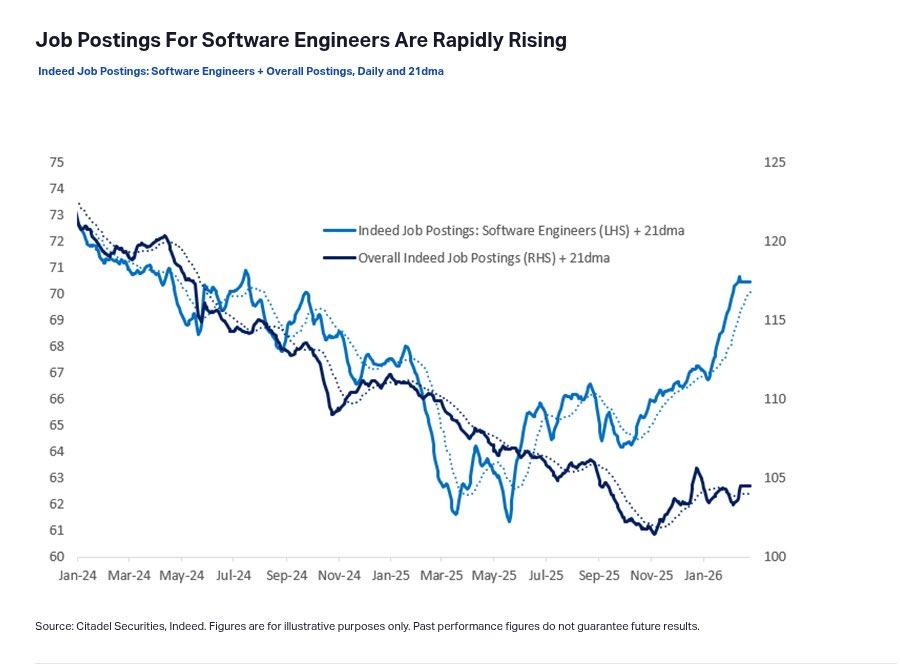
Slok's note points to two specific categories of job growth driven directly by the AI spending boom. First, firms are actively hiring AI implementation experts - the engineers, integration specialists, and operators needed to deploy AI systems inside real businesses. This is not a niche trend. The number of distinct AI and ML job titles that companies are actively hiring for has increased 50% in the last 18 months, showing up across product, legal, operations, compliance, and customer success functions at companies that barely had AI in their org charts two years ago.
Second, the physical buildout of AI infrastructure is creating massive labor demand that has nothing to do with white-collar knowledge work. Data center employment is projected to reach 650,000 positions by the end of 2026, a 30% jump from 501,000 in 2023, with roughly 340,000 roles currently unfilled due to a shortage of qualified workers. Demand for robotics technicians has risen 107% since late 2022. HVAC engineers needed for data center cooling systems are up 67%. Construction roles tied to data center development are up 30%.
Slok's bottom line is direct: the AI spending boom is stoking both employment and inflation. Nonfarm payrolls for May 2026 could come in significantly higher than the 95,000 consensus estimate, partly because AI-driven infrastructure investment and hiring are putting real upward pressure on wages and job creation across multiple sectors.
The counterargument that deserves a serious read
The Jevons framing is compelling, but it is not airtight. Fortune's analysis of Slok's argument raises a legitimate challenge: Jevons paradox works when cheaper inputs unlock genuinely new demand that did not previously exist. Steam engines opened entirely new industrial frontiers. The question for AI is whether cheaper legal memos and financial models will similarly unlock dormant, unmet demand at scale - or whether that demand was already being served, and AI is simply doing the same work with fewer people.
The data on young workers is also worth taking seriously. The Dallas Fed published a January 2026 study finding that employment for workers aged 22-25 in the most AI-exposed occupations has slipped from 16.4% of total employment in November 2022 to 15.5% by September 2025. Job-finding rates for young labor market entrants in highly AI-exposed roles have declined more than 3 percentage points since their 2023 peak. Entry-level job postings globally have fallen 29% since January 2024, according to Randstad.
The most accurate read of the current data is probably this: AI is restructuring work, not eliminating it in aggregate. The Jevons effect is real and visible at the macro level. But it is uneven - experienced workers with AI skills are seeing wage premiums of up to 56%, while younger workers entering the labor market in AI-exposed roles are facing a harder entry path than their predecessors. The aggregate employment numbers look fine. The distribution of who benefits is a different, harder question.
What this means for US operators and teams
For US companies currently evaluating AI adoption, Slok's framing changes the calculus in a specific way. The question is not whether to adopt AI to cut headcount - that framing is empirically backward based on current data. The real opportunity is to use AI to expand what your team can do, attack problems that were never economically feasible before, and move into market segments that previously required a much larger organization to serve.
Box CEO Aaron Levie put it clearly in a recent note cited in coverage of this trend: AI is not replacing existing work that is being done, it is adding new capabilities to the organization. Companies that will win are using AI to do more, not just to spend less. The firms treating AI as a cost-cutting exercise are likely leaving the larger, compounding opportunity on the table.
For individual workers, the signal from the data is equally direct. Workers with AI skills command a 56% wage premium over peers in equivalent roles without those skills. That gap was 25% one year ago. The labor market is not collapsing - it is bifurcating. Learning to work effectively with AI is not optional career advice anymore. It is the clearest path to being on the right side of that split.
Key takeaways
Source: X - Marc Andreessen
- Apollo's weekly ADP data shows zero measurable AI-driven job losses in the US labor market as of May 2026.
- The Jevons paradox explains why: cheaper AI expands total demand for professional services rather than contracting it, creating more work overall.
- Data center construction and AI infrastructure hiring are generating hundreds of thousands of new roles across engineering, construction, and trades - sectors outside the usual AI displacement conversation.
- Young workers entering AI-exposed occupations are seeing softer job-finding rates, suggesting the Jevons effect is unevenly distributed even if aggregate employment holds.
- Workers with demonstrated AI skills now earn a 56% wage premium - up from 25% one year ago - making AI fluency the most direct hedge against labor market restructuring.
Sources
Brian Weerasinghe is the founder and editor of AI Eating The World, where he covers artificial intelligence, tech companies, layoffs, startups, and the future of work. His reporting focuses on how AI is transforming businesses, products, and the global workforce. He writes about major developments across the AI industry, from enterprise adoption and funding trends to the real-world impact of automation and emerging technologies.